White Box vs Black Box Algo Trading: SEBI Rules Explained
White Box vs Black Box Algo Trading: SEBI Rules Explained
White box vs black box algo trading under SEBI's 4 Feb 2025 circular: what each means, what a black-box provider must file, and how to check a provider.
White-Box vs Black-Box Algos: What SEBI's Classification Means for You
Quick answer
• SEBI's circular of 4 February 2025 names two algo categories: white-box (logic disclosed and replicable) and black-box (logic not known to the user and not replicable).
• A black-box provider must register as a Research Analyst, keep a detailed research report for each algo, and register any changed logic as a fresh algo.
• The classification measures transparency and paperwork, not safety or profitability.
• You can check Research Analyst registration on SEBI's site and exchange empanelment on NSE's list.
SEBI's circular of 4 February 2025 sorts retail algos into two categories. A white-box algo has logic that is disclosed and replicable. A black-box algo has logic the user cannot see, so its provider must register as a Research Analyst and keep a research report for each algo.
This guide quotes the circular and gives a six-step check to run before you pay any algo provider.
What do white-box and black-box mean in SEBI's circular?
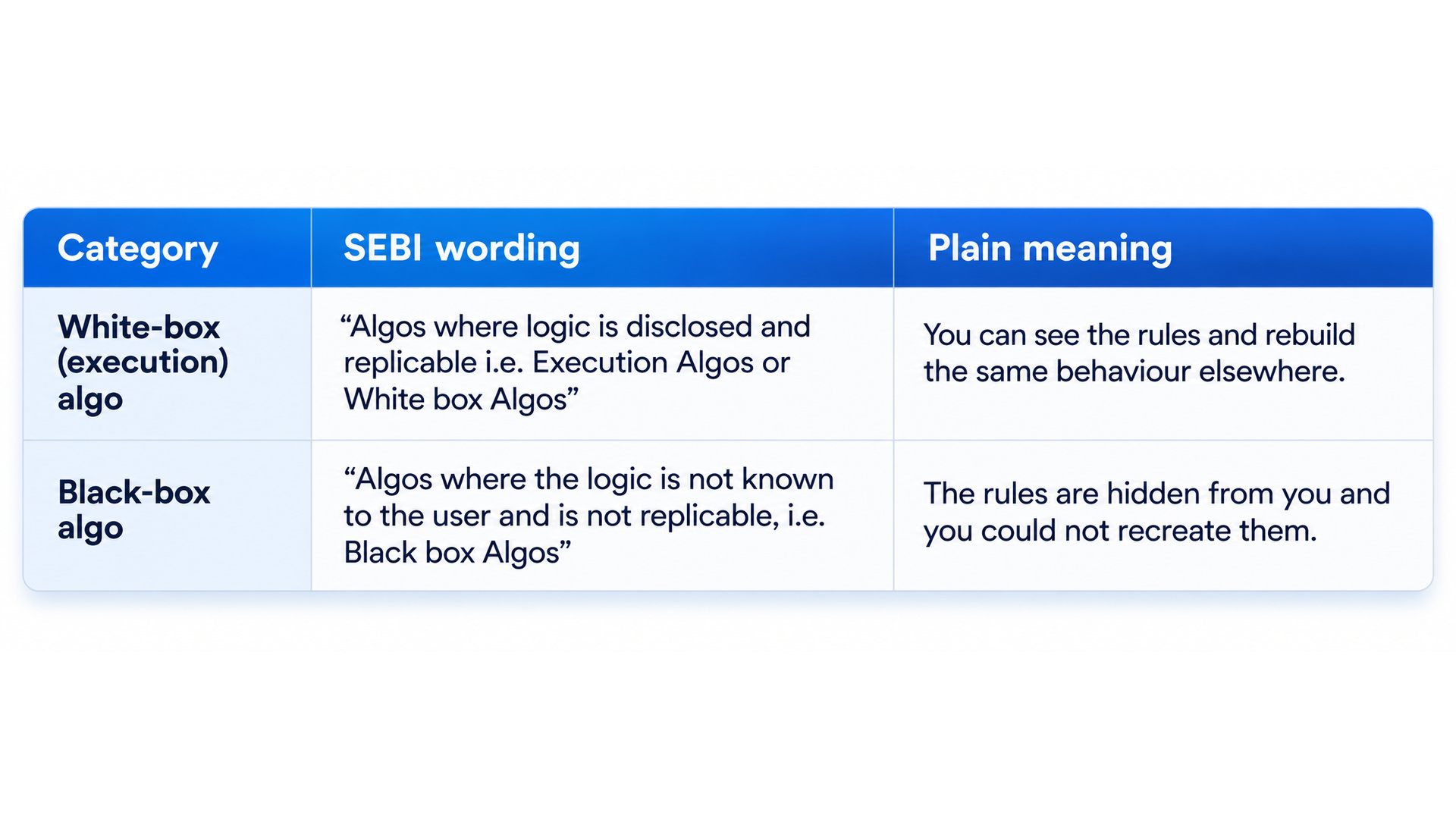
SEBI's circular of 4 February 2025, “Safer participation of retail investors in Algorithmic trading” (SEBI/HO/MIRSD/MIRSD-PoD/P/CIR/2025/0000013), sorts algos by one test: can the user see and replicate the logic?
Disclosed means the provider shows you the rules. Replicable means you could rebuild the same behaviour yourself. The circular names only two categories and does not say how to classify an algo that is disclosed but not replicable, so “grey box” is a marketing term, not a SEBI category. For the wider framework, see our complete guide to SEBI's algo trading regulations.
What do white-box and black-box mean in SEBI's circular?
How does SEBI treat each category differently?
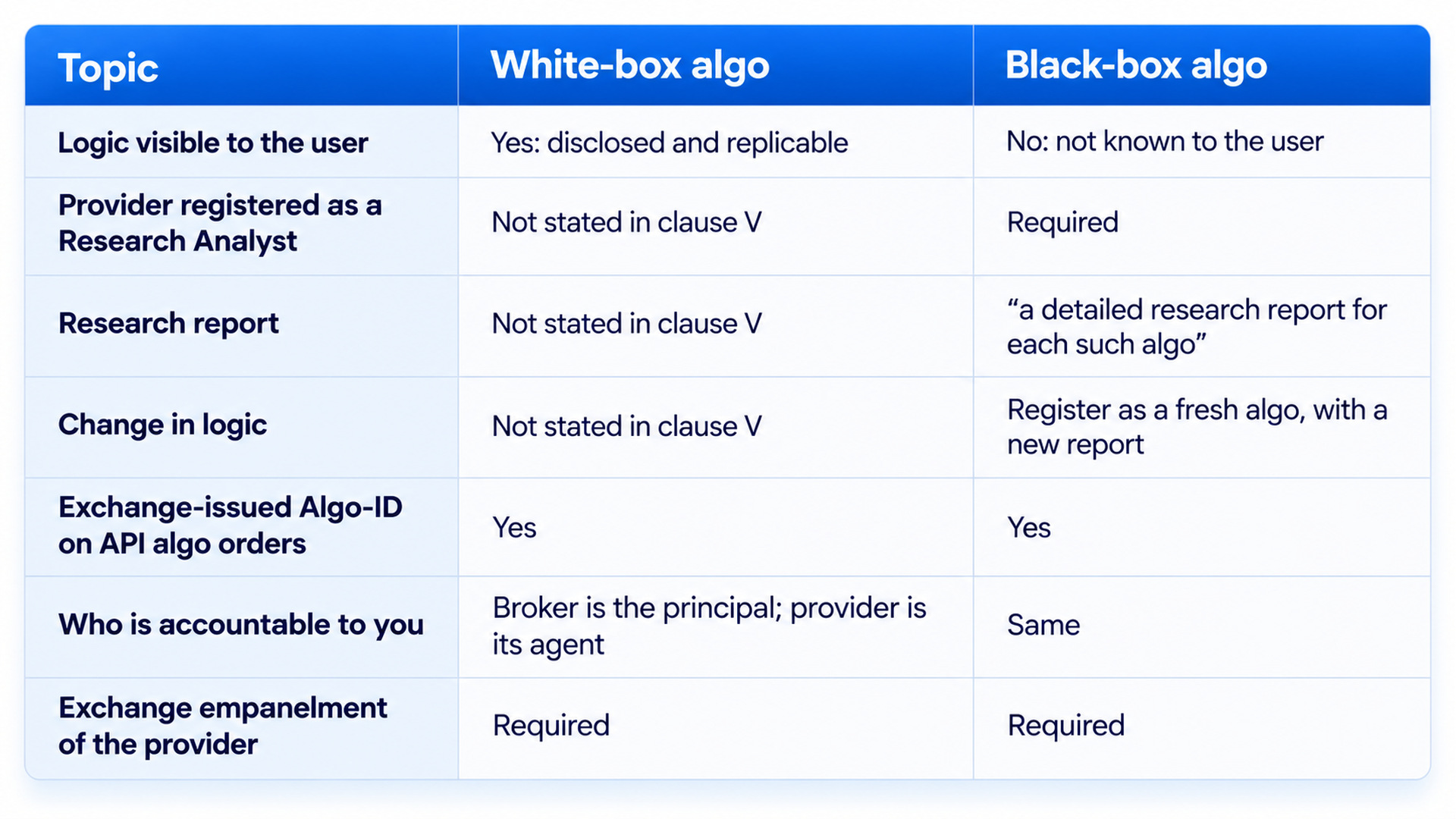
Both categories sit inside one framework, but only black-box providers carry an extra duty: Research Analyst registration and a research report for each algo. As we read it, clause V does not state these duties for white-box algos.
How does SEBI treat each category differently?
What must a black-box provider do under the circular?
It must register as a Research Analyst, keep a detailed research report for each algo, and treat any change in logic as a new algo. The circular says: “Register as a Research Analyst and maintain a detailed research report for each such algo.” On changes: “In case of any change in the logic governing the algo, register such algo as a fresh algo and maintain a detailed research report for the new algo.”
NSE's retail algo FAQ adds that a Research Analyst who wants to deploy a black-box algo must first become an Algo Provider. According to its answer to Q4, an Algo Provider hosting the black-box algos of several third-party Research Analysts is not possible.
- Research Analyst registration is a separate layer from exchange empanelment.
- A research report should exist for each algo. In the clauses we read, the circular does not say you must be given a copy, so ask what you can see.
- A changed algo is a new algo, so a track record belongs to one version. Ask which version produced a chart and whether it is the version running today.
Where does StrykeX fit in this picture?
StrykeX is empanelled with NSE and BSE. It is operated by Stockwiz Technologies LLP, a SEBI-registered Research Analyst (INH000013925). This post explains the categories and does not classify any individual StrykeX product.
Research Analyst registration and exchange empanelment are separate checks. NSE publishes a page of empanelled algo providers of the exchange, which showed a list last updated on 22 September 2026 when we checked on 3 Oct 2026. Our explainer on What Is Algo Trading? Meaning, How It Works, Strategies & Rules (2026)
Is a white-box algo safer or more profitable than a black-box algo?
No. The classification describes transparency and paperwork, not safety or results, and nothing in the circular as we read it says either category performs better.
SEBI's FY26 study, “Profitability of Individual Traders in the Equity Derivatives Segment (FY25-FY26)”, found that 87.7% of individual traders incurred net losses in FY26, down from 90.9% in FY25, with aggregate net losses of ₹91,685 crore. SEBI's FY25 study, as Business Standard reported on 7 July 2025, found 91% had net losses, about ₹1,05,603 crore in aggregate.
As far as we could find, neither study splits results by white-box or black-box algos. Transparency helps you check an algo, but a rule you can read can still lose money.
How should you read common provider claims?
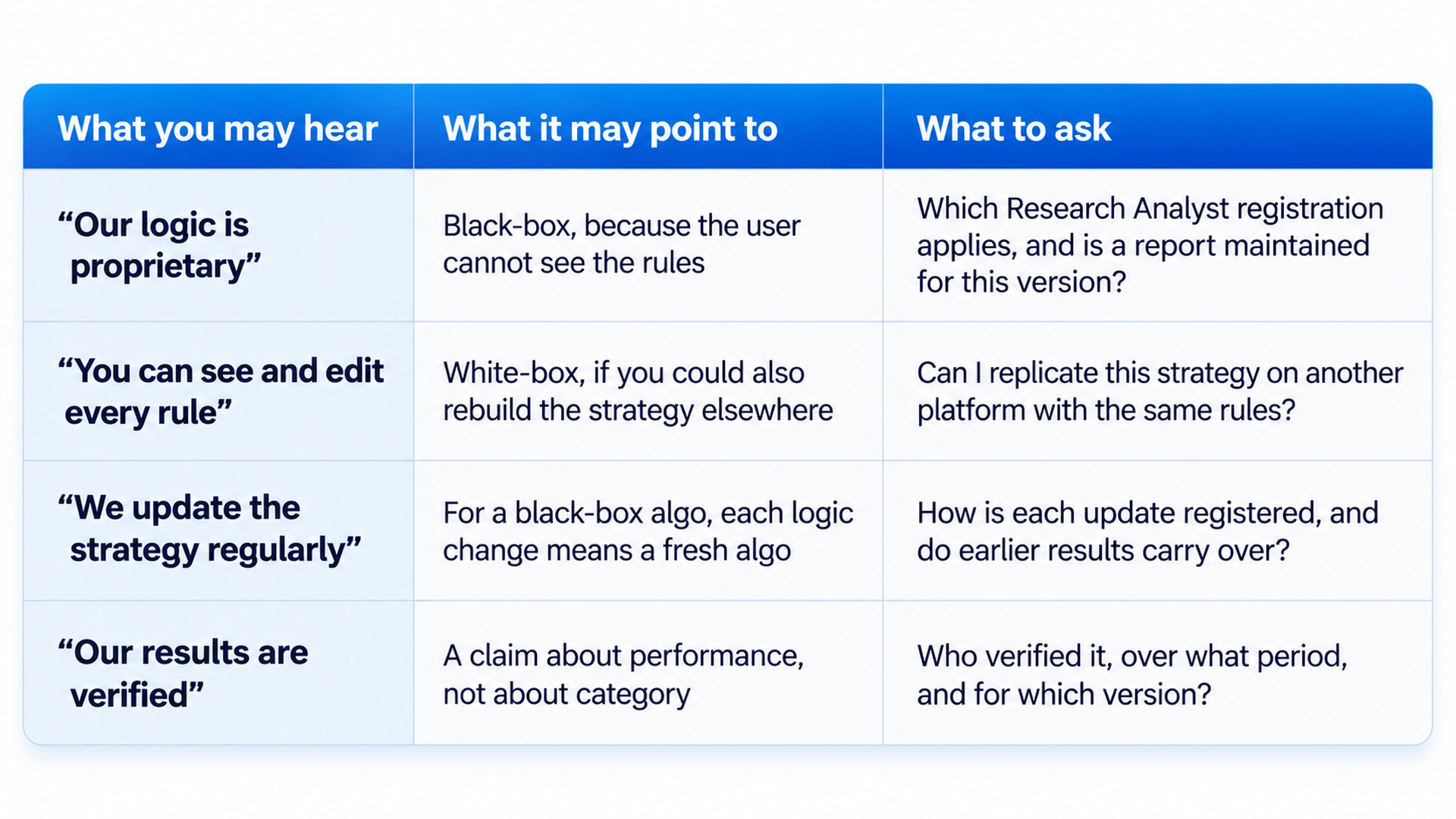
Marketing phrases rarely match SEBI's two categories. Treat each phrase as a prompt for a question, not an answer.
A provider can be empanelled, registered and verified and still offer an algo that loses money, so keep logic and results apart.
How should you read common provider claims?
How do you check an algo provider before you pay?
Run six checks: classification, Research Analyst registration, exchange empanelment, the research report, the broker's role and how performance is shown.
- Ask for the category in writing. Ask whether each algo is white-box or black-box under SEBI's February 2025 circular, and why.
- Look up black-box providers as Research Analysts. Open SEBI's recognised intermediaries page, choose Research Analysts and search the registration number the provider gives you. Practise on a known one: Stockwiz Technologies LLP, a SEBI-registered Research Analyst (INH000013925).
- Check exchange empanelment. Look for the provider on NSE's list of empanelled algo providers. A name on the list is a necessary check, not an endorsement of performance.
- Ask about the research report. For a black-box algo, ask whether a report exists for the exact version you are buying, and how you can read it.
- Confirm the broker is the principal. Orders should flow through your own broker account and carry an exchange-issued Algo-ID. See Is StrykeX a Scam? SEBI Registration Number, Verification Steps & Facts (2026)
- Check how results are shown. Ask whether numbers are backtested, forward tested or live and verified, and who verified them. Our post on PaRRVA and StrykeX Verified P&L shows how Stockwiz approaches this.
When does the white-box and black-box test not help?
Limits of the classification
It sorts algos by transparency only, so it says nothing about returns, drawdowns or how robust a strategy is. Edge cases remain, such as an algo that is disclosed but not replicable. Exchange procedures change, so read the latest NSE and SEBI circulars before relying on this post. This is general education, not legal advice.
Related articles
• How Stockwiz Uses PaRRVA and StrykeX Verified P&L for Transparent Performance Reporting
• Best Algo Trading Platform for Options Selling (2026)
• Algo Trading Accuracy Percentage: Why It Misleads
• StrykeX News: Press Coverage Labelled and How to Verify It
Frequently asked questions
What is the difference between white-box and black-box algos?
SEBI's circular of 4 February 2025 calls an algo white-box when its logic is disclosed and replicable, and black-box when the logic is not known to the user and is not replicable. The practical difference is what you can inspect and what the provider must file.
Do black-box algo providers need to be registered with SEBI?
The circular says a black-box provider must register as a Research Analyst and maintain a detailed research report for each such algo. Providers are also empanelled with the exchange. These are two separate checks.
What happens if a black-box algo's logic changes?
The circular says the provider must register the changed algo as a fresh algo and maintain a detailed research report for the new algo. Ask which version any shown performance belongs to.
Is a white-box algo safer than a black-box algo?
Not on anything the circular says. The classification is about transparency and paperwork. SEBI's FY26 study found 87.7% of individual equity derivatives traders had net losses and does not split results by algo type.
How do I check whether an algo provider is a Research Analyst?
Open SEBI's recognised intermediaries page, choose Research Analysts and search the provider's registration number or name. Ask the provider for the number first, so you are checking what they claim.
StrykeX — By Stockwiz Technologies