Algo Trading Accuracy Percentage
Algo Trading Accuracy Percentage: Why It Misleads
Algo trading accuracy percentage explained: a rupee example where 70% win rate loses money, break-even maths, and what to check instead of a win rate.
Why You Should Not Trust Any Algo's Accuracy Percentage (Including Claims Made About Ours)
Quick answer
• An accuracy percentage is a win rate: winning trades divided by all trades. It says nothing about the size of wins and losses.
• In the hypothetical example here, a 70% win rate loses ₹20,000 over 100 trades, while a 40% win rate makes ₹60,000.
• Break-even win rate depends on payoff ratio: 75.0% when the average loss is three times the average win, only 25.0% when the average win is three times the loss.
• SEBI's advertisement code for Research Analysts says an advertisement must not imply percentage accuracy.
An accuracy percentage tells you how often trades win, not whether the strategy makes money. A strategy that wins 70% of its trades can lose rupees, and one that wins 40% can profit. SEBI's advertisement code for Research Analysts also bars implying “percentage accuracy”.
Below are a worked rupee example, a break-even table and six questions to put to any platform. SEBI's advertising rules are covered more broadly in our complete guide to SEBI algo trading regulations.
What does an algo's accuracy percentage actually measure?
In most marketing, accuracy means win rate: winning trades divided by total trades. If 70 of 100 trades end in profit, the win rate is 70%. There is no standard definition: one provider may count each order, another each day.
Ask what one trade is, whether open positions are included, whether costs and slippage (the gap between expected and actual price) are counted, and whether it is a backtest, forward test or live.
Can a strategy with a 70% win rate lose money?
Yes. Win rate ignores the size of wins and losses. These two hypothetical strategies each run 100 trades.
Strategy A wins most of the time and still loses, because one ₹3,000 loss wipes out three ₹1,000 wins. Expectancy, the average result per trade, is win rate times average win minus loss rate times average loss. For A: (0.70 × 1,000) - (0.30 × 3,000) = -200. For B: 600.
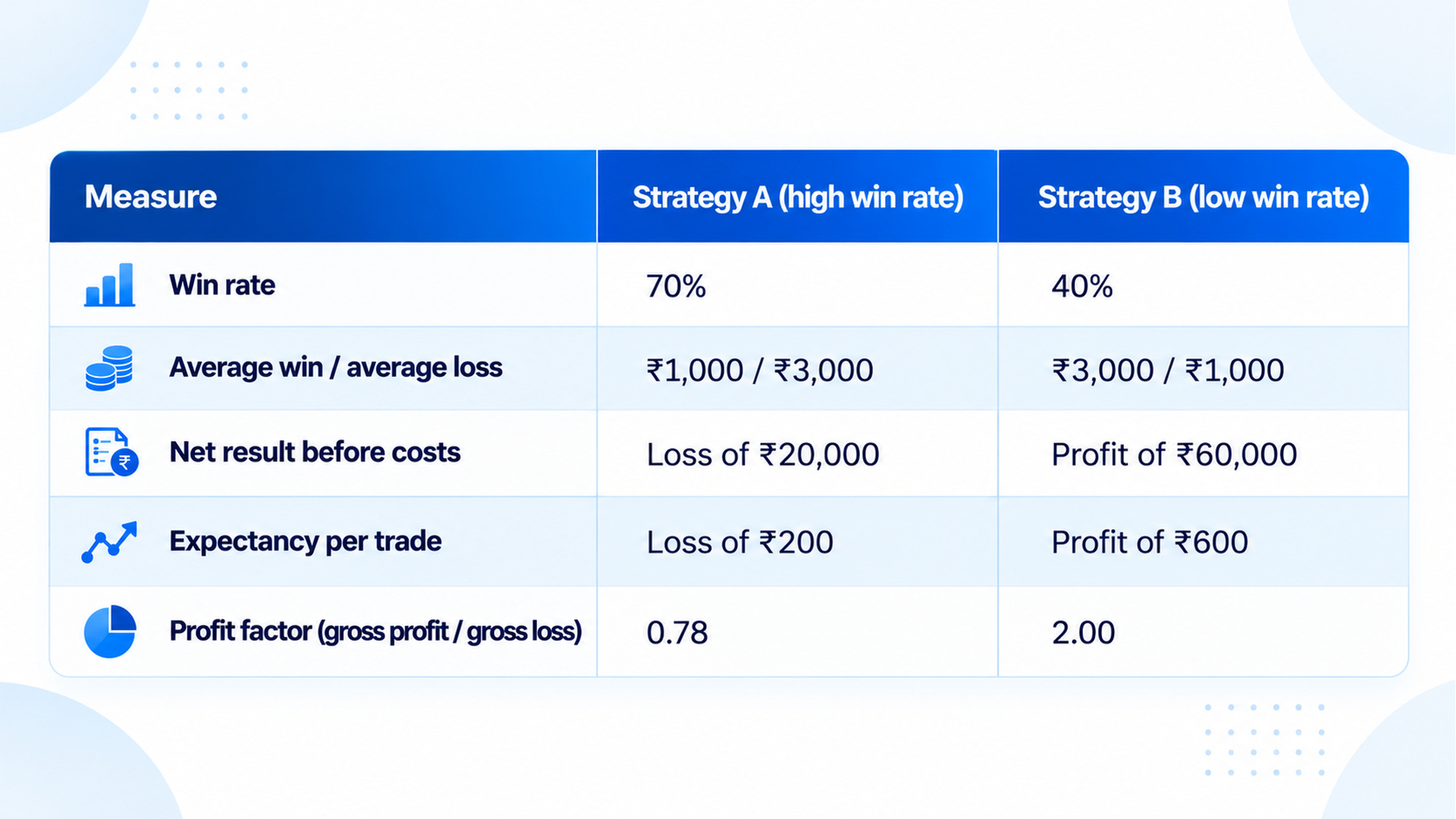
Hypothetical example, not a strategy result.
What win rate do you need to break even?
It depends on the payoff ratio, average win divided by average loss. Break-even before costs is 1 divided by (1 plus the payoff ratio).
Costs move the line. With a ₹1,000 win and a ₹3,000 loss, an assumed ₹150 cost per trade (not any broker's charge) lifts break-even from 75.0% to 78.75%, since 150 divided by 4,000 is 3.75 points.
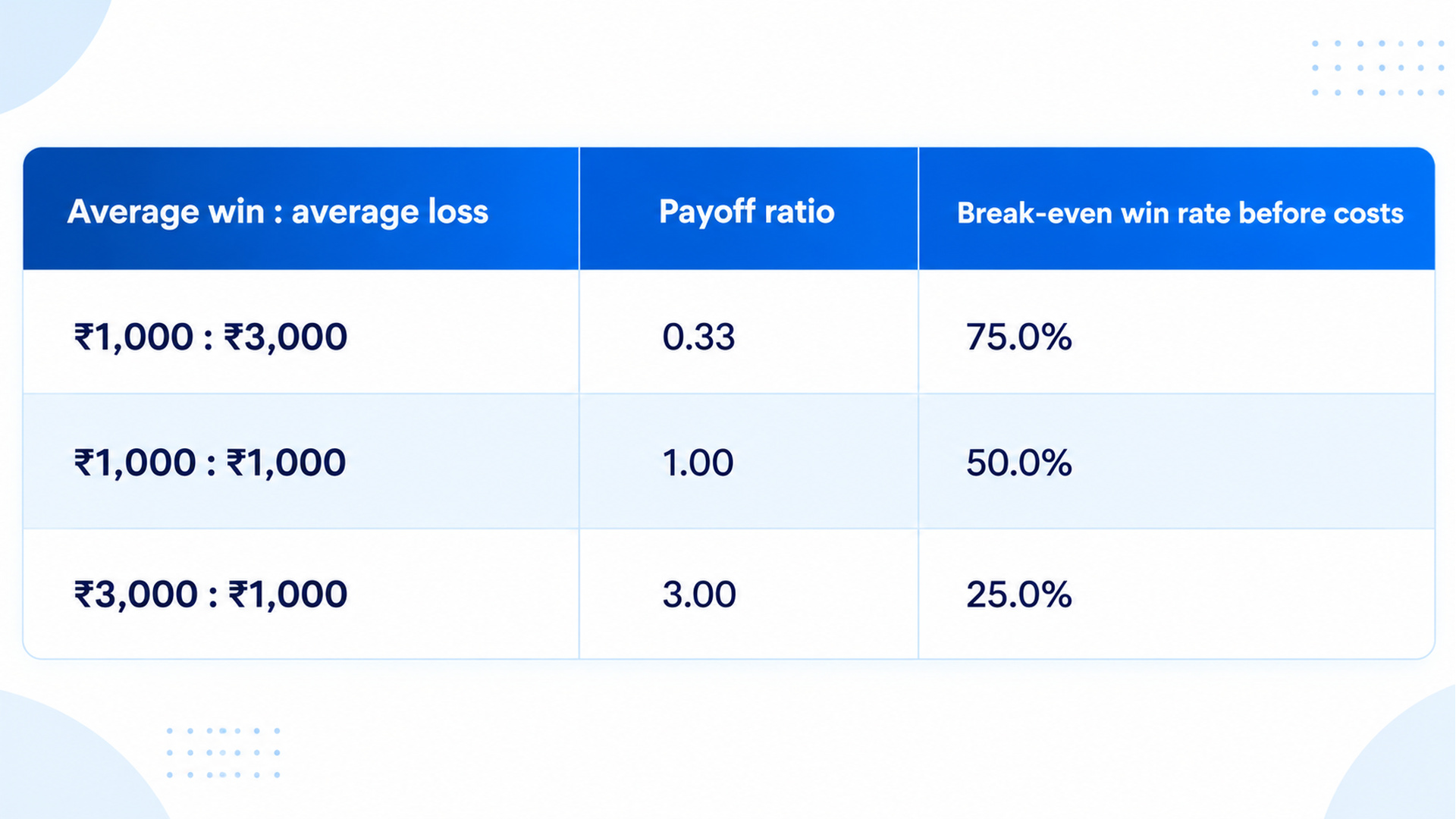
What win rate do you need to break even?
How many trades before a win rate means anything?
Far more than most marketing shows. Using a normal approximation, a 70% win rate on 20 trades is compatible with a true rate of about 50% to 90%, and on 400 trades about 65.5% to 74.5%. Ask for the trade count and date range.
What does SEBI say about accuracy claims?
SEBI's advertisement code for Research Analysts and Investment Advisers, issued on 5 April 2023, says an advertisement must not imply “percentage accuracy”. It also lists reference to the Research Analyst's past performance as prohibited. Outlook Money reported on 6 September 2024 that SEBI told brokers offering algo trading not to refer to the past or expected performance of an algorithm.
Stockwiz Technologies LLP, a SEBI-registered Research Analyst (INH000013925), is covered by this code. This article makes no accuracy claim about any StrykeX algo. Treat any accuracy figure attached to Stockwiz or StrykeX as unverified.
What can PaRRVA verify, and what can it not?
PaRRVA, the Past Risk and Return Verification Agency, is SEBI's mechanism for verifying past performance claims. Business Standard reported a pilot launch on 8 December 2025 with CARE Ratings and NSE. It checks the past, not the future. See how Stockwiz uses PaRRVA and StrykeX Verified P&L.
What should you check instead of accuracy?
Check results after costs, payoff ratio, drawdown, trade count and period, and the result type.
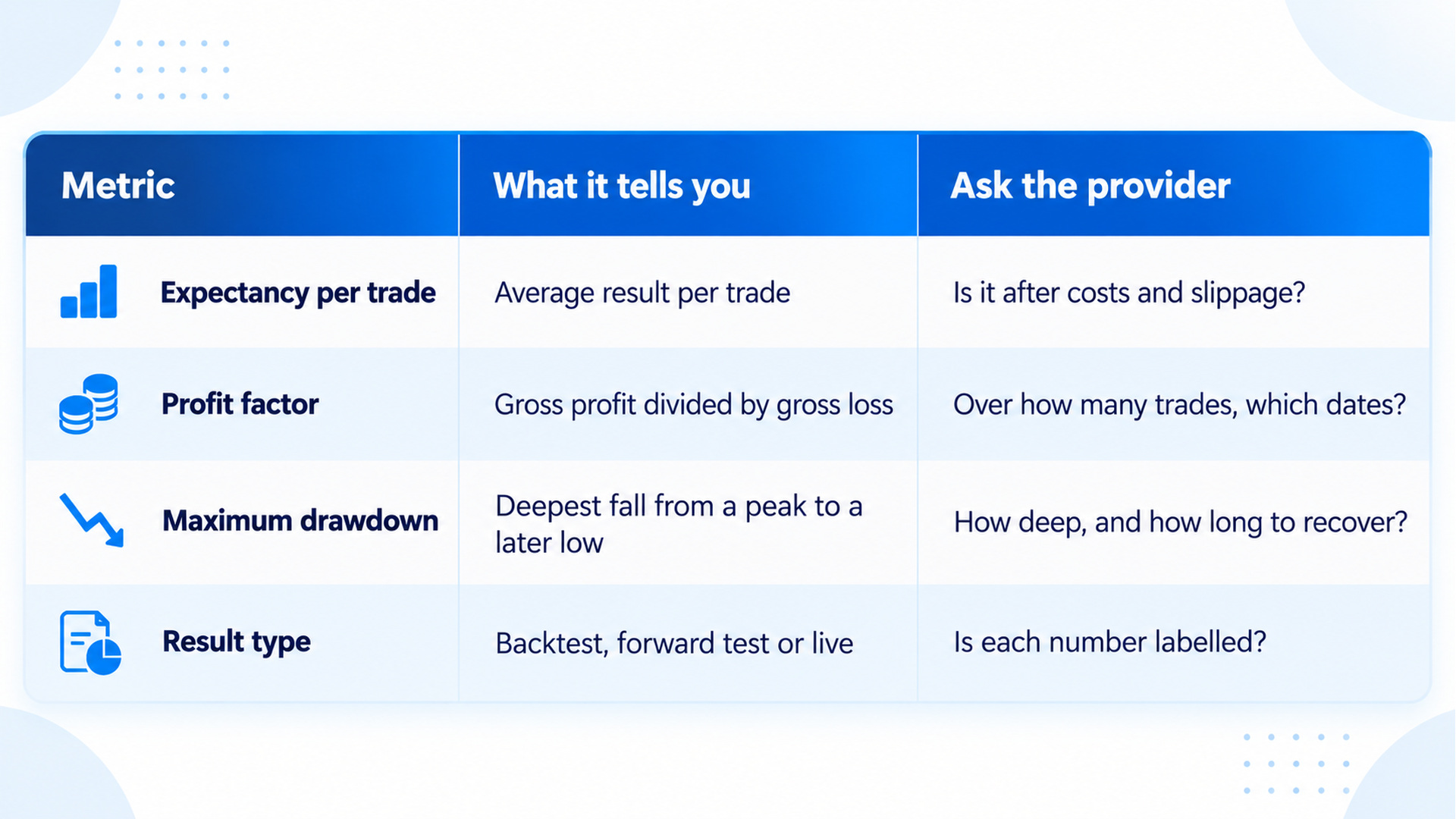
What should you check instead of accuracy?
Why does this matter for F&O traders?
SEBI's FY25 study found that 91% of individual F&O traders had net losses, about ₹1,05,603 crore in aggregate, as Business Standard reported on 7 July 2025. SEBI's FY26 study of individual equity derivatives traders puts the share at 87.7%, with aggregate net losses of ₹91,685 crore.
A headline win rate is a weak filter when most individual participants lose money. Our post on what SEBI's F&O loss data says about the new algo rules goes deeper.
How do you ask a platform for the real numbers?
Put these questions to any provider in writing before you commit capital.
- What does the percentage count: orders, positions, days or signals?
- What are the number of trades and the exact date range?
- What are average win, average loss and expectancy after costs?
- Are brokerage, taxes and slippage included?
- Is each figure labelled backtest, forward test or live, and are past returns verified through PaRRVA?
To compare platforms on these questions, start with our comparison of no-code algo platforms in India. To check a firm's complaint record, see how to read Stockwiz complaint data on SEBI SCORES.
Related articles
- How Stockwiz Uses PaRRVA and StrykeX Verified P&L for Transparent Performance Reporting
- No-Code Algo Trading Platforms in India (2026): StrykeX Compared with Eight Others on Testing, Price and Compliance
- Best Algo Trading Platform for Options Selling (2026)
- Is StrykeX a Scam? SEBI Registration Number, Verification Steps & Facts (2026)
Frequently asked questions
What is accuracy in algo trading?
Usually win rate: the share of trades that end in profit. It does not show the size of wins and losses, and providers define a trade differently.
Is a high win rate good in algo trading?
Not on its own. In a hypothetical example, a 70% win rate with a ₹1,000 average win and ₹3,000 average loss loses ₹200 per trade. Check payoff ratio, expectancy and drawdown too.
What win rate do you need to be profitable?
It depends on the payoff ratio: 75.0% when the average loss is three times the average win, 25.0% when the win is three times the loss, before costs.
What is profit factor?
Gross profit divided by gross loss over a set of trades. Above 1 means profits exceeded losses in that sample.
Can algo providers in India advertise accuracy or returns?
SEBI's advertisement code for Research Analysts and Investment Advisers says an advertisement must not imply percentage accuracy, and lists reference to past performance as prohibited.
StrykeX — By Stockwiz Technologies