What Is Algo Trading?
What Is Algo Trading? Meaning, How It Works, Strategies & Rules (2026)
What is algo trading? A clear 2026 guide — algorithmic trading meaning, how it works, components, strategies, benefits, risks, SEBI rules in India, and how to start (even without coding). Beginner-friendly
What Is Algo Trading? Meaning, How It Works, Strategies & Rules
Algo trading (algorithmic trading) is the use of a computer program to place buy and sell orders automatically, based on a set of pre-defined rules — such as price, timing, or quantity. Instead of manually watching charts and clicking, you define the conditions once, and the algorithm executes trades the moment those conditions are met. This removes emotion, reacts in milliseconds, and follows the rules with perfect discipline. In India, algo trading is legal, regulated by SEBI, and increasingly accessible to retail traders — even those who cannot code.
Picture two traders watching the same stock. The first stares at the screen, waiting for the right moment, second-guessing, hesitating — and by the time they click “buy,” the price has already moved. The second trader has set a rule in advance: “the moment this condition is met, buy.” Their order fires instantly, no hesitation, no emotion. That second trader is doing algo trading.
If you have been curious about what algo trading is — and whether it is something only banks and hedge funds can do — this guide is for you. We will explain exactly what algorithmic trading means, how it actually works, the components you need, the most common strategies, the benefits and the very real risks, how SEBI regulates it in India, and how an ordinary retail trader can get started (yes, even without writing code). No jargon for the sake of jargon — just a clear, honest explanation.
What Is Algorithmic Trading?
Algorithmic trading — often shortened to algo trading or automated trading — is the process of using a computer program to place trades in financial markets automatically, based on a set of pre-defined rules. These rules can be based on price, timing, volume, mathematical formulas, or any combination of conditions you decide in advance.
The core idea is simple: you tell the computer exactly what to look for and what to do when it sees it. The algorithm then watches the market tirelessly and executes the moment your conditions are met — far faster, and far more consistently, than any human could. It does not get tired, it does not get greedy, and it does not panic.
In one line: Algo trading = letting a computer execute your trading rules automatically, instead of clicking buy and sell by hand.
A simple example makes it click. Suppose your rule is: “If the 5-day moving average of a stock crosses above its 100-day average, buy.” Once you set that rule, the algorithm monitors the market continuously and places the order the instant the condition is satisfied — in milliseconds, while a manual trader might still be reaching for the mouse. (This is an illustrative example, not a recommendation.)
How Does Algo Trading Work?
Behind the scenes, algo trading follows a clear, repeatable cycle. Whether you build it yourself or use a ready-made platform, the logic is the same.
- Define your trading rules. Specify the asset, the entry conditions, the exit conditions, and your risk parameters (such as stop-loss).
- Build or select the algorithm. Turn those rules into a strategy — either by coding it, or by choosing a pre-built one on a no-code platform.
- Back-test the strategy. Run the rules against historical data to see how they would have behaved, including during losing periods.
- Connect to your broker. Link the strategy to your broker account via a secure API so it can place real orders.
- Go live and monitor. Activate the strategy. It executes automatically, while you monitor, pause, or exit as needed.
One crucial point: with a well-built platform, your money stays in your own broker account the entire time — the system only sends order instructions. For a real-world walkthrough of this flow, see how StrykeX works.
Key Components Required for Algo Trading
To trade algorithmically, a few building blocks need to come together. Here are the essentials — think of them as your toolkit.
- Market knowledge: a sound understanding of how markets and your chosen instruments behave.
- A trading strategy: clear, testable entry and exit rules with defined risk management.
- A broker with API access: so the algorithm can place orders on your behalf.
- An algo platform or code: either a no-code platform or your own program to run the strategy.
- Reliable data: accurate, timely market data, since your signals are only as good as your data.
- Risk controls: stop-loss, position limits, and a daily loss cap — non-negotiable.
- Capital you can risk: start small with money you can afford to lose while you learn.
Common Algo Trading Strategies
Algo trading is not one single approach — it is an umbrella for many rule-based strategies. Here are the most widely used ones, explained simply.
1. Trend-following strategies
The most popular category. These follow indicators like moving averages or the Supertrend to ride a trend, with no need to predict the market — just react to it. Our Supertrend indicator strategy guide is a good example of how a trend-following rule set works.
2. Mean-reversion strategies
These assume that prices tend to return to an average over time. The algorithm buys when price is unusually low relative to its average and sells when it is unusually high — the opposite philosophy to trend-following.
3. Arbitrage strategies
These exploit small price differences for the same asset across markets or instruments, aiming to profit from the gap. They typically require speed and precision.
4. Momentum strategies
These ride strong directional moves, entering when momentum builds and exiting when it fades.
5. Options and derivatives strategies
Rule-based strategies built around options and futures, often used for hedging or defined-risk positions. If you are new to these instruments, our futures vs options guide explains the differences.
High-Frequency Trading vs Algo Trading: What’s the Difference?
People often confuse high-frequency trading (HFT) with algo trading. HFT is actually a specialised subset of algo trading — all HFT is algorithmic, but most algo trading is not HFT.
The takeaway: HFT is a high-speed, capital-intensive niche dominated by institutions. The algo trading available to retail traders is rule-based automation that runs on ordinary infrastructure — powerful, but not the millisecond arms race of HFT.
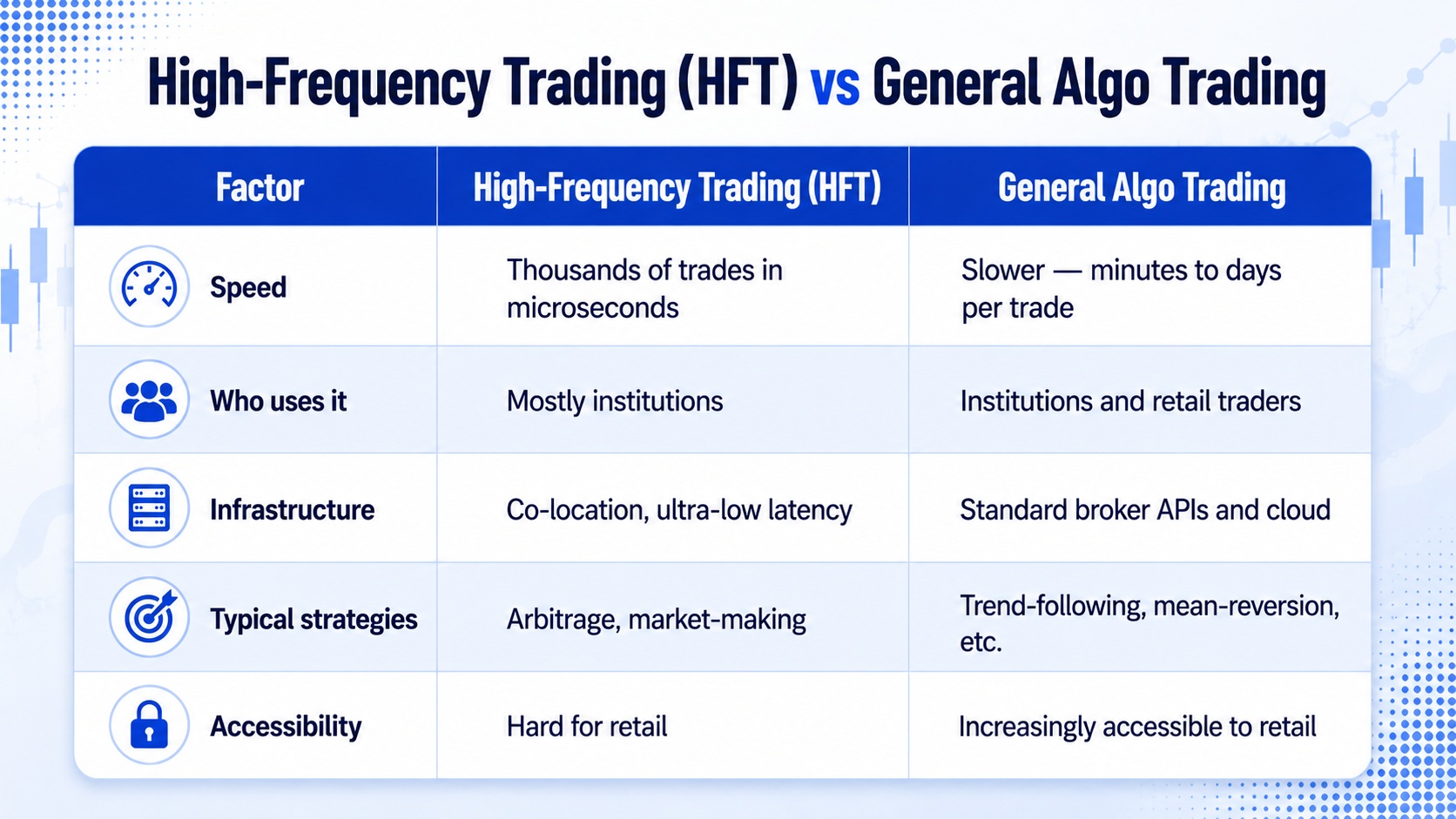
High-Frequency Trading vs Algo Trading
Algo Trading vs Manual Trading
The clearest way to understand algo trading is to compare it with trading by hand.
Neither is “better” in every case — it depends on your goals and temperament. We compare the two in depth in StrykeX vs manual trading.
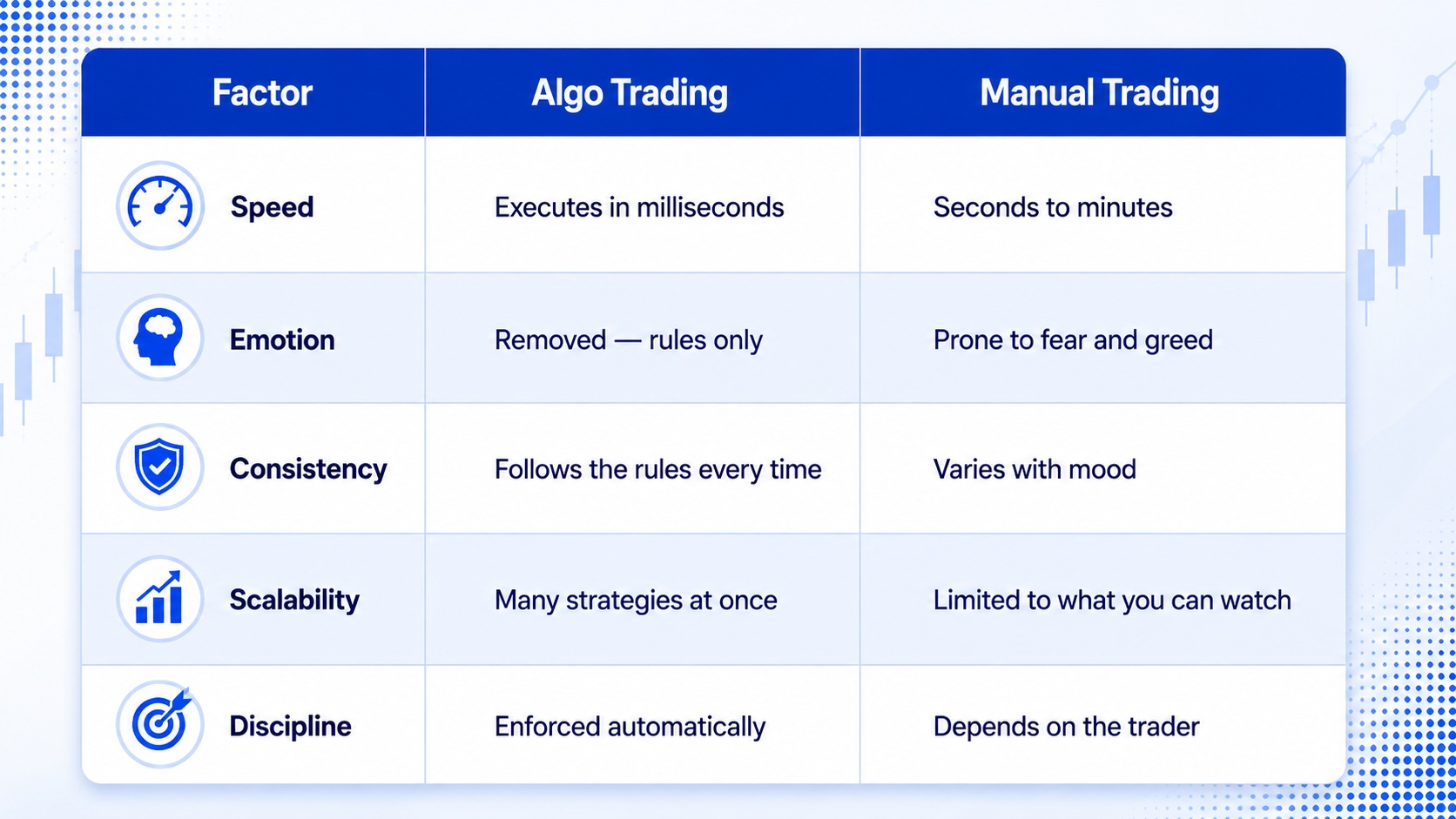
Algo Trading vs Manual Trading
Benefits of Algo Trading
- Lightning-fast execution. Orders fire in milliseconds, capturing opportunities a human would miss.
- No emotional bias. The algorithm follows the rules exactly — no fear, no greed, no hesitation.
- Consistency and discipline. The same rules apply to every trade, every time.
- Back-testing. You can test a strategy on historical data before risking real capital.
- Time efficiency. Automation handles monitoring and execution, freeing you up.
- Multi-strategy scale. Run several strategies across instruments at once — impossible to do manually.
Risks of Algo Trading (The Honest Part)
This is the section many “start algo trading today” articles rush past. Algo trading is powerful, but it carries real risks you must respect.
- Market risk: the big one. Automation does not remove the risk of loss — a strategy can and will lose money in the wrong conditions.
- Over-optimisation (curve-fitting): a strategy tuned to look perfect on past data often fails live.
- Technical failures: connectivity, data, or system issues can affect execution.
- Poor risk settings: aggressive position sizing or missing stop-losses amplify losses.
- Misunderstanding the strategy: deploying something you do not understand is a recipe for surprises.
Important: Automation enforces discipline; it does not guarantee profit. No algo, no platform, and no strategy can promise returns — anything that claims to should be treated with deep suspicion.
Is Algo Trading Legal in India? SEBI Regulations
Yes — algo trading is legal in India and is regulated by the Securities and Exchange Board of India (SEBI). SEBI has progressively built a framework to bring retail algorithmic trading under proper oversight, with an emphasis on transparency, broker accountability, and investor protection.
In practice, retail algo trading works through the regulated system, not outside it. Orders route to your SEBI-regulated broker, execute on regulated exchanges like the NSE and BSE, and settle through standard clearing infrastructure. SEBI has also moved to require that algos used by retail traders are tagged and routed appropriately through brokers, improving traceability.
A practical tip: use a platform operated by a SEBI-registered entity. StrykeX, for example, is operated by Stockwiz Technologies LLP, a SEBI-registered Research Analyst (INH000013925) — an accountable, identifiable Indian operator. You can read more in our is StrykeX legit or a scam guide.
Can You Do Algo Trading Without Coding?
Absolutely — and this is the part that surprises most newcomers. You do not need to be a programmer to trade algorithmically. No-code platforms let you deploy pre-built, rule-based strategies that connect to your broker and run automatically, all through a visual interface. Coding gives more customisation, but for most retail traders it is entirely optional. We cover this fully in can you do algo trading without coding.
How to Start Algo Trading (Step-by-Step)
- Learn the basics of how rule-based strategies and risk management work.
- Open a broker account that supports API connectivity.
- Choose a platform — a no-code, SEBI-registered platform is the easiest start. Check that your funds stay in your own account.
- Pick one tested strategy and understand how it behaves.
- Back-test it across both trending and sideways periods.
- Start small with capital you can afford to risk, and set strict stop-loss and daily loss limits.
- Monitor and scale gradually as your confidence in the strategy grows.
If you want a regulated, no-code starting point, our StrykeX review and is StrykeX safe guides explain how the platform works and what to check first.
Conclusion
Algo trading has quietly transformed how modern markets work — bringing speed, precision, and discipline that human reflexes simply cannot match. At its heart, it is a beautifully simple idea: define your rules clearly, and let a computer execute them without hesitation or emotion. What was once the exclusive territory of banks and hedge funds is now genuinely within reach of everyday retail traders, especially with no-code, SEBI-registered platforms.
But the honest truth runs alongside the promise: algo trading is a tool, not a money machine. It enforces discipline; it does not remove market risk. Learn the fundamentals, respect the risks, start small, use strict risk controls, and choose a regulated platform that keeps your funds in your own account. Do that, and algorithmic trading can become a genuinely powerful part of how you participate in the markets.
Related Articles
• StrykeX Review (2026): Features, Performance & Safety
• Can You Do Algo Trading Without Coding? (Yes — Here’s How)
• Supertrend Indicator Strategy: Rules, Settings & How to Automate It
• Futures vs Options: Key Differences Every Indian Trader Should Know
Frequently asked questions
What is algo trading in simple words?
Algo trading is using a computer program to place buy and sell orders automatically based on pre-defined rules. You set the conditions once, and the algorithm executes trades the moment they are met — no manual clicking required.
Is algo trading legal in India?
Yes. Algo trading is legal in India and is regulated by SEBI. Trades execute through SEBI-regulated brokers on regulated exchanges such as the NSE and BSE. Using a SEBI-registered platform is recommended.
Can I do algo trading without coding?
Yes. No-code platforms let you deploy pre-built, rule-based strategies without any programming. See can you do algo trading without coding.
What is the difference between algo trading and HFT?
High-frequency trading (HFT) is a specialised, ultra-fast subset of algo trading used mainly by institutions, executing thousands of trades in microseconds. General algo trading is slower, rule-based automation accessible to retail traders.
Is algo trading profitable?
Algo trading can be effective at enforcing discipline and removing emotion, but it does not guarantee profit. All trading carries market risk, and losses are possible regardless of how a strategy performed historically.
How much money do I need to start algo trading?
You can start small. The sensible approach is to begin with an amount you can afford to put at risk, observe how the strategy behaves live, and scale only as your confidence grows.
Can I lose money in algo trading?
Yes. Automation removes manual and emotional errors but not market risk. Losses are possible, so strict risk management — stop-loss, position sizing, and daily loss limits — is essential.
What is the best way to start algo trading for beginners?
The easiest route is a regulated, no-code platform with ready-made, tested strategies and built-in risk controls. See how StrykeX works for a beginner-friendly walkthrough.
StrykeX — By Stockwiz Technologies