Non-Directional Option Strategies in India: Payoffs in ₹
Non-Directional Option Strategies in India: Payoffs in ₹
Non-directional option strategies: straddle, strangle, iron condor and iron butterfly with hypothetical rupee payoffs, failure cases and rule-based builds.
Non-Directional Option Strategies in India: Payoffs in ₹
Quick answer
• Non-directional strategies take a view on how far the market moves, not which way. Short versions earn from a range-bound market; long versions need a big move.
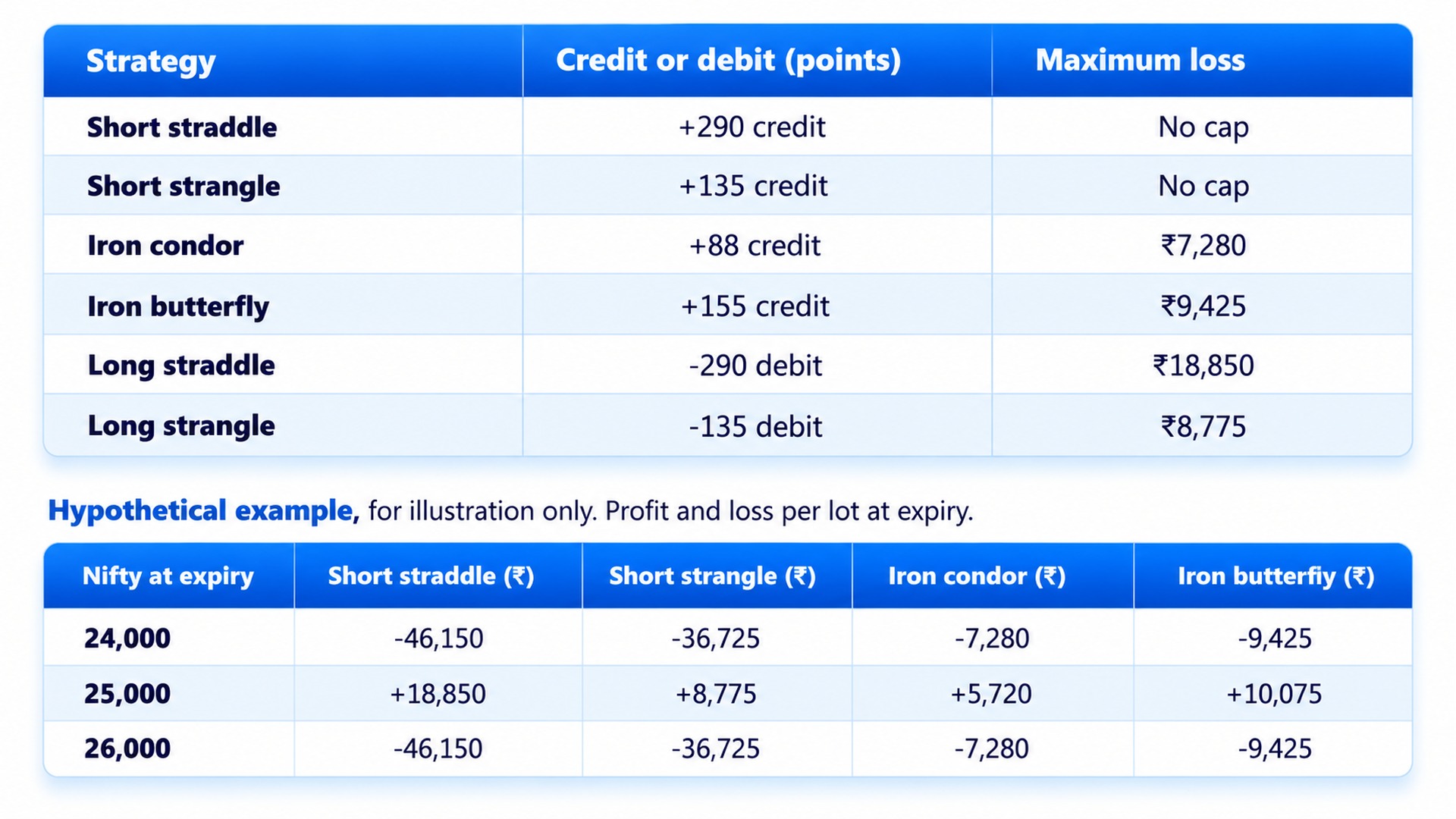
• In our hypothetical set-up, a short straddle collects 290 points (₹18,850 per lot) but has no loss cap; an iron condor collects 88 points (₹5,720) and caps its loss at ₹7,280.
• Each fails in a specific market: short structures in sharp moves, long structures in quiet markets, iron structures at their capped maximum loss.
• A rule-based version needs fixed rules for entry, strikes, order sequence, stop-loss, exit and leg failures. SEBI's studies show 91% (FY25) and 87.7% (FY26) of individual F&O traders had net losses.
Non-directional option strategies take a view on how far the market will move, not which way. Short versions earn when the market stays in a range; long versions need a big move either way.
Below: rupee payoffs for each, where each fails, and how rules turn them into an algo.
What is a non-directional option strategy?
A non-directional strategy gains or loses on the size of the market's move and the passage of time, not on a bullish or bearish call. Selling options (short premium) earns when the market stays in a range. Buying options (long premium) earns when it moves far enough either way.
Time decay, called theta, works for sellers and against buyers. Four structures cover most cases: straddle, strangle, iron condor and iron butterfly.
How are the numbers in this guide set up?
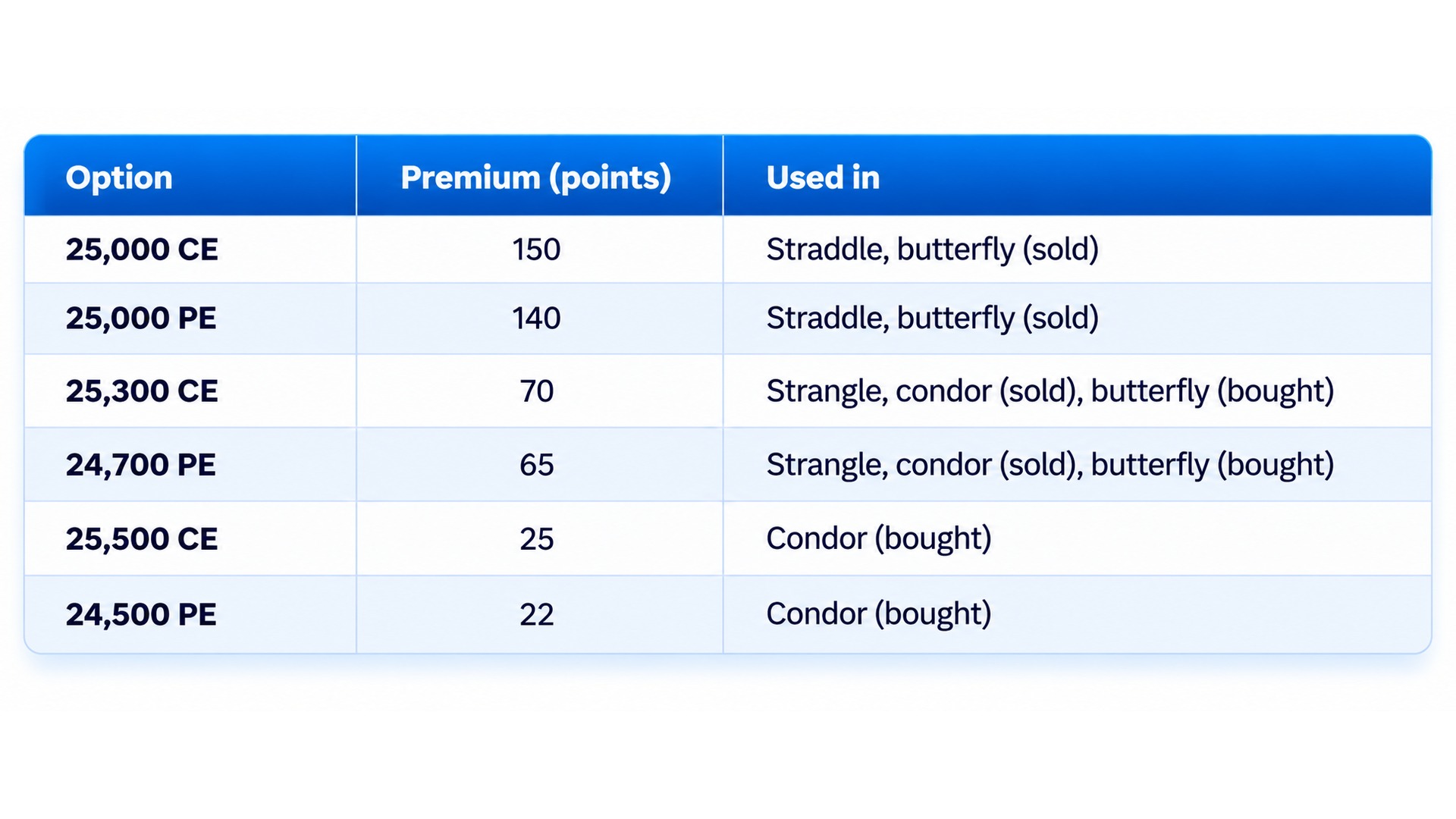
Every rupee figure uses one invented set-up. Hypothetical example. Nifty is at 25,000, expiry is a week away, and the premiums are illustrative, not quotes. This example assumes a lot of 65 units; check the current lot size before you trade. Premiums are in index points, so multiply by 65 for rupees per lot. CE is a call option and PE a put option.
All results are expiry payoffs, before charges and slippage. Live profit and loss before expiry will differ.
How are the numbers in this guide set up?
How do short straddles and strangles work?
A short straddle sells a call and a put at the same at-the-money (ATM) strike. A short strangle sells an out-of-the-money (OTM) call and put at different strikes, collecting less premium across a wider range. Both have no loss cap.
- Short straddle: sell the 25,000 call at 150 and put at 140. Credit 290 points, or ₹18,850 per lot (290 × 65). Breakevens, the strike plus and minus the credit, are 24,710 and 25,290. At 26,000 the loss is 710 points (1,000 - 290), or ₹46,150.
- Short strangle: sell the 25,300 call at 70 and the 24,700 put at 65. Credit 135 points, or ₹8,775. Breakevens are 24,565 and 25,435, a profit zone of 870 points against 580 for the straddle. At 26,000 the loss is 565 points (700 - 135), or ₹36,725.
Long versions buy the same options. A long straddle costs 290 points (₹18,850) and a long strangle 135 points (₹8,775), which are their maximum losses.
How do the iron condor and iron butterfly cap the loss?
Both add bought options further out as protection, which caps the loss and costs part of the credit.
- Iron condor: a short strangle plus a bought 25,500 call at 25 and 24,500 put at 22. Net credit 88 points (135 - 47), or ₹5,720. Each wing is 200 points, so the maximum loss is 112 points (200 - 88), or ₹7,280. Breakevens are 24,612 and 25,388.
- Iron butterfly: a short straddle plus a bought 25,300 call at 70 and 24,700 put at 65. Net credit 155 points (290 - 135), or ₹10,075. Each wing is 300 points, so the maximum loss is 145 points, or ₹9,425. Breakevens are 24,845 and 25,155, a narrow 310-point profit zone.
How do the payoffs compare at expiry?
The plain short structures keep more premium but have no loss cap. The iron structures cap the loss by paying for protection.
How do the payoffs compare at expiry?
When does each strategy fail?
Each fails when the market does the opposite of what it is built for.
- Short straddle and strangle: a trend or gap beyond the breakevens, or a volatility jump after news, with no loss cap.
- Long straddle and strangle: time decay when the market goes nowhere. The move must exceed the premium paid.
- Iron condor: a move past either bought strike gives the maximum loss, and charges take a larger share of a small credit.
- Iron butterfly: profits only near the centre strike, so an ordinary drift already costs money.
- All of them, as algos: if only some legs fill, you hold a different payoff than planned, sometimes an uncovered short option.
How is each strategy built as a rule-based algo?
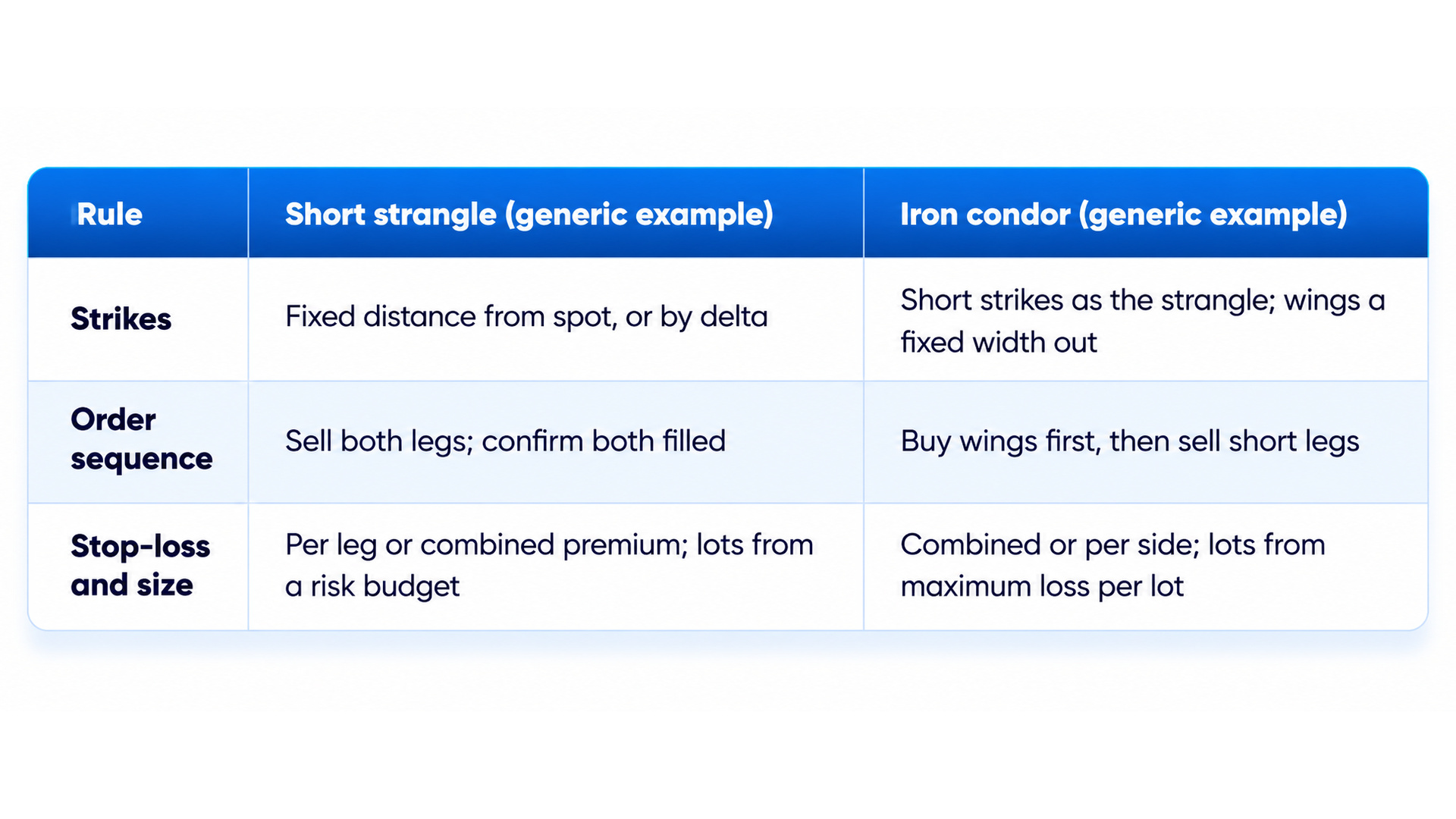
An algo turns the strategy into fixed rules for entry, strikes, sizing, exit and failure handling. The rules matter more than the name.
A combined stop-loss example, hypothetical: you sell the straddle for 290 points and exit if the combined premium rises 50%, to 435. The loss is 145 points, or ₹9,425 per lot. This is a rule, not a cap, and a gap can fill worse. See White Box vs Black Box Algo Trading: SEBI Rules Explained
StrykeX's pricing page lists a Custom Strategy Builder and 30+ pre-built algo strategies (read on 3 Oct 2026). For platform criteria, see choosing an algo platform for options selling. Pairing a range-bound algo with a trend-following one is covered in Algofolios explained.
What do SEBI's loss studies say, and what do they not say?
SEBI's studies show most individual F&O traders lose money, but they do not test these strategies.
The FY25 study found 91% of individual F&O traders had net losses, about ₹1,05,603 crore in total (reported by Business Standard, 7 Jul 2025). The FY26 study, published 20 Aug 2026, found 87.7%, about ₹91,685 crore (reported by ETV Bharat). StrykeX's help centre says option selling can lose more than you invest and advises stop-losses (checked on 3 Oct 2026).
Related articles
• Algo Trading Accuracy Percentage: Why It Misleads
• White Box vs Black Box Algo Trading: SEBI Rules Explained
• uTrade Algos vs Stratzy vs StrykeX: 2026 Comparison
• Best Algo Trading Platform for Options Selling in India (2026): Checklist and Where StrykeX Fits
Frequently asked questions
What is a non-directional option strategy?
It is an options structure whose result depends on how far the market moves, not which way. Short versions earn in a range-bound market. Long versions need a large move.
What is the difference between a straddle and a strangle?
A straddle uses one at-the-money strike for call and put. A strangle uses two out-of-the-money strikes. In our hypothetical set-up the short straddle collects 290 points and the short strangle 135, but the strangle has the wider profit zone.
What is the difference between an iron condor and an iron butterfly?
Both add bought options as protection. An iron condor has a wider profit zone and smaller credit. An iron butterfly sells at the centre strike, collects more and profits only near it.
Which option strategies have a limited maximum loss?
Long straddles and strangles lose at most the premium paid. Iron condors and butterflies lose at most the wing width minus the credit. Short straddles and strangles have no cap.
Can non-directional option strategies be automated?
Yes. An algo needs fixed rules for entry time, strikes, order sequence, stop-loss, exit and partial fills. Test them before using real capital.
StrykeX — By Stockwiz Technologies