Gaudium IVF
Gaudium IVF: India’s First Listed IVF Chain — Business, Moat & Analysis (2026)
India’s only listed IVF player. Its hub-and-spoke model, AI-led moat, ~48% IVF EBITDA margins, financials, the huge under-penetrated TAM, risks and valuation — explained.
Gaudium IVF: India’s First Listed IVF Chain — The Business, the Moat & the Story
Gaudium IVF is India’s first and only listed IVF (in-vitro fertilisation) chain. It runs a clinician-led, asset-light, hub-and-spoke model with very high margins (its core IVF business runs ~48% EBITDA), a net-cash balance sheet, and an AI-led clinical edge in sperm and embryo selection. It sits in a hugely under-penetrated market — tens of millions of infertile couples in India, with under 2% of addressable demand currently treated. This is an educational breakdown of the business, the thesis, and the risks — not a buy recommendation.
Every so often a genuinely one-of-a-kind business lists on the market. Gaudium IVF is one of those — it is India’s only listed pure-play IVF company, which makes it the sole way to own the fertility-care theme on the exchange. In this analysis, based on a detailed video breakdown you can watch above, we unpack what the business does, why its model is so profitable, the moat it is building with AI, the enormous market it is chasing, and — just as importantly — the risks a new listing like this carries.
A note up front: everything here is educational, drawn from a third-party video analysis and public data. It is not investment advice or a recommendation to buy or sell. You can verify the live financials any time on Screener or the NSE quote page.
AI in IVF — India's only listed IVF stock explained, full video analysis on YouTube
What Is Gaudium IVF?
Gaudium IVF is a clinician-led fertility and IVF chain. The roots go back to a single Delhi (Janakpuri) centre in 2009, founded by Dr. Manika Khanna and Dr. Piyush Khanna — both doctors and the company’s promoters — with the current entity incorporated in 2015. What makes it stand out is not just that it does IVF, but how it is structured.
The company runs a hub-and-spoke network: full-service “hubs” act as the main centres that support a wider set of smaller “spoke” branches. This design makes expansion far easier and cheaper — a single hub can support several spokes — which is exactly why the company has adopted it. Crucially, its clinical outcomes are held within roughly ±1% across centres, so a patient gets a consistent standard of care regardless of which branch they visit. That standardisation is unusual and valuable in specialty healthcare, where results often hinge on one specific star doctor.
In one line: A premium, asset-light, SOP-driven IVF chain — the kind of scalable, high-quality franchise the market tends to reward.
→ Want breakdowns like this before the crowd? Join our free research community here for our latest ideas and updates.
The AI Moat: A Genuine Differentiator
Gaudium describes itself as India’s first IVF chain to put AI embryology into routine practice — using AI tools for sperm selection and embryo ranking. Why does this matter? Because IVF is a success-driven business: the better the success rate, the more patients refer others, and the more the company can charge. The company reports a ~58% first-attempt success rate and ~85% cumulative success across attempts — high figures — and expects its AI rollout to lift first-attempt success by around 8%.
That is the real moat. In a field where word-of-mouth and referrals drive a huge chunk of business, a measurable edge in success rates compounds — and lets the company charge a premium rather than competing on price. This is not a commoditised service where a rival simply undercuts on cost; here, efficacy is everything.
How Gaudium Makes Money: The Revenue Mix
The revenue split tells you where the quality is:
- IVF treatment — ~64% of revenue, the core, highest-margin business, running around 48% EBITDA margins.
- Pharmacy — ~31% of revenue, run through a subsidiary at a lower ~9–10% EBITDA margin; important because patients naturally buy medication here.
- Hospital & ancillary — ~4% of revenue, including a 15-bed day-care/NICU post-natal setup in Janakpuri.
There’s also a rising international medical-tourism angle: India’s IVF cost can be a fraction of overseas prices, and Gaudium has planned international spokes (e.g. Nigeria, Sydney, Paris). Since fertility care is highly SOP-driven, an Indian clinic’s methods travel across borders more easily than many other treatments — a real advantage if executed. You can see the current segment detail in the company’s investor presentation and exchange filings.
Gaudium IVF: The Numbers at a Glance
Here is the financial picture as described in the video (round figures). Cross-check the live versions on Screener and Tickertape.
The standouts: genuinely high margins, a net-cash balance sheet, and a capital-light model where growth doesn’t require heavy capex (hubs are largely leased). The reported ROCE fell recently — but, as the video stresses, that is because the ~₹90 crore of IPO cash is still sitting idle in deposits, not yet deployed. Once it is put to work, returns should normalise back up. It’s a deployment issue, not a profitability one.
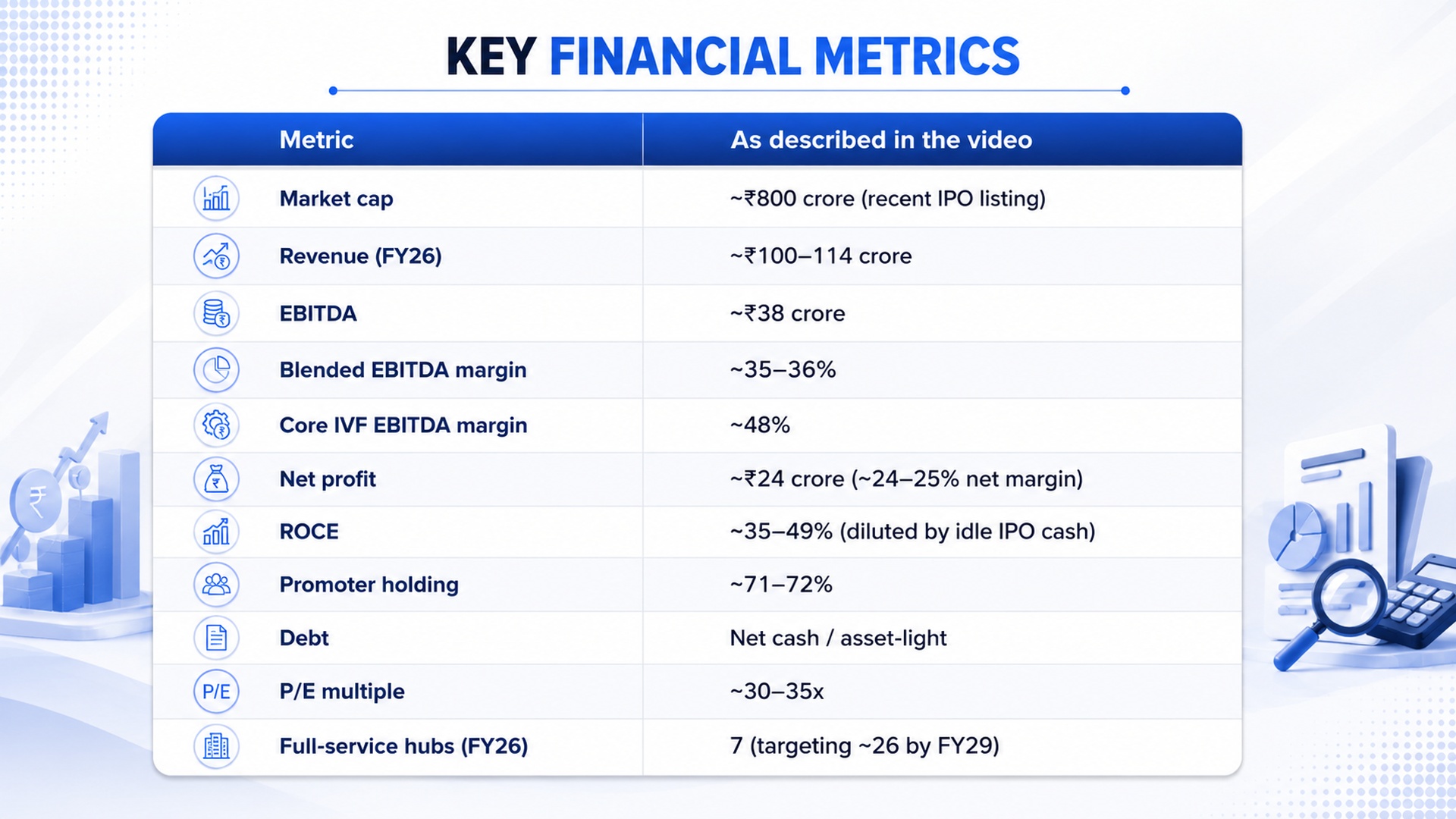
Gaudium IVF: The Numbers at a Glance
The Growth Story: An Enormous, Under-Penetrated Market
Here is what makes the runway so long. India has an estimated 27 million infertile couples, yet only around 0.3 million IVF cycles happen today — meaning the vast majority of need goes unmet. Under 2% of addressable demand is currently treated, and Gaudium itself holds well under 1% share. The gap, not market share, is the opportunity.
Several structural forces drive this demand: delayed parenthood and rising age at first child, lifestyle and health factors (PCOS, obesity, stress, and male infertility, which affects a large share of cases), falling fertility rates, and reduced stigma around IVF. On top of that, about 70% of the market is still unorganised and standalone — ripe for consolidation by an organised, AI-led player under India’s ART Act framework. The company is chasing an Indian IVF market projected to grow at a double-digit CAGR toward multi-billion-dollar scale.
The one-line thesis: A scarce, high-margin, AI-led consolidator in a massively under-penetrated fertility market — the only listed way to own the theme.
Growth Catalysts to Watch
- Hub rollout: scaling from 7 full-service hubs toward ~17 (FY27) and ~26 (FY29), each supporting multiple spokes, funded by the ~₹90 crore IPO proceeds.
- AI embryology at scale: the success-rate uplift compounding into pricing power and referrals.
- Tier-2/3 penetration: access today is concentrated in metros; smaller cities are wide open.
- Medical tourism: international spokes converting inbound demand at a large cost advantage.
- Financing tie-ups & cross-sell: patient-financing partnerships plus an end-to-end journey from fertility to post-natal care.
Management Quality: Said vs Delivered
The video rates management highly. Both promoters are award-winning, well-regarded doctors, and — importantly — clinical excellence here is the management edge, not separate from it. So far the company has delivered on its guidance: maintaining low debt-to-equity, protecting margins, hitting clinical success rates, and going live with AI embryology on schedule. The hub rollout is running a couple of months behind schedule (South Delhi in progress; Gurgaon and Nagpur in leasing), which the video frames as minor. The company has also been unusually candid about its one genuine soft spot — receivables — and the specific fixes it is putting in place. You can review the quarterly results and commentary via the company’s exchange filings.
The Risks You Have to Respect
- Lumpy quarters & receivables: revenue is recognised at embryo transfer and patients often pay in instalments, so quarters are genuinely lumpy and trade receivables (debtor days) have been rising. This is the model’s main soft spot — the company is tightening it, but watch it.
- Execution risk on hubs: the ambitious ~19-hub expansion plan is unproven at scale, and rollout is slightly behind schedule.
- Short public track record: this is effectively the first full year as a listed company, so governance and guidance have limited history to be judged on.
- Key-person / concentration risk: a promoter-led, clinician-driven business carries key-person risk (the promoters are a married couple, which cuts both ways).
- Thin liquidity: a micro-cap currently in a trade-to-trade (T2T) series, so the stock can be illiquid and hit circuit limits.
- Competition: large chains like Indira IVF and other growing players compete for the same demand.
Valuation: Why It Looks Cheap for the Quality
Gaudium trades at roughly 30–35x earnings — which the video argues is inexpensive relative to comparable asset-light, high-ROCE healthcare names (maternity/diagnostics leaders often trade at 50–80x+). The reason for the discount: the market is currently treating Gaudium as a tiny, unproven new listing rather than a high-margin platform, and the receivables/execution risks are exactly why that mispricing persists.
The video creator lays out a scenario range — a bear case (~20–27% downside if execution and receivables disappoint and the multiple de-rates), a base case (~40% upside if guidance is met), and a bull case (the stock could double or more if forward guidance is beaten and earnings re-rate) — and describes the setup as a possible long-term multibagger. We are presenting all of that as the creator’s opinion, not our recommendation or a forecast. Any price target is a view, not a promise, and the stock could fall if the risks above play out. Always check current multiples on Screener before drawing conclusions.
What to Watch Next Quarter
- Receivables and collections — whether debtor days start improving
- Hub openings in South Delhi, Gurgaon, and Nagpur
- OPU/patient volume growth and the AI uplift to first-attempt success
- Deployment of the ~₹90 crore IPO cash into high-margin expansion
- Updates on international spokes and medical-tourism traction
The Bottom Line
Stripped to its essence, Gaudium IVF is a scarce, high-quality, net-cash asset-light business with genuinely high margins, a real AI-led moat, and a front-row seat to one of India’s most under-penetrated healthcare markets — currently priced modestly because it is a young listing carrying receivables and execution question marks. The bull case rests on the hub rollout and AI edge executing; the bear case rests on receivables, lumpy cash conversion, and a short track record. That is the debate, laid out honestly.
Whether it fits your portfolio depends on your goals, risk tolerance, and your own research — not a YouTube video or a blog. Use this as a starting point to understand the business, then verify the numbers on Screener and the exchange filings, weigh the risks, and decide for yourself.
Verify the Data (External Sources)
For transparency, here are the public sources where you can check everything discussed above:
- Gaudium IVF on Screener — financials, ratios, shareholding, peer comparison
- NSE quote page — live price and exchange data
- BSE India — official exchange listing and announcements
- BSE corporate announcements & filings — results, investor presentations, disclosures
- Tickertape — fundamentals and analytics
Get Research Like This
Found this useful? Get premium stock recommendations and deep-dive analysis like this — subscribe to our research services, curated by a SEBI-registered Research Analyst. Or start free by joining our research community.
Related Articles
Frequently asked questions
What does Gaudium IVF do?
Gaudium IVF is India’s first and only listed pure-play IVF (in-vitro fertilisation) chain. It runs a clinician-led, asset-light, hub-and-spoke network offering AI-assisted fertility treatment, plus pharmacy and ancillary hospital services.
Why is Gaudium IVF considered unique?
It is the only listed pure-play IVF company in India, giving investors the sole listed way to own the fertility-care theme. It also pioneered AI embryology in routine practice and runs a high-margin, standardised, scalable model.
What is Gaudium IVF’s moat?
Its AI-led clinical edge (sperm and embryo selection), high standardised success rates, strong referrals/word-of-mouth, and a scalable SOP-driven hub-and-spoke model. High entry barriers — skilled embryologists, capital, brand trust — protect it.
Is Gaudium IVF a good investment?
This article is educational and does not make recommendations. The business has high margins, a net-cash balance sheet, a real moat, and a huge under-penetrated market — but also real risks like receivables, execution, and a short public track record. Check live data on Screener and consult a SEBI-registered investment adviser before deciding.
How big is India’s IVF market?
The video cites roughly 27 million infertile couples in India against only ~0.3 million cycles today — under 2% penetration of addressable demand — with the market projected to grow at a double-digit CAGR toward multi-billion-dollar scale. The gap is the opportunity.
Where can I check Gaudium IVF’s share price and financials?
You can view the live share price, financials, and shareholding on Screener, the NSE quote page, and Tickertape.
StrykeX — By Stockwiz Technologies