Ddev Plastiks Industries
Ddev Plastiks Industries: The Quiet Electrification Play Explained
Ddev Plastiks Industries analysis: India’s largest listed polymer compound maker — business model, electrification thesis, XLPE moat, financials, the BESS opportunity, risks and valuation. Educational deep-dive with video.
Ddev Plastiks Industries: The Quiet Electrification Play Explained
Ddev Plastiks Industries is India’s largest listed maker of specialty polymer compounds — the value-added materials that go into wires, cables, and high-voltage power lines. It supplies nearly every major Indian cable maker, holds a moat built on multi-year customer qualifications, is net debt-free with a ~30% ROCE, and is now expanding into higher-margin XLPE compounds and a new Battery Energy Storage Systems (BESS) vertical. It is essentially an indirect proxy on India’s multi-decade electrification and energy-transition theme. This is an educational breakdown of the business, the thesis, and the risks — not a buy recommendation.
Some of the most interesting stock stories hide in plain sight — unglamorous businesses quietly supplying the picks and shovels for a much bigger boom. Ddev Plastiks Industries is a textbook example: you have almost certainly used products built with its materials without ever hearing its name. In this analysis, based on a detailed video breakdown you can watch above, we unpack what the business does, why it sits at the heart of India’s electrification wave, what the numbers say, and — just as importantly — what could go wrong.
A quick note up front: everything here is educational, drawn from a third-party video analysis and public data. It is not investment advice or a recommendation to buy or sell. You can verify the live financials any time on Screener or the NSE quote page.
Ddev Plastiks Industries: Watch the Full Detailed Video on YouTube
What Does Ddev Plastiks Industries Actually Do?
Ddev Plastiks Industries is India’s largest listed polymer compound maker. That sounds dry, so let’s make it concrete. It does not make ordinary PVC pipes or commodity plastic. Instead, it takes raw materials — PVC, polyethylene, chemicals — and converts them into high-performance, value-added compounds that cable and wire manufacturers then use to make their finished products.
Think of it as a critical supplier one step up the chain from raw plastic. A cable company cannot simply buy PVC and start making fire-safe, high-voltage cables — it needs a specially formulated compound that meets strict safety and performance standards. That compound is what Ddev makes, and it supplies it to essentially every major Indian wire and cable player — the big listed names in the sector.
Its product portfolio spans five or six categories, each tied to a growth theme:
• XLPE (cross-linked polyethylene) compounds — used in high-voltage power cables. A high-margin core, branded under names like Saplas.
• HFFR (halogen-free flame-retardant) compounds — for fire-safe cables, riding India’s tightening fire-safety norms.
• PVC compounds — the more commoditised, lower-margin base business.
• PE compounds — for packaging and industrial applications.
• Specialty compounds and masterbatches — colour and additive compounds.
You can see the current segment mix and product details in the company’s own investor presentation and filings on the BSE.
The Electrification Thesis: Why This Business Matters Now
Here is the big-picture reason the story is interesting. India is in the middle of a structural electrification shift — and Ddev sits underneath almost all of it. Power grids, transmission lines, data centres, EV charging infrastructure, 5G rollout, renewable energy: every one of these needs wires and cables, and those cables need Ddev’s compounds.
In other words, it is an indirect proxy play on India’s long-term electrification cycle. Rather than betting on a single EV maker or one power company, you get exposure to the entire theme through the supplier that feeds them all. The customer list reads like a who’s who of Indian cables — the big listed wire and cable names all buy from it. For context on the sector’s scale, the regulated exchanges NSE and BSE list the major cable peers whose demand ultimately drives Ddev’s order book.
The one-line thesis: A specialty-materials business making critical polymers for long-duration themes — electrification, power infrastructure, renewable energy, and battery storage.
→ Want breakdowns like this before the crowd? Join our free research community here for our latest ideas and updates.
The Moat: Why Competitors Can’t Just Walk In
A great business needs a durable advantage, and Ddev has a genuine moat rooted in customer stickiness. When a cable company gets its product approved, that approval is tied to the specific compound it used. Switching to a different compound supplier means redoing the entire, expensive qualification process — something no cable maker wants to risk mid-production.
On top of that, the higher the voltage, the tougher the qualification. Making cable-grade compounds for high-voltage lines requires multi-year qualifications that are extremely hard to clear. Ddev is reportedly the only Indian player offering a range from 66 kV up to 132 kV, and is now working toward 220 kV. That combination — sticky approvals plus hard-won qualifications — is the real entry barrier, and it is why the video describes replacing this supplier as “next to impossible.”
Ddev Plastiks: The Numbers at a Glance
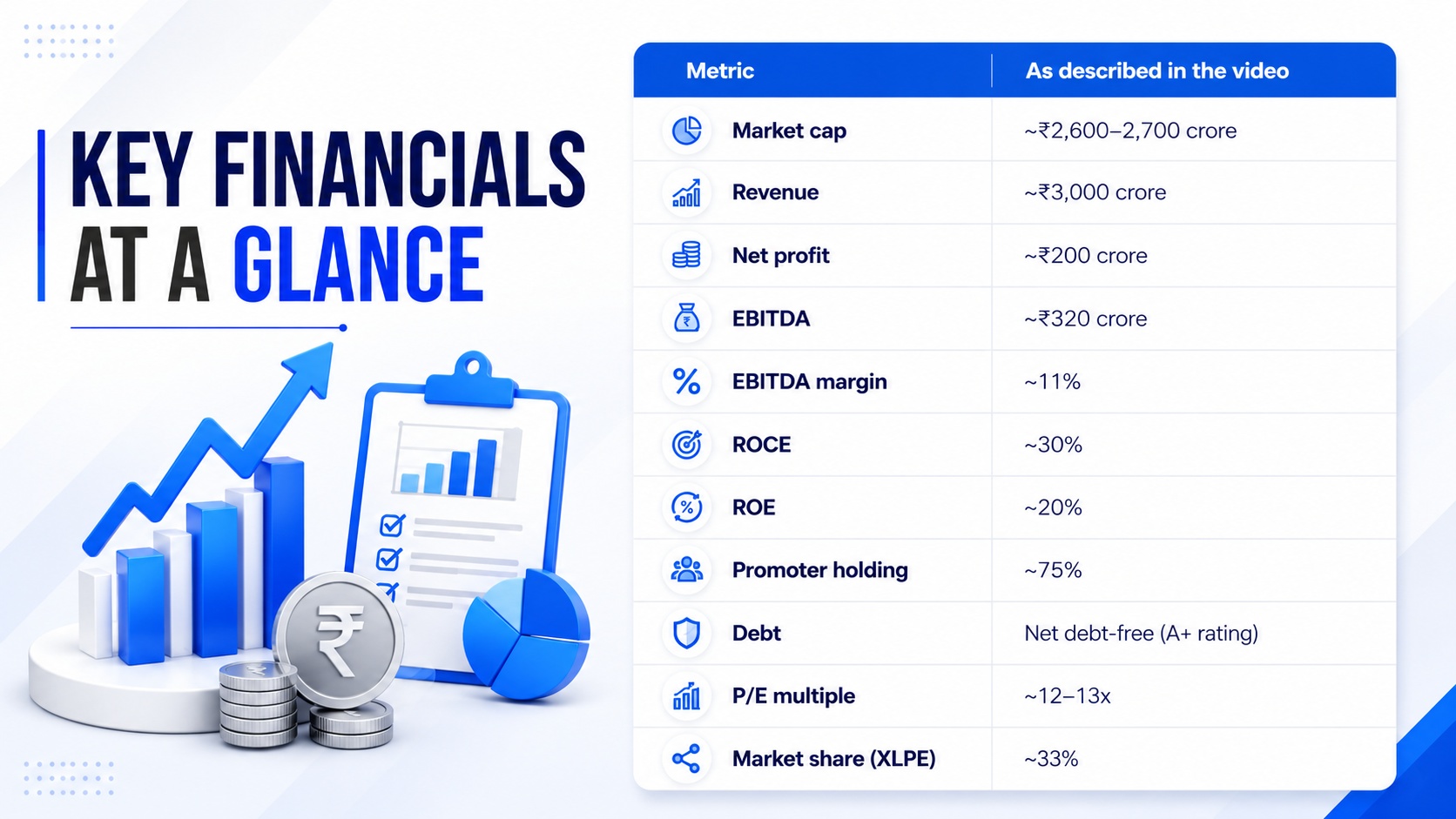
Here is the financial picture as described in the video (round figures). You can cross-check the live, up-to-date versions of every one of these on Screener and Tickertape.
The standouts: a ~30% ROCE and ~20% ROE are top-quartile for a polymer compounder, the balance sheet is net debt-free, and the company funds its expansion from internal accruals rather than debt. The main soft spot is the ~11% EBITDA margin — a function of the lower-margin PVC-heavy mix — which is exactly what management is trying to shift.
Ddev Plastiks: The Numbers at a Glance
The Growth Levers: Where It Goes From Here
Ddev’s next chapter is a deliberate move up the value curve. Two catalysts are running in parallel:
- Premiumisation — moving up the voltage ladder
The company is intentionally shifting from commodity PVC toward higher-margin XLPE (high-voltage), HFFR (fire safety), and specialty compounds. It has doubled HFFR capacity, added XLPE capacity via a new Rajasthan greenfield project, and is targeting a move from 132 kV to 220 kV cable-grade compounds by 2030 — with HVDC products of the future beyond that. Higher voltage means fewer rivals and better margins.
- BESS — the new battery energy storage vertical
The bigger, more speculative bet is entry into Battery Energy Storage Systems. Ddev has planned around 5 GW of assembly capacity with a ₹150–200 crore investment, expects initial revenue in the second half of FY27, and sees it scaling meaningfully by FY30. Early margins will be thin (5–8%), since components are initially China-sourced, and — crucially — no orders have been booked yet. This is the option value in the story, not a proven business.
The honest caveat: BESS is genuine optionality, not a certainty. Until real orders arrive, the video itself treats BESS revenue and margins as “optionality” — upside if it executes, but unproven today. This execution risk is a core part of the story.
Management Quality: Said vs Delivered
One of the strongest points the video makes is on management credibility. Across the last several quarters, Ddev committed to targets — 13–14% revenue growth, ~11% EBITDA margin, capacity additions, and a debt-free funding model — and largely delivered on all of them, despite raw-material volatility and export-transit disruption from geopolitical conflict. The one genuine shortfall (volume growth landing near 7% vs a ~10% target) was a war-driven external shock, not a planning miss. You can review the quarterly results and management commentary yourself via the company’s exchange filings on BSE.
The Risks You Have to Respect
No analysis is honest without the risks laid out plainly. The video flags several:
• Raw-material volatility: PVC and PE prices swing with petrochemical/oil cycles, and if Ddev can’t pass costs through, margins compress.
- Customer concentration: if the wire and cable industry slows, so does demand for compounds.
• BESS execution risk: the new vertical is unproven, China-dependent early on, and has no orders yet.
• Competition: large global polymer compound players could enter, though customer stickiness is a defence.
• Thin liquidity: high (~75%) promoter holding and low institutional ownership mean the stock can be less liquid — you can check the latest shareholding pattern on Screener.
Valuation: Why the Discount, and What Could Close It
Ddev trades at roughly 12–13x earnings — cheaper than some peers (the video notes a peer at ~26x). The discount exists because a chunk of the mix is still commodity PVC, margins swing with feedstock, the float is thin, and BESS is unproven. In the video creator’s framing, the market is currently pricing it like a “steady compounder” rather than a re-rating candidate.
The video creator argues the re-rating gap could close if working capital normalises, ROCE stays around 30%, the product mix shifts toward higher-margin lines, and BESS gets any validation — and lays out an optimistic price target implying a large upside. We are presenting that as the creator’s opinion, not as our recommendation or a forecast. Any price target is a view, not a promise, and the stock could equally fall if the risks above play out. Always check the current valuation multiples on Screener before drawing conclusions.
What to Watch Next
If you are tracking this story, the video suggests these signposts for upcoming quarters:
- BESS order wins and MoUs — the single biggest swing factor
- Rajasthan XLPE greenfield utilisation ramp-up
- Commercialisation progress from 132 kV toward 220 kV
- HFFR capacity utilisation climbing toward 80–90%
- Working-capital normalisation and margin recovery as raw-material prices settle
The Bottom Line
Stripped to its essence, Ddev Plastiks Industries is a high-quality, net debt-free specialty-materials business with a genuine moat, top-quartile returns, and a front-row seat to India’s electrification and energy-transition megatrend — currently trading at a modest multiple because the market still views it as a commodity compounder. The bull case rests on premiumisation and the BESS optionality executing; the bear case rests on raw-material swings and BESS disappointing. That is the debate, laid out honestly.
Whether it fits your portfolio depends on your goals, risk tolerance, and your own research — not a YouTube video or a blog. Use this as a starting point to understand the business, then verify the numbers on Screener and the exchange filings, weigh the risks, and decide for yourself.
Verify the Data (External Sources)
For transparency, here are the public sources where you can check everything discussed above:
- Ddev Plastiks on Screener — financials, ratios, shareholding, peer comparison
- NSE quote page (DDEVPLSTIK) — live price and exchange data
- BSE India — official exchange listing and announcements
- BSE corporate announcements & filings — results, investor presentations, disclosures
- Tickertape — fundamentals and analytics
Get Research Like This
Found this useful? Get premium stock recommendations and deep-dive analysis like this — subscribe to our research services, curated by a SEBI-registered Research Analyst. Or start free by joining our research community.
Related Articles
Frequently asked questions
What does Ddev Plastiks Industries do?
Ddev Plastiks Industries is India’s largest listed polymer compound maker. It converts raw materials like PVC and polyethylene into high-performance, value-added compounds used by wire and cable manufacturers — for example XLPE for high-voltage cables and HFFR for fire-safe cables.
Why is Ddev Plastiks called an electrification play?
Because its compounds go into the wires and cables needed for power grids, transmission, data centres, EV charging, and renewables. It is an indirect proxy on India’s long-term electrification and energy-transition theme.
What is Ddev Plastiks’ moat?
Customer stickiness and hard qualifications. Once a cable maker’s product is approved with a specific compound, switching suppliers means redoing an expensive multi-year qualification — which few will risk. Higher-voltage compounds are especially hard to qualify.
What is BESS and why does it matter for Ddev?
BESS stands for Battery Energy Storage Systems. Ddev is entering this fast-growing vertical, which could become a major growth driver — but it is unproven, China-dependent early on, and has no orders yet, so it is best viewed as optionality.
Is Ddev Plastiks Industries a good investment?
This article is educational and does not make recommendations. The business has strong returns, a moat, and structural tailwinds, but also real risks — raw-material volatility, customer concentration, and BESS execution. Check the live data on Screener and consult a SEBI-registered investment adviser before deciding.
Where can I check Ddev Plastiks’ share price and financials?
You can view the live share price, financials, and shareholding on Screener, the NSE quote page, and Tickertape.
StrykeX — By Stockwiz Technologies