Algo Trading Scams in India
Algo Trading Scams in India: How to Spot and Avoid Them (2026)
Learn how to spot and avoid algo trading scams in India. Red flags, common scam types, how to verify SEBI registration, and a step-by-step checklist to protect your capital. Honest 2026 safety guide.

Algo Trading Scams in India: How to Spot and Avoid Them
Most algo trading scams in India share the same red flags: they promise guaranteed or “assured” returns, ask you to deposit money into their own account, operate anonymously without a verifiable SEBI registration, and pressure you to act fast. You can avoid them by following three rules — verify the operator’s SEBI registration on the official SEBI website, make sure your funds stay in your own broker account, and treat any promise of guaranteed profit as an automatic warning sign. A legitimate platform never guarantees returns and never holds your money.
Algo trading has exploded in popularity among Indian retail traders — and wherever money and excitement gather, scammers follow. For every genuine, regulated platform, there are opportunists selling “guaranteed profit” bots, fake “SEBI registered” claims, and Telegram groups promising to double your money by Friday. The good news? Almost all of these scams follow predictable patterns, and once you know the patterns, they become surprisingly easy to spot.
This guide is written to protect you, not to sell you anything. We will walk through the most common algo trading scams in India, the exact red flags to watch for, how to verify whether a platform is genuinely regulated, and a simple checklist you can run before trusting anyone with your capital. By the end, you will be able to separate a legitimate operator from a well-dressed scam in a couple of minutes.
Why Algo Trading Scams Are So Common in India
Understanding why these scams work is the first step to becoming immune to them. Three things make algo trading fertile ground for fraud:
- It sounds sophisticated. “Algorithm” and “AI trading” sound advanced and mysterious, which scammers exploit to seem credible.
- It promises passivity. The dream of “set it and forget it” profit is exactly what fraudsters dangle.
- Verification feels hard. Many new traders do not know how to check a SEBI registration, so fake claims go unchallenged.
The result is a market where a slick website and a few screenshots can part honest people from their savings. This article fixes the third problem — verification — which is the one that defeats almost every scam.
Common Types of Algo Trading Scams
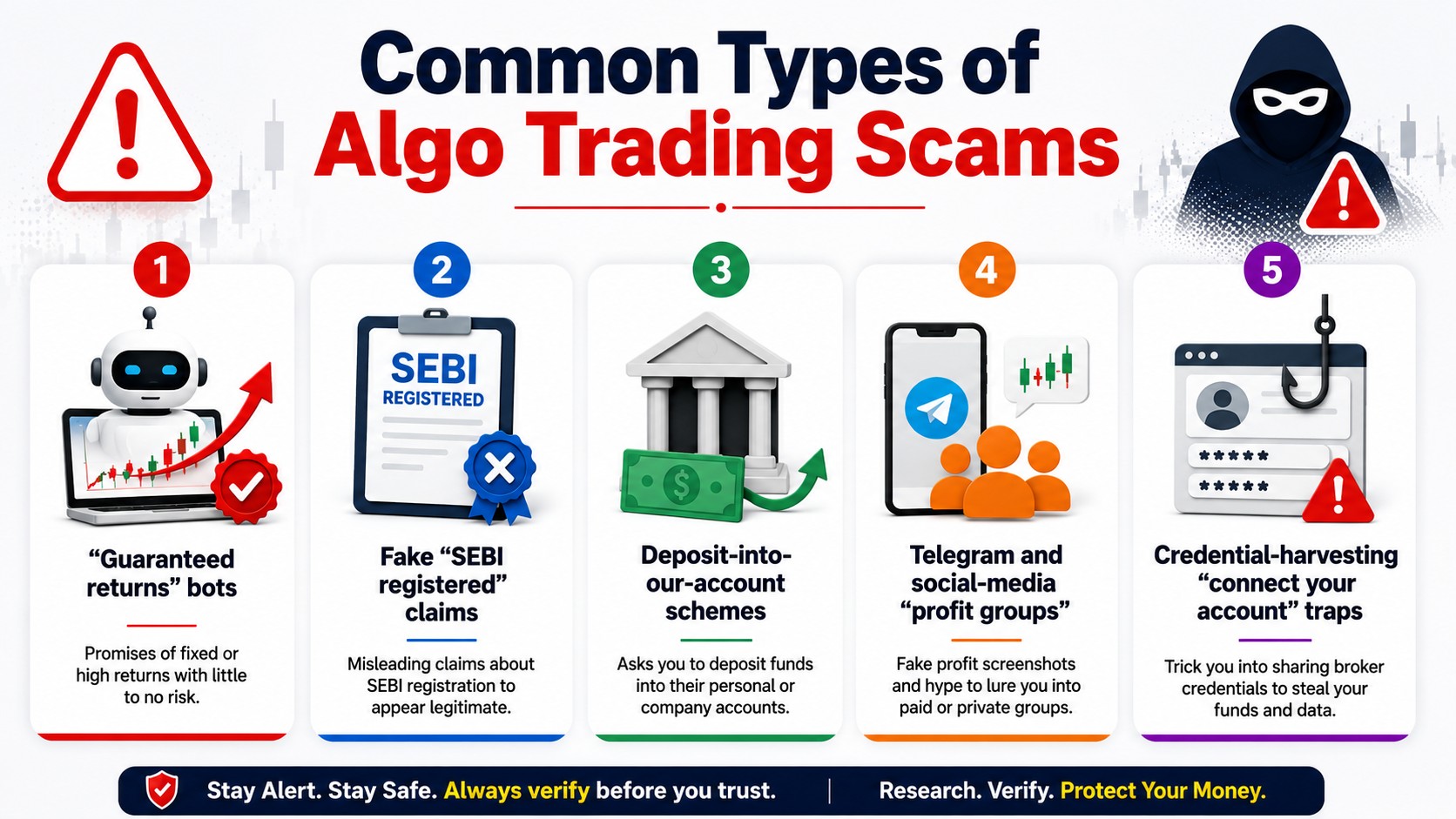
1. “Guaranteed returns” bots
The classic. A platform or “trading bot” promises fixed daily, weekly, or monthly returns — “2% a day, guaranteed.” No legitimate trading product can guarantee returns, because all trading carries market risk. A guarantee is not a feature; it is the single clearest sign of a scam.
2. Fake “SEBI registered” claims
Scammers slap “SEBI registered” or a logo on a website without any verifiable registration number — or they quote a number that does not check out. SEBI registers entities (like Research Analysts), not “software,” so a vague claim with no verifiable number and category is a red flag.
3. Deposit-into-our-account schemes
The platform asks you to transfer funds into their wallet or account so they can “trade on your behalf.” This is how most financial fraud actually steals money. A legitimate algo platform never takes custody of your funds — your money stays in your own regulated broker account.
4. Telegram and social-media “profit groups”
Groups showing endless winning screenshots, urging you to join a “VIP” bot or pay for “guaranteed” signals. Screenshots are trivially faked, and urgency (“only 10 spots left!”) is a manipulation tactic, not a business model.
5. Credential-harvesting “connect your account” traps
A fake platform asks for your broker login and password directly. Legitimate platforms connect only through secure, authorised broker APIs — never by collecting your actual password. If someone asks for your password or OTP, walk away.
Red Flags: The Scam Checklist
If a platform ticks any of these boxes, treat it as a serious warning. If it ticks several, run.
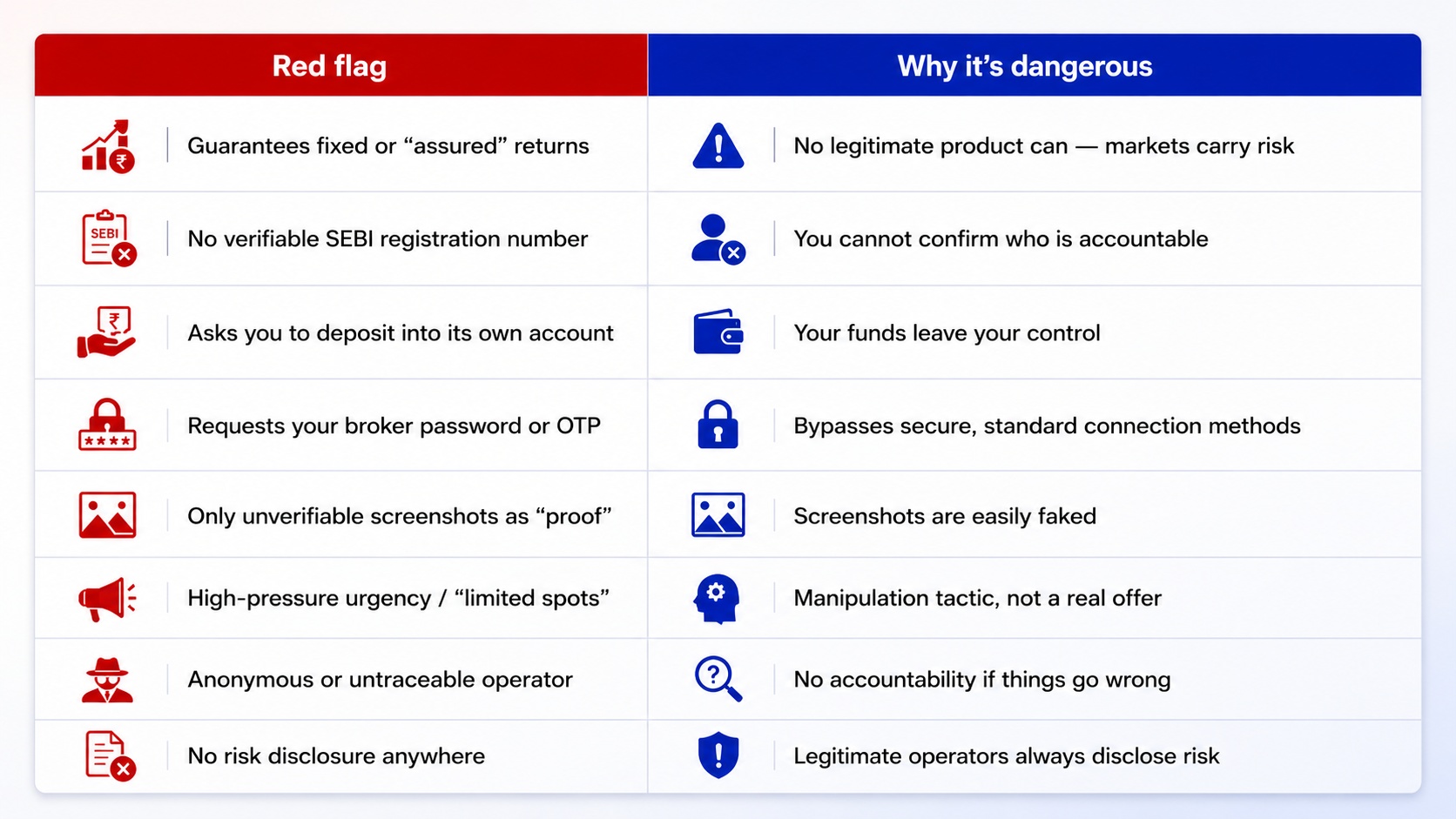
The Scam Checklist
How to Verify a “SEBI Registered” Claim (Step-by-Step)
This is the single most powerful skill for avoiding scams — and it takes about two minutes. “SEBI registered” means nothing unless you can verify it, so here is exactly how.
- Find the registration number. A genuine operator will state its category (e.g. Research Analyst) and a registration number like INHxxxxxxxxx. No number = red flag.
- Check it on the SEBI website. Search the number on the official SEBI intermediary register. If it does not appear, or the details do not match, do not proceed.
- Verify the legal entity. Confirm the company name and, for an LLP, its LLPIN on the MCA registry.
- Confirm fund custody. Check that your money stays in your own broker account and is never transferred to the platform.
- Confirm the connection method. It should connect via a secure broker API, not by asking for your password.
Remember: SEBI registers entities, not software. A platform claiming to be “SEBI approved” as software is misusing the term — what you want is a platform operated by a SEBI-registered entity with a verifiable number.
What a Legitimate Algo Trading Platform Looks Like
It helps to know the positive signals too — what “good” actually looks like. A trustworthy algo trading platform will:
- Be operated by a SEBI-registered, identifiable Indian entity with a verifiable registration number.
- Never take custody of your funds — your money stays in your own broker account.
- Connect via secure broker APIs, not by collecting your password.
- Disclose risk honestly and make no guaranteed-return claims.
- Show verified performance (e.g. broker-side P&L) rather than only self-reported screenshots.
StrykeX is one example of a platform built this way: it is operated by Stockwiz Technologies LLP, a SEBI-registered Research Analyst (INH000013925); it never holds your funds; and it connects to your own broker account via secure API. We explain exactly how these safeguards work in our is StrykeX safe and is StrykeX legit or a scam guides — which also double as templates for evaluating any platform, not just ours.
What to Do If You Suspect a Scam
- Stop all payments immediately and do not send any more money or share further details.
- Revoke access — if you connected a broker API, revoke it; if you shared credentials, change your password and enable two-factor authentication.
- Document everything — screenshots, messages, transaction records.
- Report it — you can raise complaints through SEBI’s SCORES platform and, for financial fraud, the national cybercrime channels.
- Warn others — a genuine review or report can protect the next person.
Conclusion: Protect Your Capital With a Two-Minute Check
Algo trading scams in India thrive on one thing: people not knowing how to verify claims. Now you do. The next time a platform, bot, or Telegram group promises effortless, guaranteed profit, you can run through the checklist — verify the SEBI registration, confirm your funds stay in your own account, and treat any guarantee as a warning — and protect yourself in the time it takes to make a cup of tea.
Legitimate algo trading is real, useful, and regulated. So is the opportunity to lose everything to a scam that looks the part. The difference is almost always visible in the red flags above. Stay sceptical of guarantees, verify before you trust, keep your money in your own account, and you will sidestep the vast majority of fraud out there.
Related Articles
• Is StrykeX Legit or a Scam? Honest 2026 Verdict
• Is StrykeX Safe? Fund Protection & Security Explained
• What Is Algo Trading? Meaning, How It Works, Strategies & Rules
• Can You Do Algo Trading Without Coding? (Yes — Here’s How)
• Futures vs Options: Key Differences Every Indian Trader Should Know
Frequently asked questions
How do I know if an algo trading platform is a scam?
Check for the classic red flags: guaranteed returns, no verifiable SEBI registration number, requests to deposit money into their account, or requests for your broker password. A legitimate platform never guarantees profit and never holds your funds.
How do I verify if a platform is SEBI registered?
Find the operator’s registration number and category, then search it on the official SEBI intermediary register. If the number does not appear or the details do not match, treat the claim as false.
Can algo trading platforms guarantee profits?
No. No legitimate trading platform or bot can guarantee profits, because all trading carries market risk. Any guarantee of fixed or “assured” returns is a clear scam signal.
Should I give a platform my broker password?
Never. Legitimate platforms connect through secure, authorised broker APIs — not by collecting your login password or OTP. A request for your password or OTP is a major red flag.
Do safe algo platforms hold my money?
No. Safe platforms never take custody of your funds — your money stays in your own regulated broker account and the platform only sends order instructions. See is StrykeX safe for how this works.
Is algo trading itself a scam?
No. Algo trading is a legitimate, SEBI-regulated activity in India. The scams are fraudulent operators exploiting the concept — not the concept itself. Learn the basics in what is algo trading.
Where can I report an algo trading scam in India?
You can raise complaints through SEBI’s SCORES platform for market-related issues, and report financial fraud through the national cybercrime reporting channels. Document everything before reporting.
StrykeX — By Stockwiz Technologies