Market Updates
Will SEBI's Rules Ban Retail Algo Trading? (The Short Answer: No)
Let's deal with the fear first, because it's the reason most people land on this page. No, SEBI has not banned retail algorithmic trading. It's legal. It was legal before April 2026, and it's legal after. If someone told you otherwise — or if a panicky forum post made you think your strategies were about to become contraband — you can relax on that point. What SEBI did was regulate how retail algo trading happens. Those are very different things, and the distinction is worth understanding properly rather than half-hearing it.
Will SEBI's Rules Ban Retail Algo Trading? (The Short Answer: No)
Let's deal with the fear first, because it's the reason most people land on this page.
No, SEBI has not banned retail algorithmic trading. It's legal. It was legal before April 2026, and it's legal after. If someone told you otherwise — or if a panicky forum post made you think your strategies were about to become contraband — you can relax on that point.
What SEBI did was regulate how retail algo trading happens. Those are very different things, and the distinction is worth understanding properly rather than half-hearing it.
Where the "ban" rumour comes from
Three things fed the confusion.
First, the rollout was messy. The framework was announced in February 2025, scheduled for August 2025, pushed to October, then phased out to a final deadline of 1 April 2026. Every delay generated a fresh wave of "what's happening to algo trading?" headlines, and headlines compress nuance into fear.
Second, some services genuinely did stop working. The untraceable third-party "algos" that ran on people's accounts without registration could no longer operate. To a user of one of those, it felt like a ban — but it was specific to non-compliant operators, not to automation itself.
Third, the language got stricter. Words like "barred" appeared in the rules — brokers who missed compliance milestones were barred from onboarding new API clients. Strip the context and "barred" sounds like a shutdown. In context, it was a deadline enforcement mechanism aimed at brokers, not traders.
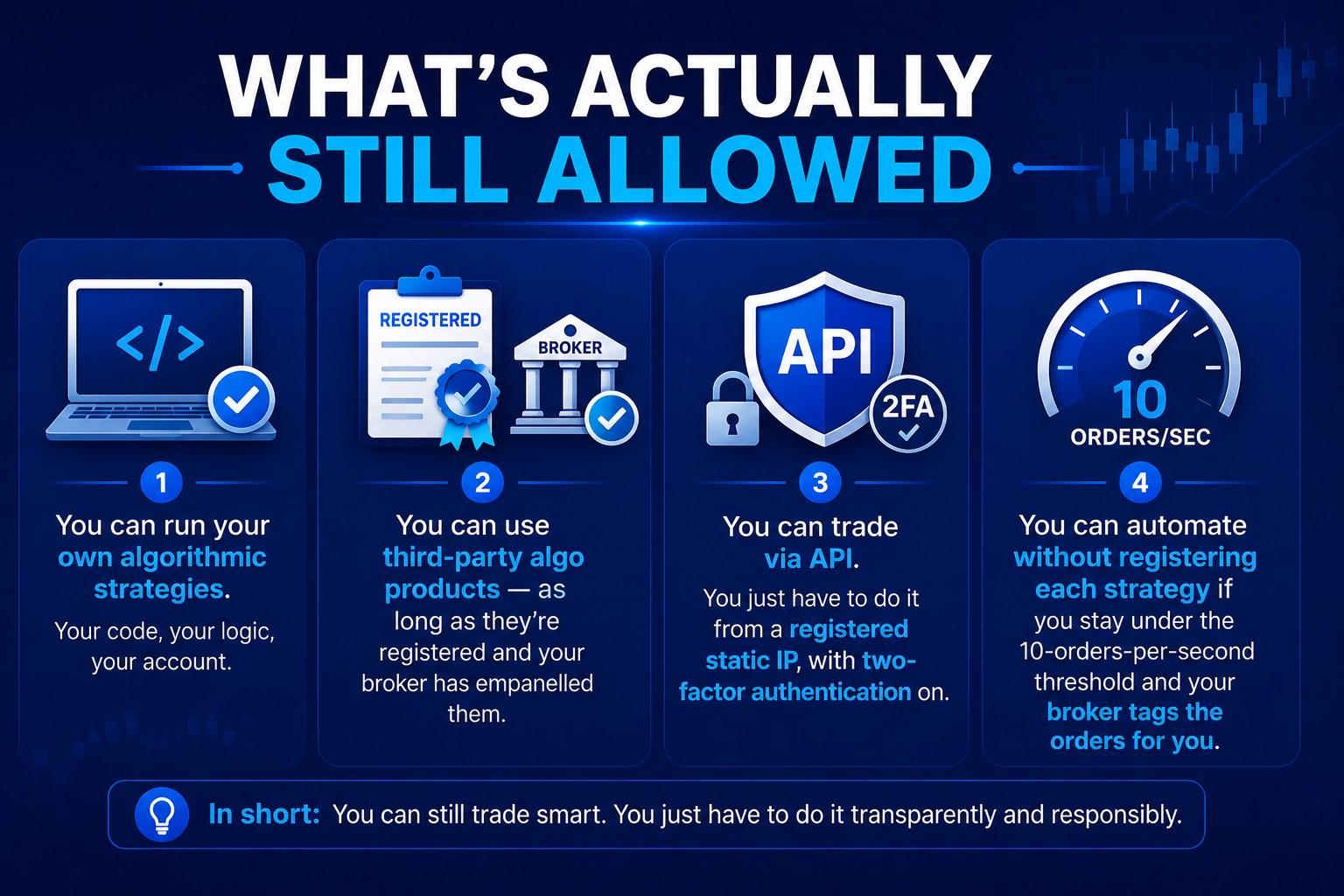
What's actually still allowed
Plenty. Specifically:
- You can run your own algorithmic strategies. Your code, your logic, your account.
- You can use third-party algo products — as long as they're registered and your broker has empanelled them.
- You can trade via API. You just have to do it from a registered static IP, with two-factor authentication on.
- You can automate without registering each strategy if you stay under the 10-orders-per-second threshold and your broker tags the orders for you.
In other words, the same activities you could do before are still on the table. The framework added guardrails; it didn't remove the road.
What's genuinely off the table now
To be balanced, here's what you can't do anymore:
- Run a strategy that has no Algo-ID and isn't registered. Untagged automated orders can't legally hit the exchanges.
- Use an algo provider that hasn't empanelled with the exchanges and passed your broker's due diligence.
- Connect to the API from random, changing IP addresses.
- Operate an anonymous "trade your account for you" service with no accountability — that business model is effectively dead.
Notice the pattern: everything on this list is about anonymity and accountability, not about automation per se.
Why a registered trader should actually welcome this
Here's the counterintuitive part. The reform is genuinely protective. Before it, nothing stopped an operator from advertising 40% monthly returns, running trades on client money with zero traceability, and disappearing when the strategy imploded. SEBI's own data on retail F&O losses — more than 90% of individual traders losing money — is the backdrop the whole framework was written against.
A regulated environment doesn't help the scammers. It helps the honest participants by making the dishonest ones easy to identify. If you're trading cleanly, the new rules quietly work in your favour.
So what should you do?
If you trade algos, three checks settle the matter:
- Is your broker compliant with the framework? If they're still onboarding API clients, they are.
- Is any third-party tool you use registered and exchange-empanelled?
- Is your API access set up with a static IP and 2FA?
Tick those and you're trading inside the framework, fully legally. Our SEBI compliance checklist is-your-algo-setup-sebi-compliant-checklist turns this into a proper line-by-line audit, and the complete guide to the 2026 rules explains the reasoning behind each provision.
The headline you should walk away with isn't "algo trading is banned." It's "algo trading is now accountable." For a serious trader, that's an upgrade.
StrykeX — By Stockwiz Technologies