Trading and Investing
Why Manual Options Execution Quietly Costs You More Than You Think
Most options traders obsess over picking the right strategy and barely think about how their orders actually get filled. That's backwards for a sneaky reason: the gap between the price you see and the price you get — slippage — can quietly outweigh whether you picked a slightly better strike. Execution isn't a footnote to your strategy. For active options trading, it's part of the edge.
Here's where manual execution leaks money, and why it leaks more in options than in most things.
Why Manual Options Execution Quietly Costs You More Than You Think
Most options traders obsess over picking the right strategy and barely think about how their orders actually get filled. That's backwards for a sneaky reason: the gap between the price you see and the price you get — slippage — can quietly outweigh whether you picked a slightly better strike. Execution isn't a footnote to your strategy. For active options trading, it's part of the edge.
Here's where manual execution leaks money, and why it leaks more in options than in most things.
What slippage actually is
Slippage is the difference between the price you expected when you decided to trade and the price you actually got when the order filled. You see an option quoted at ₹100, you click buy, and you fill at ₹100.40. That ₹0.40 — multiplied by your lot size — is slippage. It doesn't show up as a "loss" on any single trade; it just makes your entries slightly worse and your exits slightly worse, trade after trade, until it adds up to a real number.
For a buy-and-hold investor, slippage is trivial. For an active options trader placing many orders, it's a persistent tax on every one.
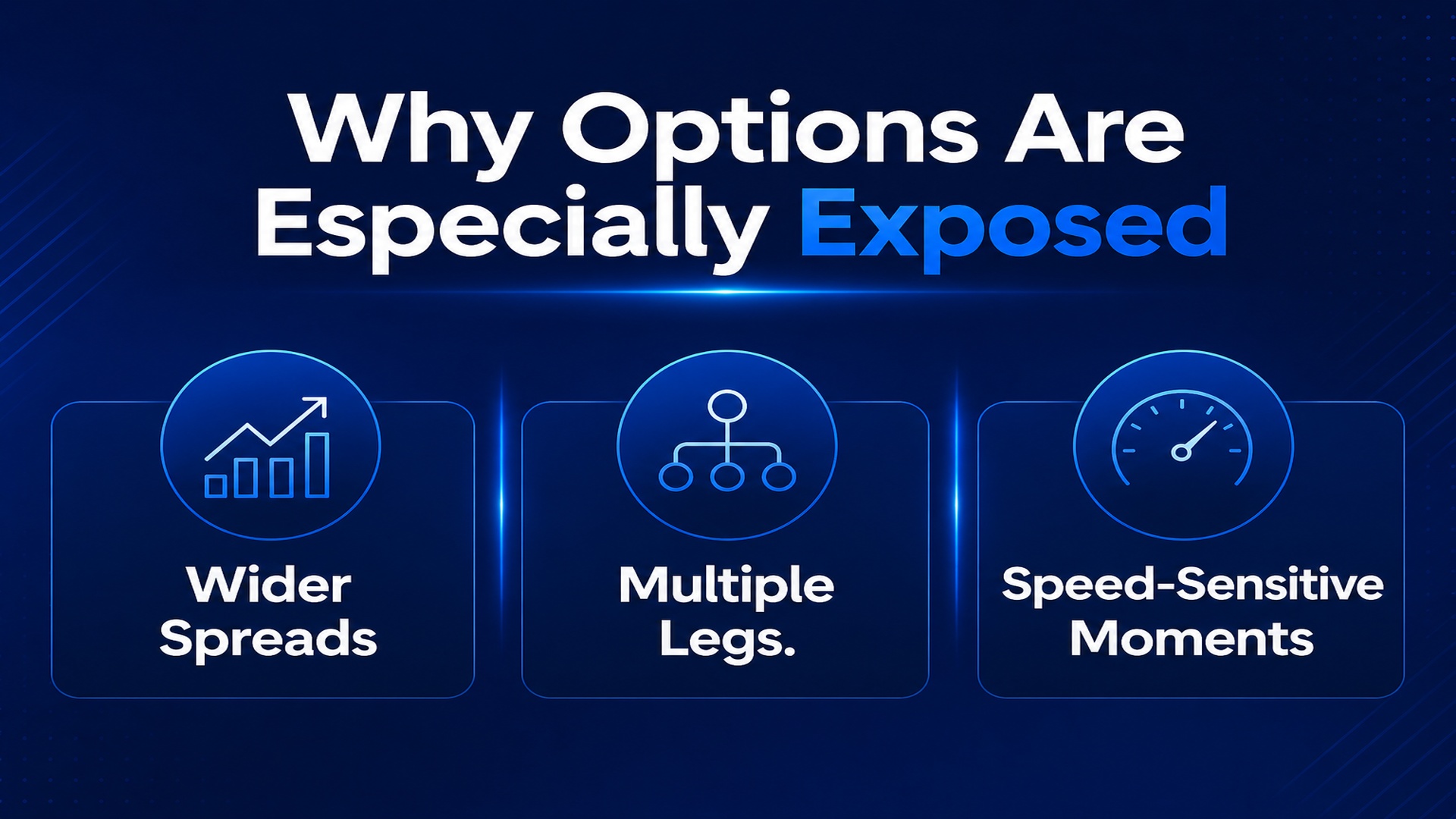
Why options are especially exposed
Several features of options trading conspire to make slippage worse than in, say, large-cap equity:
Wider spreads. Many options — especially away from the most-traded strikes, or in less-liquid indices like the midcap index — have meaningful bid-ask gaps. The wider the spread, the more it costs to cross it.
Multiple legs. Multi-leg strategies like condors and spreads mean two, three, or four fills per position. Each leg has its own slippage, and manually legging into a position means the market can move between your legs, leaving you with a worse combined price than the payoff diagram assumed.
Speed-sensitive moments. Around expiry and in fast-moving indices like BANKNIFTY, prices move quickly. The seconds between deciding and clicking — and between one leg and the next — are seconds in which the price drifts away from you.
The specific ways manual execution leaks
Put concretely, here's where the human at the keyboard loses ground:
- Reaction lag. By the time you see the signal, decide, and click, the price has moved. A machine acts in milliseconds; you act in seconds.
- Legging risk. Entering a multi-leg structure by hand, one order at a time, exposes you to the market shifting mid-entry — you get one leg at a good price and the others at worse ones.
- Emotional hesitation. The pause to second-guess an entry, or the flinch on an exit, happens at exactly the moments when price is moving — so hesitation has a direct price tag.
- Chasing. Missing the intended price and then "chasing" the fill at a worse level, repeatedly, across a session.
Each is small per trade. Across hundreds of trades, they compound into a drag that can turn a marginally profitable strategy into a losing one — without the strategy itself being wrong.
Why this matters more after April 2026
Execution costs don't exist in isolation. Stack slippage on top of brokerage per leg and the STT that rose on F&O in April 2026, and the total cost of an actively-traded options strategy can be substantial. A thin edge has to survive all of it. Many don't — and the trader blames the strategy when the real culprit was the cost of getting in and out.
The case for precise execution
This is precisely where automated execution earns its keep — not by predicting markets, but by executing better: acting in milliseconds rather than seconds, placing multi-leg orders together rather than legging in by hand, and removing the hesitation and chasing that human traders fall into. The point isn't that machines are smarter; it's that they're faster and more consistent at the mechanical act of getting filled at a good price.
A platform built for precise, low-slippage execution treats the fill quality as part of the strategy, not an afterthought. StrykeX, from Stockwiz, is built around exactly this idea — clean multi-leg execution designed to reduce the slippage that manual trading bleeds. The deeper mechanics of how automated systems reduce market impact are in [how algos execute options adjustments] and our broader work on execution quality.
The takeaway for any options trader: before you blame your strategy, look at your execution. The leak is often there, and it's fixable. For the full options context, see the options strategies guide for India.
StrykeX — By Stockwiz Technologies