Market Updates
What Is an Algo-ID? The Unique Strategy ID Now Required on Every Order
Imagine every car on a highway suddenly required a visible, registered number plate that linked back not just to the owner but to the exact reason that car was on the road that day. Traffic that used to be anonymous becomes traceable in an instant. That's roughly what the Algo-ID did to automated order flow on Indian exchanges. It's the most important single mechanism in SEBI's 2026 retail algo framework, and also the most misunderstood. So let's take it apart.
What Is an Algo-ID? The Unique Strategy ID Now Required on Every Order
Imagine every car on a highway suddenly required a visible, registered number plate that linked back not just to the owner but to the exact reason that car was on the road that day. Traffic that used to be anonymous becomes traceable in an instant. That's roughly what the Algo-ID did to automated order flow on Indian exchanges.
It's the most important single mechanism in SEBI's 2026 retail algo framework, and also the most misunderstood. So let's take it apart.
The plain definition
An Algo-ID you'll also see it called a unique strategy ID is an identifier issued by the stock exchange that gets attached to every order an algorithm generates. Not just the orders that get executed — every action: placing an order, modifying it, cancelling it. Each carries the tag.
Before the framework, an automated order arriving at the exchange looked broadly like any other order. There was no reliable, standardised way to say "this specific order came from this specific registered strategy." The Algo-ID changes that. One strategy, one identity, stamped on everything it does.
Why SEBI built the system this way
The goal is traceability, and traceability solves several problems at once.
If a strategy starts behaving badly — flooding the order book, contributing to a sharp unexplained move, or simply malfunctioning — regulators and exchanges can now trace the activity back to its source quickly. Before, that investigation could hit a wall. Now there's a thread to pull.
It also discourages manipulation. When every order is fingerprinted, patterns that used to hide in the noise become visible. And it underpins accountability: because the broker is the registered, responsible party, the Algo-ID connects questionable activity to someone who can actually answer for it.
None of this requires the strategy's logic to be public. The Algo-ID identifies the source, not the secret sauce. Your edge stays your edge.
How an order actually gets its ID
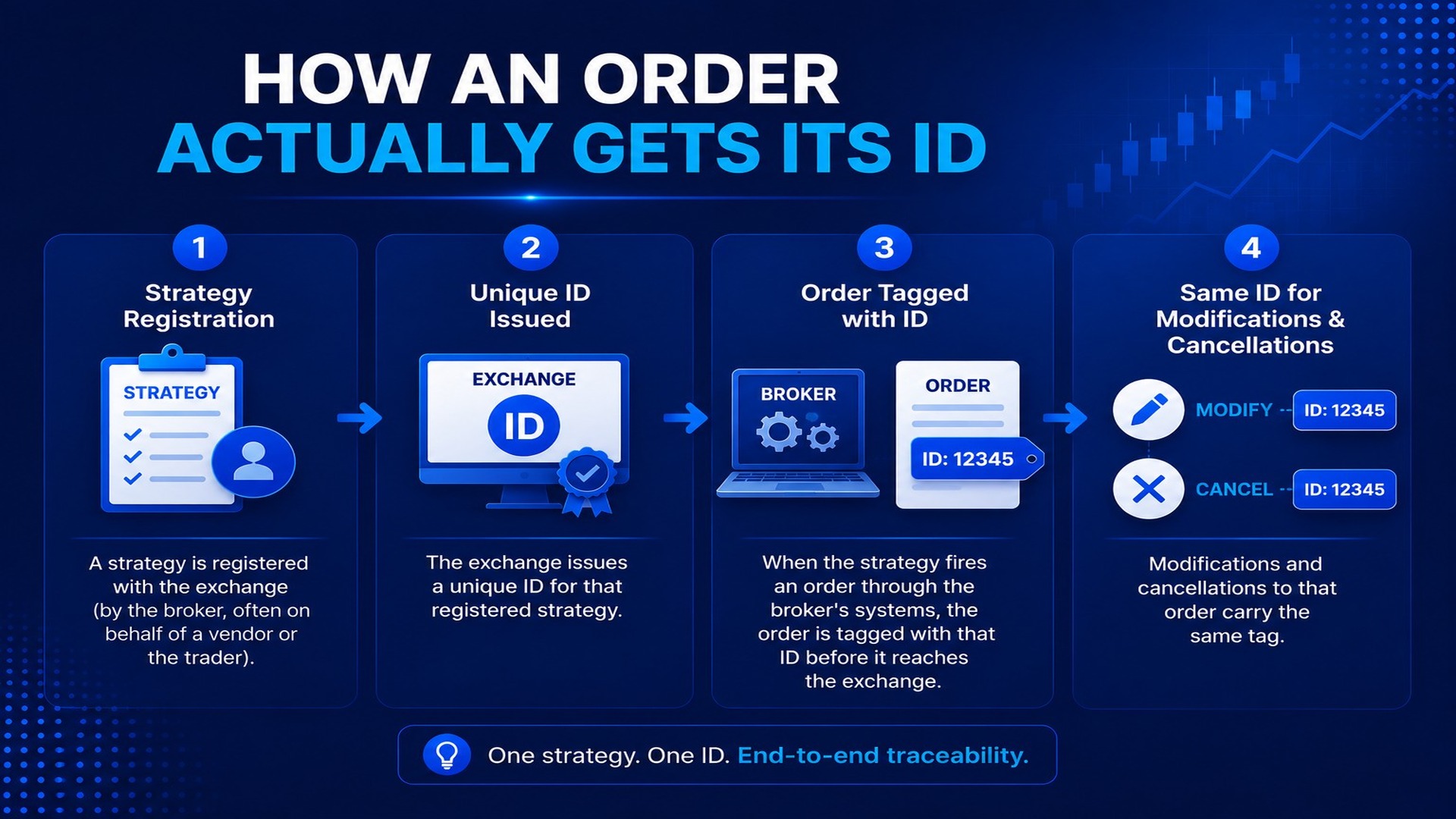
The mechanics depend on how you trade, but the flow looks like this:
- A strategy is registered with the exchange (by the broker, often on behalf of a vendor or the trader).
- The exchange issues a unique ID for that registered strategy.
- When the strategy fires an order through the broker's systems, the order is tagged with that ID before it reaches the exchange.
- Modifications and cancellations to that order carry the same tag.
For most retail traders this happens automatically through a compliant broker or platform. You don't hand-stamp anything; the tagging is built into the pipeline. If you're trading through an exchange-empanelled platformmeaning, the registration and tagging are handled for you as part of being on that platform.
How an order actually gets its ID
Do you, personally, need to register a strategy to get an Algo-ID?
This is where the 10-orders-per-second threshold matters. In broad terms:
- Below the threshold, in typical retail use, your broker tags your orders and you don't separately register each strategy yourself.
- Above the threshold, or if you're offering a strategy to other people, registration requirements apply and the Algo-ID attaches to a formally registered strategy.
We dig into exactly where that line sits in the 10-orders-per-second guide, because the nuance "per exchange, per calendar second" trips people up.
A worked example
Say you run a simple options strategy on BANKNIFTY through a compliant broker's API. You place an entry order, the market moves, you modify your stop, and later you square off. Under the framework, all four actions — entry, modify, exit, and any cancellations along the way — carry the same Algo-ID tied to your registered strategy. If a regulator ever needed to reconstruct what your automation did that session, the trail is complete and unambiguous.
For you, nothing about that felt different. You traded. The plumbing did the rest.
The takeaway
The Algo-ID is the quiet backbone of the whole reform. It's what turns "automated order flow" from an anonymous flood into something accountable and inspectable, without forcing anyone to expose their strategy logic. If you're on a compliant setup, you benefit from the integrity it brings without lifting a finger.
To see how the Algo-ID fits with the other five pillars of the framework, read the complete 2026 SEBI algo trading guide. sebi-algo-regulations-2026-complete-guide
StrykeX — By Stockwiz Technologies