Market Updates
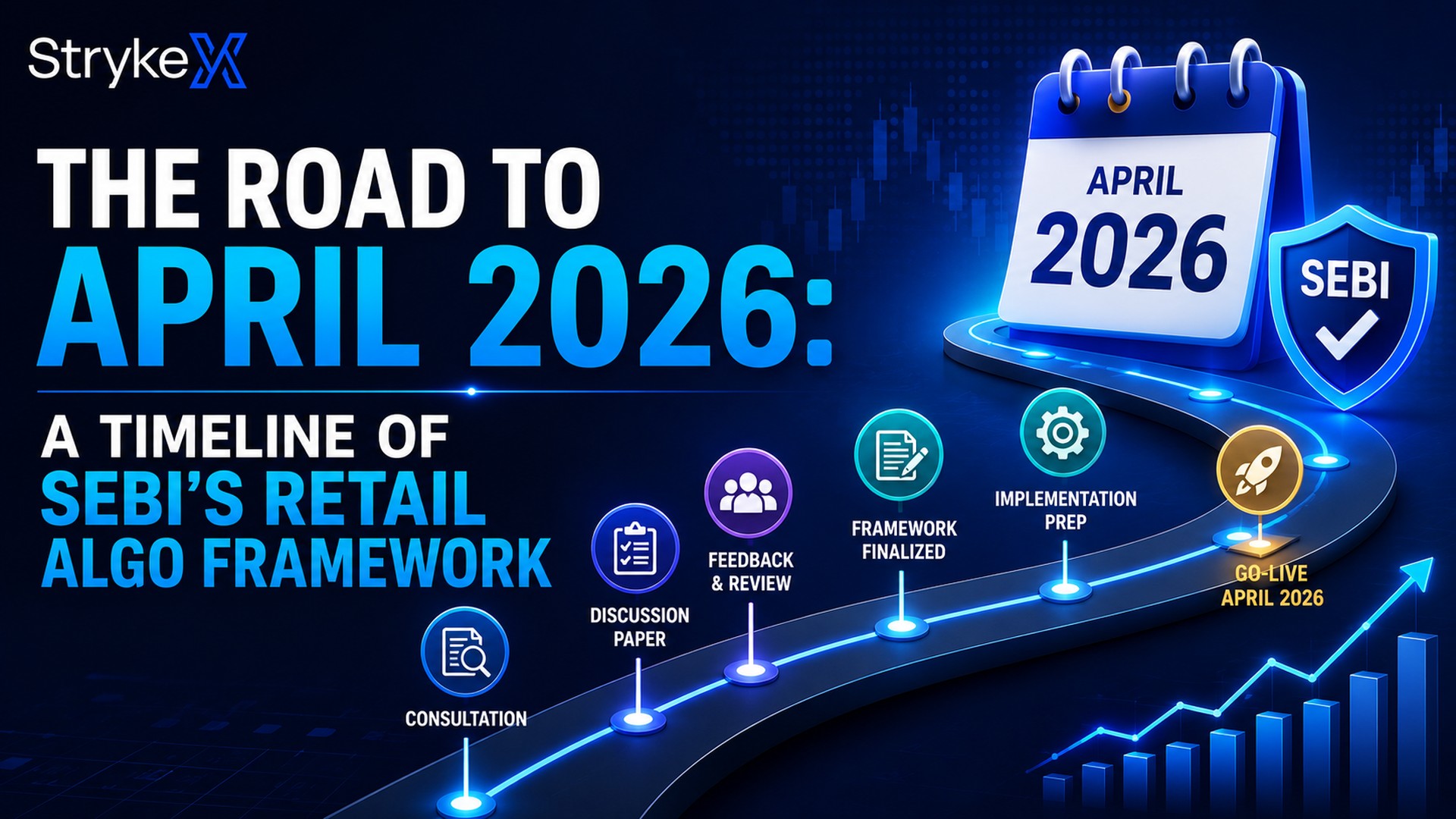
The Road to April 2026: A Timeline of SEBI's Retail Algo Framework
Few regulations in recent memory got delayed as often as this one. The retail algo framework was announced, scheduled, postponed, postponed again, and finally softened into a phased rollout before it landed for good. If you found the whole thing confusing to follow, you weren't alone — and the delays themselves tell you something about how the reform was made. Here's the full sequence, with a bit of why behind each step.
The Road to April 2026: A Timeline of SEBI's Retail Algo Framework
Few regulations in recent memory got delayed as often as this one. The retail algo framework was announced, scheduled, postponed, postponed again, and finally softened into a phased rollout before it landed for good. If you found the whole thing confusing to follow, you weren't alone — and the delays themselves tell you something about how the reform was made.
Here's the full sequence, with a bit of why behind each step.
February 2025 — the framework arrives
On 4 February 2025, SEBI issued its circular on "Safer participation of retail investors in algorithmic trading." This was the foundational document — the one that introduced the Algo-ID concept, the broker-as-principal model, the order-rate threshold, and the access controls.
The framing in the title is the giveaway about intent. This was always pitched as investor protection, written against a backdrop of heavy retail F&O losses and a fast-growing, loosely supervised algo segment.
The original plan — 1 August 2025
The framework was first meant to take effect on 1 August 2025. On paper, a clean go-live date roughly six months after the circular.
In practice, that timeline collided with reality. Brokers and algo vendors had to build new systems — exchange-issued order tagging, static IP enforcement, registration workflows, security testing. Six months wasn't enough for an industry-wide systems overhaul, and they said so.
First deferral — 1 October 2025
SEBI pushed the date to 1 October 2025 in response to those representations. But by then it was becoming clear that a single hard switch-on date for everyone was unrealistic, because brokers were at very different stages of readiness.
The exchanges had also issued clarifications and modifications to the operational details in September, which meant some brokers had to adjust systems they thought were finished. A flat deadline would have caught the slower-moving ones offside through no real fault of their own.
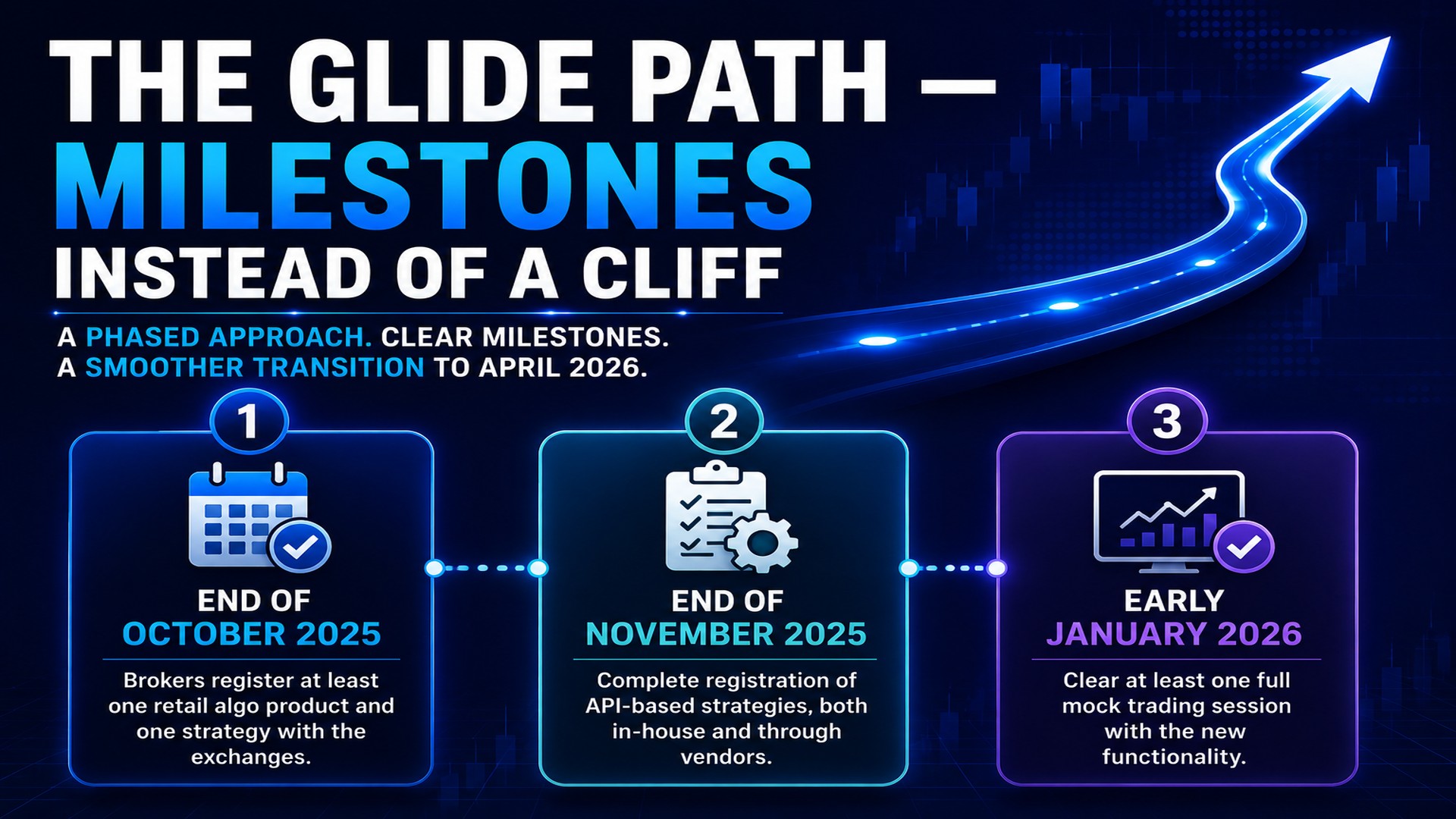
The glide path — milestones instead of a cliff
So SEBI did something more pragmatic: it replaced the single deadline with a phased "glide path" of milestones, letting ready brokers go live from October while giving others a structured runway. The milestones ran roughly like this:
- End of October 2025 — brokers register at least one retail algo product and one strategy with the exchanges.
- End of November 2025 — complete registration of API-based strategies, both in-house and through vendors.
- Early January 2026 — clear at least one full mock trading session with the new functionality.
This staged approach is the part that confused outsiders most, because "the algo rules" were technically both already-live (for ready brokers) and not-yet-fully-mandatory (for everyone) at the same time.
The enforcement bite — 5 January 2026
The glide path had teeth. Brokers who missed the milestones were barred from onboarding new retail API clients from 5 January 2026. That's the date the word "barred" entered the conversation and fed the "algo trading is being banned" rumours — even though it applied to non-compliant brokers, not to traders.
Full mandate — 1 April 2026
Finally, on 1 April 2026, the complete framework — including the exchanges' operational modalities — became mandatory for all brokers and all retail algo participants. The grey zone closed. From this point, an unregistered strategy without an Algo-ID simply can't trade.
By coincidence, the same date carried an unrelated cost change: the Securities Transaction Tax on futures rose from 0.02% to 0.05%.
What the delays actually tell you
It would be easy to read the repeated postponements as dithering. They're better read as consultation. SEBI announced, listened to an industry that said "we can't build this in time," adjusted, listened again, and replaced a blunt deadline with a workable phased one. The result is a framework that arrived later than planned but with far fewer broken systems than a forced August 2025 launch would have produced.
For what each provision in the framework actually does, the complete 2026 SEBI algo guide walks through them one by one.
StrykeX — By Stockwiz Technologies