Market Updates
The 10 Orders-Per-Second Rule: Do You Actually Need to Register Your Strategy?
Of all the numbers in SEBI's 2026 algo framework, this is the one that causes the most needless anxiety. Traders see "10 orders per second" and immediately assume they've crossed it. Almost none of them have.
So let's get specific about what the threshold means, how it's measured, and — the question you actually came here for — whether it applies to you.
The 10 Orders-Per-Second Rule: Do You Actually Need to Register Your Strategy?
Of all the numbers in SEBI's 2026 algo framework, this is the one that causes the most needless anxiety. Traders see "10 orders per second" and immediately assume they've crossed it. Almost none of them have.
So let's get specific about what the threshold means, how it's measured, and — the question you actually came here for — whether it applies to you.
What the threshold is
SEBI drew a line at 10 orders per second to separate ordinary automated trading from the higher-intensity activity that needs formal strategy registration. The crucial detail, the one most explainers skip, is how it's measured: per exchange, within any single calendar second.
"Per exchange" matters because orders to NSE and BSE are counted separately. "Within a calendar second" means the clock isn't a rolling window you control — it's the literal tick of the second hand. Eleven orders spread across two seconds is fine. Eleven orders inside one second is not.
Why the line exists at all
Below this rate, you're trading. Above it, you're operating at an intensity where the order flow itself can affect market microstructure and needs tighter oversight. The threshold is SEBI's way of saying "casual automation gets light-touch treatment; intense automation gets registered and watched."
It's a reasonable place to draw the line. A human discretionary trader can't manually fire ten orders in a second. A simple retail strategy rarely needs to either.
The honest answer for most retail traders
If you run something like a moving-average crossover, a handful of options legs, or a position strategy that places orders when conditions are met — you are almost certainly nowhere near 10 orders per second. These strategies fire occasionally, not in bursts.
In that case, the framework's design works in your favour: you don't separately register each strategy. Your compliant broker tags your orders with the exchange-issued Algo-ID, and the registration burden sits with the broker, not you. If you're fuzzy on the Algo-ID itself, start here what-is-algo-id-unique-strategy-id.
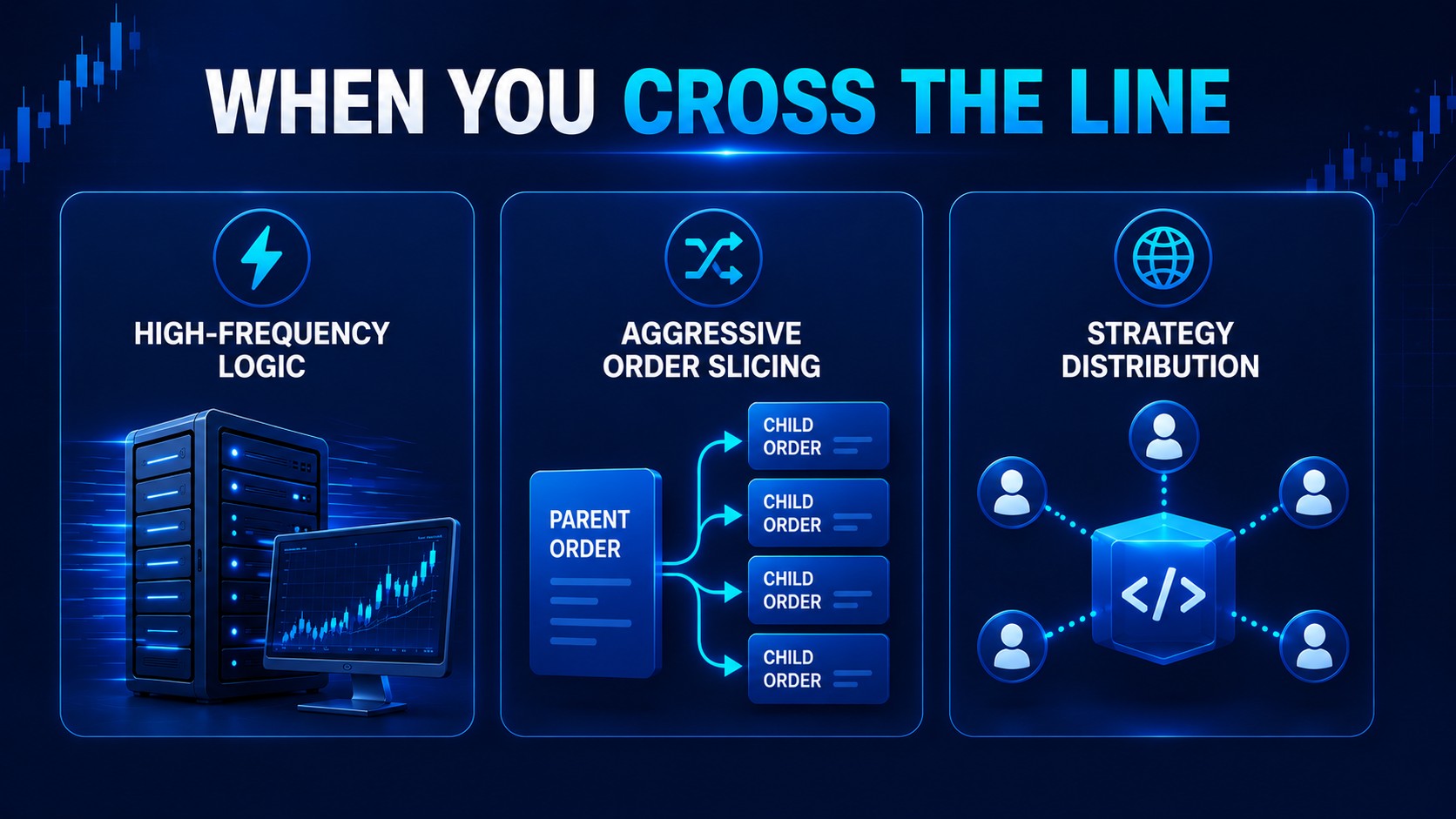
When you do cross the line
A few situations push you over, and it's worth knowing them:
- Genuine high-frequency logic — strategies designed to react and re-quote many times a second.
- Aggressive order-slicing — if your execution logic chops a parent order into many child orders and fires them in a tight burst, you can spike the per-second count even if your strategy feels slow.
- Selling or distributing a strategy to others — once a strategy isn't just for your own account, registration requirements apply regardless of speed.
That second point is the sneaky one. A trader thinks "I only trade twice a day," forgets that each entry is sliced into a dozen rapid child orders, and unknowingly brushes the threshold during execution. If your tooling does smart order-splitting, check what it actually does inside that one-second window.
How to find out where you stand
You don't need to guess. Two practical moves:
- Look at your order logs. Count the maximum number of orders (placements, modifications, cancellations all count) your setup has sent to a single exchange in any one second. If your peak is comfortably in low single digits, you're clear.
- Ask your broker or platform. A compliant broker can tell you whether your activity has tripped the threshold, because they're monitoring it as part of their own obligations.
The bottom line
For the overwhelming majority of retail algo traders, the 10-orders-per-second rule is a non-event — you sit well under it, your broker handles tagging, and you don't register anything yourself. The rule is there to catch genuine high-intensity activity, not your overnight options strategy.
If you want the threshold in the context of the whole framework, the complete 2026 SEBI algo guide. sebi-algo-regulations-2026-complete-guide puts it alongside the other provisions.
StrykeX — By Stockwiz Technologies