Market Updates
SEBI's New Algo Trading Rules (April 2026): What Actually Changed
There's a gap between what people think the new algo rules did and what they actually did. Scroll through trading forums and you'll find equal parts "SEBI banned retail algos" and "nothing really changed." Both are wrong.
Here's the grounded version, framed as a simple before-and-after, so you can see exactly what moved when the framework went live on 1 April 2026.
SEBI's New Algo Trading Rules (April 2026): What Actually Changed
There's a gap between what people think the new algo rules did and what they actually did. Scroll through trading forums and you'll find equal parts "SEBI banned retail algos" and "nothing really changed." Both are wrong.
Here's the grounded version, framed as a simple before-and-after, so you can see exactly what moved when the framework went live on 1 April 2026.
Before: a 2012 rulebook stretched too thin
The old framework dated to 2012 and was written for institutional players — the proprietary desks and large brokers with co-location servers. Retail traders arrived years later through broker APIs, and the rules never really caught up with them.
That created a grey zone. A retail trader could connect a script, or subscribe to a third-party "algo," and route automated orders through a broker with no exchange-level identifier on those orders and no clearly accountable party if the strategy misfired. When over half of exchange turnover is algorithmic and a large slice of that is retail, a grey zone of that size is a supervision problem.
After: traceability, accountability, and a locked-down door
The April 2026 framework rebuilt the system around three ideas. Take them one at a time.
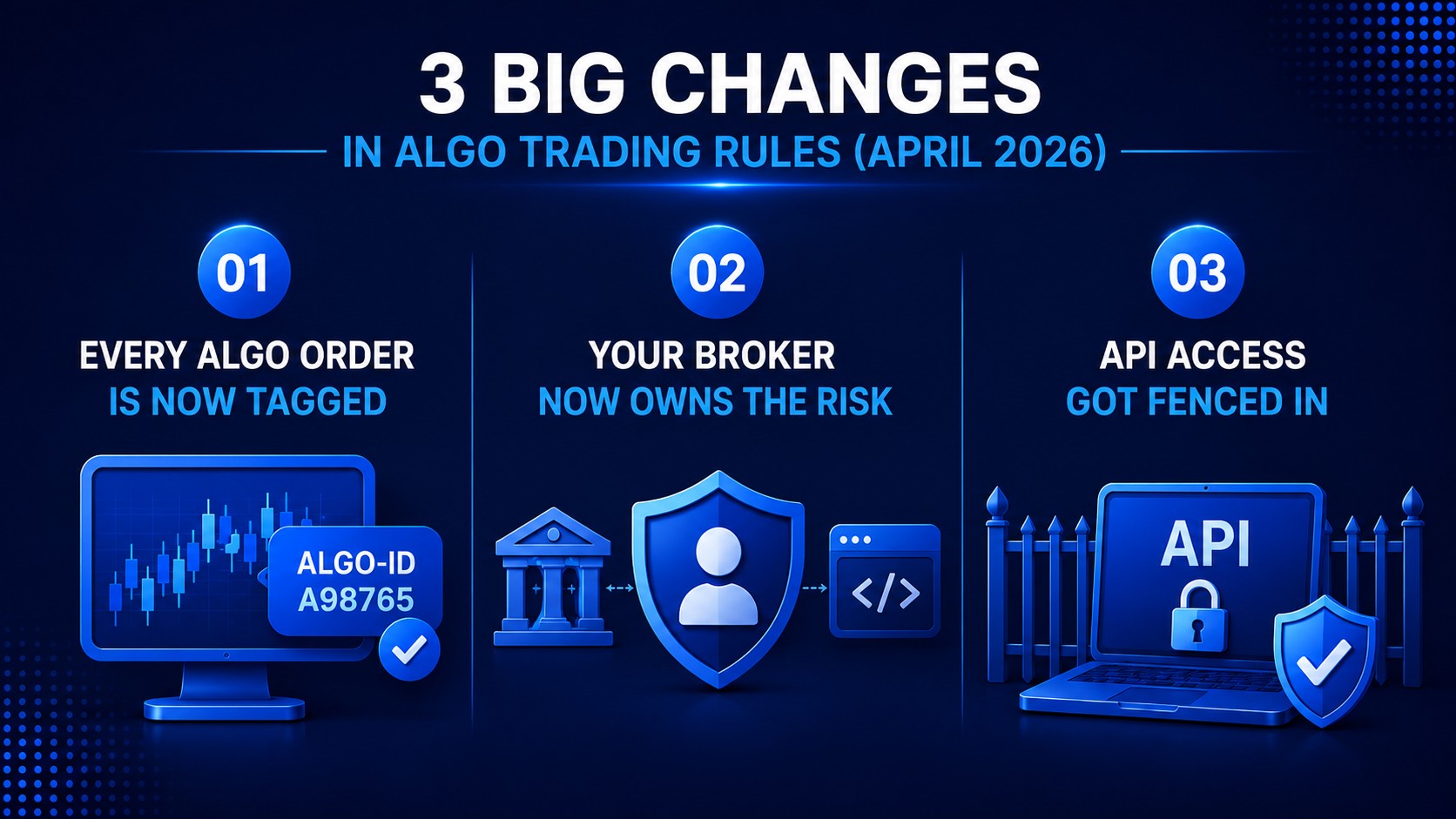
Change 1 — Every algo order is now tagged
The single biggest shift. Each order an algorithm sends — whether it's placing, modifying, or cancelling — now carries a unique Algo-ID issued by the exchange. Before, an automated order looked much like any other. Now it's traceable from the strategy that generated it all the way to the fill.
For an honest trader this is invisible. For a regulator chasing manipulation, it's the difference between a paper trail and a dead end.
3 Big Changes In Algo Trading Rules
Change 2 — Your broker now owns the risk
This is the part most retail traders underestimate. The framework establishes a principal-agent relationship: the broker is the principal and the algo provider is the agent. The broker is now answerable for every algorithm operating through its platform.
The practical fallout? Brokers got a lot more careful about which tools they let near their API. Due diligence that barely existed two years ago is now a gate every provider has to pass. If your favourite algo tool quietly disappeared from a broker's approved list over the past year, this is usually why.
Change 3 — API access got fenced in
Three concrete things changed for anyone trading through an API:
- Static IP only. Orders can come from a single static IP address registered with your broker. Anything from another address is rejected outright.
- Two-factor authentication. Mandatory, not optional.
- A rate threshold. Cross 10 orders per second (per exchange, per calendar second) and you move into territory where strategy registration applies.
The static IP rule is the one that catches people off guard, because most home internet connections hand out dynamic IPs that change. If you trade from home via API, that's a setup step you can't skip.
And the part that genuinely ended
If a strategy isn't registered and doesn't carry an Algo-ID, it can't legally trade on Indian exchanges after 1 April. That's what closed the door on the untraceable "subscribe and we'll trade your account" services that promised improbable returns and vanished when they blew up. Not banned by name — just made impossible to run anonymously.
What did not change
Worth saying plainly, because the rumour mill got this wrong:
- Retail algo trading is still completely legal.
- You can still run your own strategies and your own code.
- If you're on a compliant broker and a compliant platform, your daily routine barely shifted.
One cost change did land on the same date but isn't part of the algo framework: the Securities Transaction Tax on futures rose from 0.02% to 0.05% from 1 April 2026. It hits active traders whether or not they automate, so factor it into your numbers.
The one-line summary
The rules didn't restrict who can automate — they restricted who can do it invisibly. Traceable, accountable, properly registered automation is fine. Anonymous black boxes are out.
If you want the full picture, our complete guide to the 2026 SEBI algo framework. sebi-algo-regulations-2026-complete-guide walks through every provision and the glide path that led up to it. And if you'd rather just confirm your own setup is clean, start with the compliance checklist is-your-algo-setup-sebi-compliant-checklist.
StrykeX — By Stockwiz Technologies