Market Updates
SEBI Algo Trading Regulations 2026: Complete Guide for Retail Traders
For more than a decade, algorithmic trading in India lived under rules written in 2012 — rules built for institutions, with retail traders mostly operating in the gaps. That era ended on 1 April 2026, the day SEBI's retail algo framework became mandatory for every stockbroker in the country
SEBI Algo Trading Regulations 2026: The Complete Guide for Retail Traders
For more than a decade, algorithmic trading in India lived under rules written in 2012 — rules built for institutions, with retail traders mostly operating in the gaps. That era ended on 1 April 2026, the day SEBI's retail algo framework became mandatory for every stockbroker in the country.
If you run a Python script through a broker API, use a third-party algo product, or have simply heard that "the algo rules changed" and want to know whether your setup is still legal, this guide is the plain-language version. We've kept it free of jargon where we can, and explained the jargon where we couldn't.
A quick note before we start: this is an educational explainer, not legal or investment advice. Trading in derivatives carries real risk of loss, and the rules below are summarised — the binding text is in SEBI's circulars and the exchange operational guidelines.
Why SEBI rewrote the rules at all
The honest answer is that retail algo trading had outgrown its supervision. Algorithmic orders now account for more than half of the turnover on Indian exchanges, and a lot of that growth came from retail traders plugging unofficial tools into broker APIs with nobody clearly accountable when something broke.
Sitting behind the reform is a number SEBI has repeated often: more than 90% of individual F&O traders lose money, with aggregate net losses widening by roughly 41% to about ₹1.05 lakh crore in FY25. Add a steady drip of "earn 40% a month" algo services running on client accounts with zero traceability, and you have the conditions for exactly the kind of investor harm a regulator is built to prevent.
So the framework isn't really about banning automation. It's about making every automated order traceable to a source, and putting a regulated, accountable party — your broker — on the hook for it.
How we got here: the timeline
The framework didn't arrive overnight, and the repeated delays caused a lot of confusion. Here's the actual sequence:
- 4 February 2025 — SEBI issues its circular on "Safer participation of retail investors in algorithmic trading," laying out the framework.
- Original go-live: 1 August 2025 — deferred after brokers and algo vendors said they needed more time.
- Deferred to 1 October 2025 — then softened into a phased "glide path" rather than a hard switch.
- Glide path milestones — brokers had to register at least one retail algo product and strategy with the exchanges by end-October 2025, complete registration of API-based strategies (in-house and vendor) by end-November, and clear at least one full mock trading session by early January 2026.
- 5 January 2026 — brokers who missed those milestones were barred from onboarding new retail API clients.
- 1 April 2026 — the complete framework, including the exchanges' operational modalities, became mandatory for everyone.
If you've been trading on a compliant broker and platform through this period, most of this happened in the background and your day-to-day didn't change much. The teeth of the rules bite hardest on non-compliant operators.
The six things that actually changed
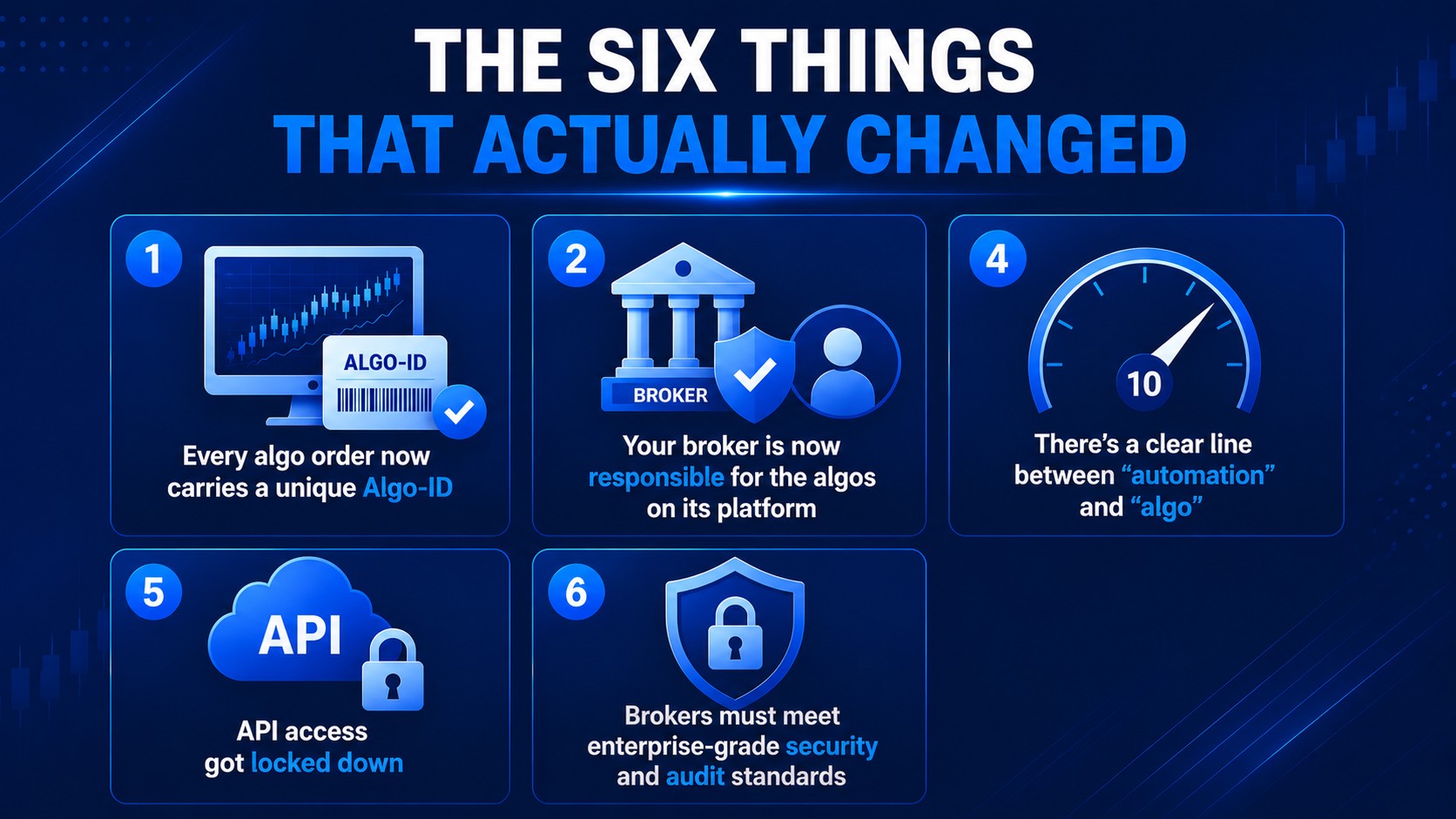
- Every algo order now carries a unique Algo-ID
This is the structural centre of the whole framework. Every order generated by an algorithm — placement, modification, or cancellation — must now carry a unique identifier issued by the exchange. Think of it as a fingerprint that ties each order back to a specific registered strategy. We've written a full explainer on what the Algo-ID is and how it works what-is-algo-id-unique-strategy-id.
- Your broker is now responsible for the algos on its platform
Under the new model, the stockbroker is the principal and the algo provider is the agent. In plain terms: the broker carries the regulatory responsibility for every algorithm running through its systems, which is why brokers now do far more due diligence before letting any tool touch their API.
- Algo providers must be empanelled with the exchanges
An algo vendor can no longer connect directly to the exchange or operate as an anonymous box. Providers have to empanel with the stock exchanges, pass the broker's due diligence, and — where they offer undisclosed strategies — hold the appropriate registration. This is the part that separates a serious, exchange-empanelled provider exchange-empanelled-algo-vendor-meaning from a fly-by-night one.
- There's a clear line between "automation" and "algo"
SEBI drew the line at 10 orders per second, measured per exchange within any single calendar second. Stay below it and, in most retail cases, you don't need separate strategy registration — your broker tags the orders for you. Cross it, or sell your strategy to others, and registration requirements kick in. We unpack the nuances in the 10-orders-per-second guide ten-orders-per-second-rule-explained.
- API access got locked down
If you trade via API, three things changed: only a static IP address registered with your broker can send orders, two-factor authentication is mandatory, and connections from anywhere else are simply rejected. The first one trips up a lot of home traders on dynamic home connections — here's how to set up static IP whitelisting static-ip-whitelisting-api-trading-setup.
- Brokers must meet enterprise-grade security and audit standards
Audit trails for every order, mandatory two-factor authentication, and vulnerability assessment and penetration testing VAPT before a platform can go live. Brokers without these can't onboard new API clients at all.
What this means for you, depending on who you are
If you use a compliant broker and a compliant platform: operationally, very little changed for you on 1 April. Your orders get tagged, your access is via a registered static IP, and you carry on. The benefit is invisible but real — you're now trading in a system where bad actors are far easier to catch.
If you're a DIY coder running your own strategies via API: you'll feel the static IP and 2FA requirements most. As long as you stay under the order-rate threshold and your broker tags your orders, you generally don't need to register each strategy yourself. We compare the DIY-API experience versus using a platform here diy-api-traders-vs-platform-users.
If you were using an unregistered third-party "tipster algo": this is where things genuinely changed. If a strategy isn't registered and doesn't carry an Algo-ID, it can't legally trade on Indian exchanges. The framework deliberately closed the door on untraceable services promising outsized returns.
A word on costs and a common myth
Two things worth clearing up. First, separate from the algo framework but landing on the same date: the Securities Transaction Tax on futures rose from 0.02% to 0.05% effective 1 April 2026 — a cost change that affects active traders regardless of automation.
Second, the framework is not a ban, and it does not guarantee anyone profits. No regulation can. What it does is raise the floor on transparency and accountability. We tackle the "is algo trading still allowed" question directly in Will SEBI's rules ban retail algo trading?
Where to go from here
If you only do one thing after reading this, run your own setup against our SEBI compliance checklist is-your-algo-setup-sebi-compliant-checklist and confirm your broker and any tool you use are properly registered and empanelled.
Stockwiz is a SEBI-registered research and technology firm (registration INH000013925), and its algo platform StrykeX is empanelled with the NSE and BSE. If you have questions about whether your automation is operating inside the new framework, that's the lens we look through.
StrykeX — By Stockwiz Technologies