Markets
Rossell India Stock Analysis 2026: A Deep-Value Tea Play After the Demerger
Rossell India (NSE: ROSSELLIND) is a very different stock today than it was two years ago. After spinning off its fast-growing aerospace & defence arm (Rossell Techsys) in 2024, what's left is a small, pure-play Assam tea company trading below its book value at a single-digit P/E. Is this a deep-value opportunity or a value trap in a tough industry? Here's the quick X-Ray. For data-backed entries, start trading with SEBI registered research analyst backed signals.
The Company in 30 Seconds
Rossell India (formerly Rossell Tea Limited) is a bulk-tea producer that owns tea estates in Assam and sells "Rossell Tea," along with a small black-pepper line. It exports to the UK, Germany, the Netherlands, the UAE, Saudi Arabia, Canada, and more. Incorporated in 1994, its high-growth aerospace & defence division was demerged into the separately-listed Rossell Techsys (ROSSTECH) in August 2024 so today ROSSELLIND is essentially the tea business.
- Founded: 1994 (tea roots much older)
- Promoter Holding: ~74.8%
- Business: Bulk tea (Assam estates) + black pepper
Cross-check the latest numbers on Screener.
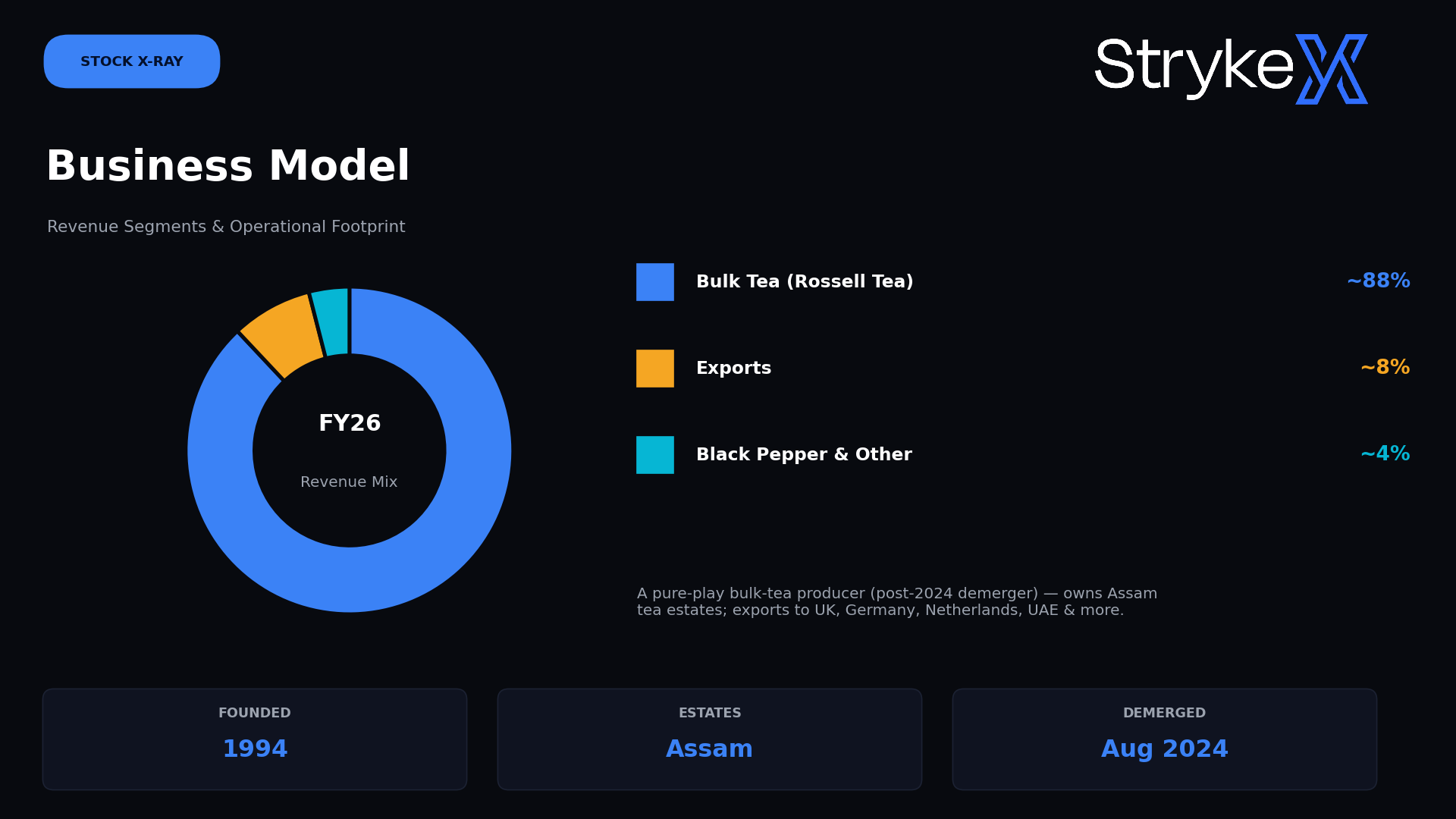
Revenue mix: the overwhelming majority is bulk tea from its Assam estates, with a smaller share from exports and a modest black-pepper/other line. Note: the aerospace/defence business is no longer part of ROSSELLIND — it now trades separately as Rossell Techsys.
Why Rossell India Could Appeal
- Deep-value optics — trades below book value (P/B ~0.9x) and at a single-digit P/E, unusual in today's market.
- High promoter holding — promoters hold ~74.8%, signalling alignment.
- Tea-cycle leverage — Assam tea output has been pressured by weather, and firmer tea prices could lift realisations.
- Asset backing — owned tea estates provide tangible land-and-asset value behind the low market cap.
Want to automate your own trading strategy? Start algo trading with AI-powered robots.
Things to Watch (and Be Cautious About)
- Tea-price cycle — bulk-tea realisations are cyclical and weather-driven; a price upcycle is the key swing factor.
- Cost pressures — wages, fuel, and climate variability weigh heavily on plantation margins.
- Low growth — five-year sales growth has been weak (around -10%), and ROE has been modest (~7%).
- Holding-company perception — post-demerger, the market is still re-rating what the standalone tea business is worth.
- Liquidity — it's a micro-cap; position sizing and volatility need care.
Just don't chase a cheap-looking stock blindly — here are 7 costly trading mistakes to avoid.
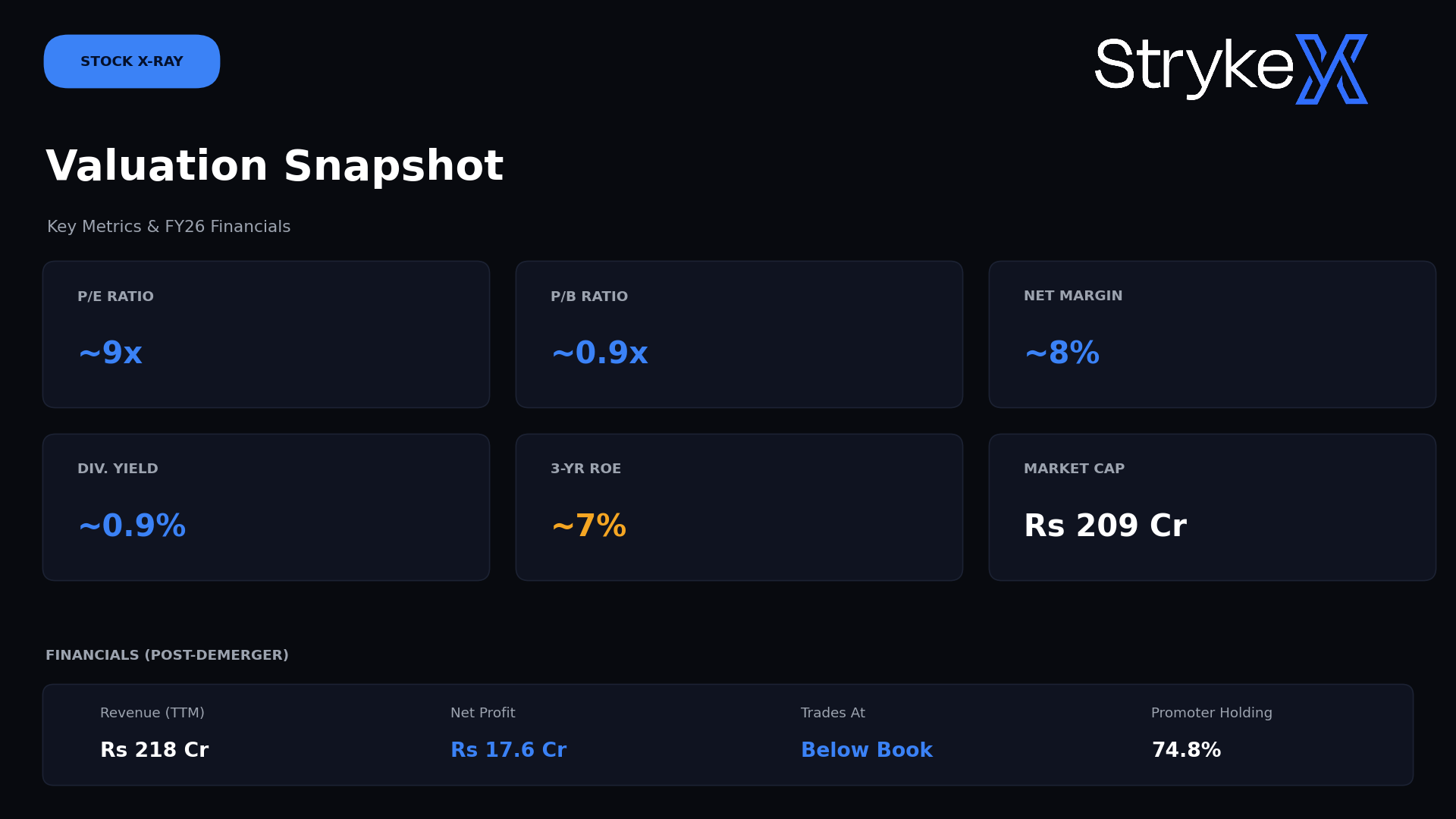
P/E ~9x, P/B ~0.9x (below book), net margin ~8%, 3-year ROE ~7%, market cap ~₹209 Cr. TTM: revenue ~₹218 Cr, net profit ~₹17.6 Cr, with a small dividend (~0.9% yield).
The Numbers
A cheap-looking value stock but cheap can stay cheap in a low-growth industry. New to systematic trading? Start with the complete beginner's guide to algo trading in India.
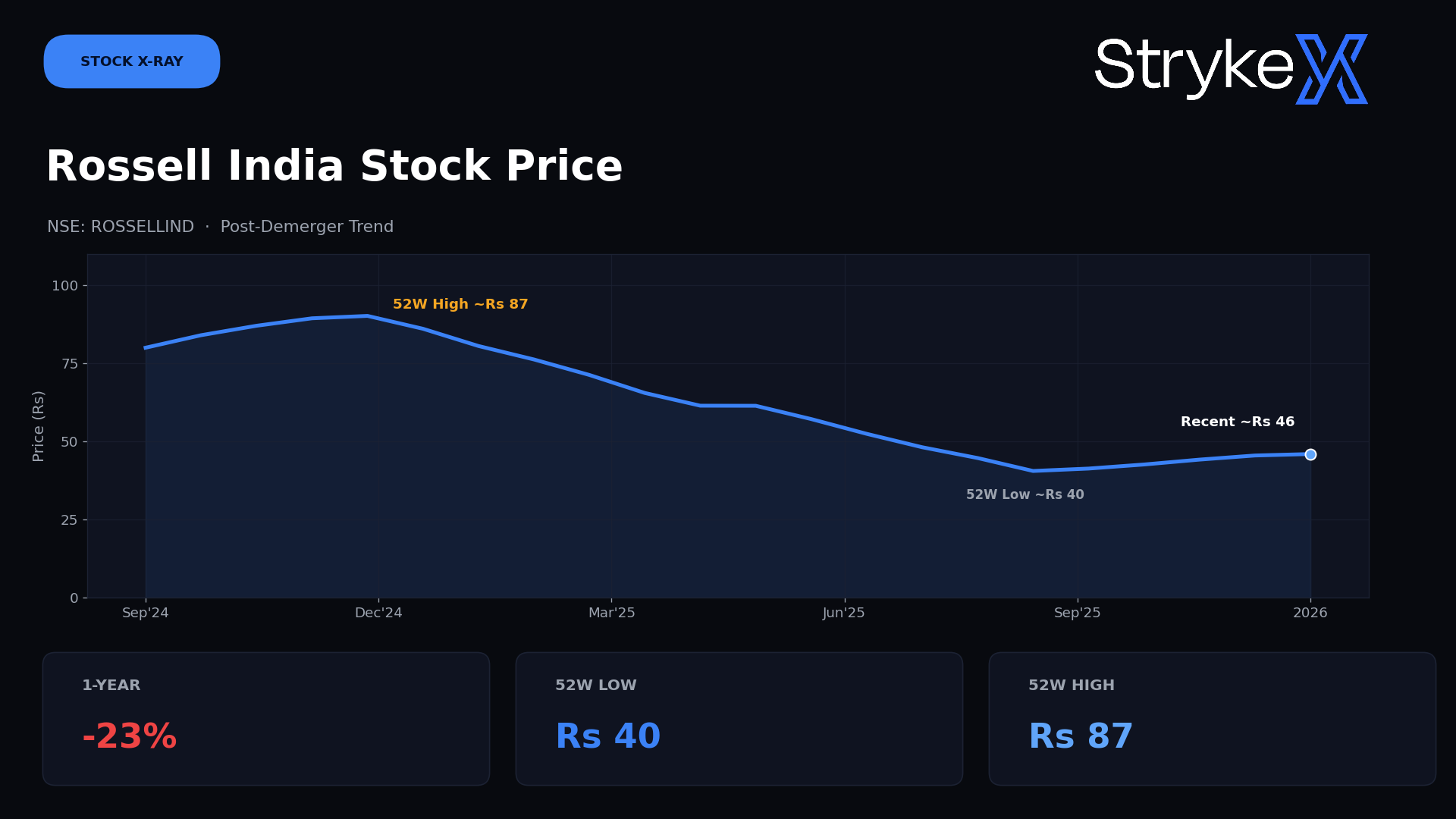
Post-demerger trend: after the August 2024 demerger, the standalone tea entity drifted from a high near ₹87 down to a 52-week low around ₹40, recently recovering to about ₹46 down roughly 23% over the year. (Note: longer-term "returns" look distorted because of the demerger adjustment.)
How Rossell India Stacks Up
Rossell India is a small bulk-tea producer — it can't be compared with FMCG giant Tata Consumer, which is a branded-products powerhouse on a premium multiple. Among pure plantation peers like McLeod Russel and Jay Shree Tea, Rossell screens as profitable and below book but the whole sub-sector is cyclical and low-growth.
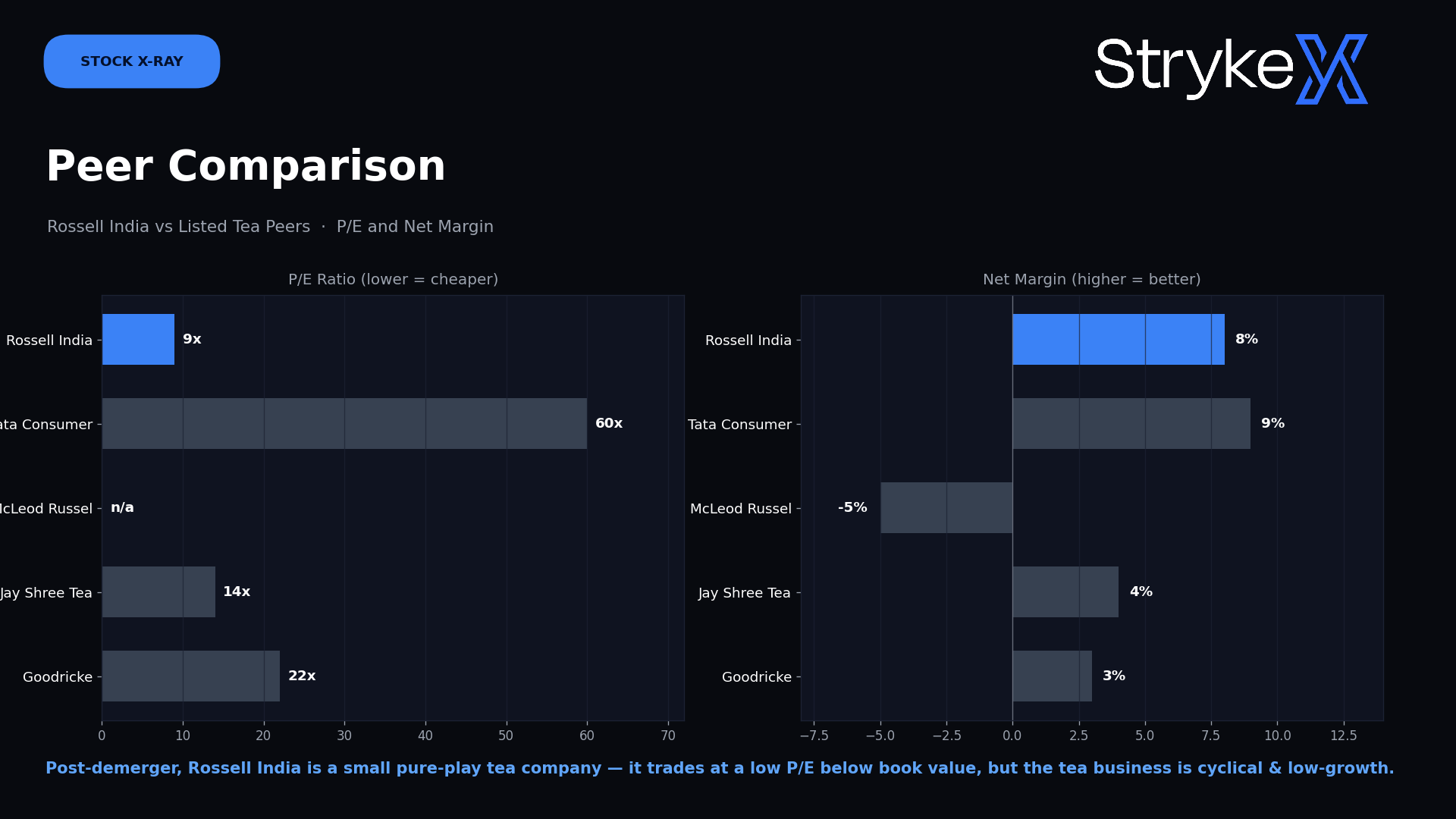
Compare on Screener: Rossell India · Tata Consumer · McLeod Russel · Jay Shree Tea · Goodricke
Our Take
Bull case: A deep-value, asset-backed Assam tea play trading below book at a single-digit P/E, with high promoter holding and optionality if the tea-price cycle turns up after years of pressure.
Bear case: It's a small, low-growth, cyclical plantation business with weak multi-year sales growth (~-10%), modest ROE (~7%), weather and cost exposure and limited liquidity. Cheap can persist, and there's no AI/defence growth engine left after the demerger.
Bottom line: A genuine deep-value, contrarian tea play for patient, risk-aware investors — not a growth story. The thesis hinges on the tea-price cycle and asset value, not earnings momentum. DYOR.
Ready to Act?
Frequently Asked Questions
Is Rossell India a good stock to buy in 2026?
Rossell India is a deep-value, asset-backed Assam tea producer trading below book value (P/B ~0.9x) at a single-digit P/E, with high promoter holding (~74.8%). However, it's a small, low-growth, cyclical plantation business with weak multi-year sales growth and modest ROE (~7%). It may suit patient, contrarian, value-oriented investors comfortable with a tea-cycle bet; it is not a growth or momentum stock. Always check the latest numbers on Screener and do your own research.
What does Rossell India do now and what is its NSE symbol?
Rossell India (formerly Rossell Tea) is a bulk-tea producer with tea estates in Assam also selling black pepper and exporting to several countries. After demerging its aerospace & defence arm into Rossell Techsys in 2024, ROSSELLIND is essentially the standalone tea business. It trades under the symbol ROSSELLIND on NSE (BSE: 533168).
What happened to Rossell India's defence/aerospace business?
Rossell's aerospace & defence division (interconnect solutions and electrical assemblies for military aerospace) was demerged into a separately-listed company, Rossell Techsys (NSE: ROSSTECH / BSE: 544294), effective August 2024. Existing shareholders received shares in the new entity. So the high-growth defence business is no longer part of ROSSELLIND.
Is Rossell India profitable and does it pay a dividend?
Yes. On a trailing basis the tea business had revenue of around ₹218 crore and net profit of roughly ₹17.6 crore, with a net margin near 8%. It pays a small dividend (yield ~0.9%).
Why is Rossell India trading below book value?
The market often assigns low valuations to small, cyclical, low-growth plantation companies. Weak multi-year sales growth, modest returns on equity, weather/cost exposure, and limited liquidity all weigh on the multiple, leaving it below book which value investors may see as either an opportunity or a value trap.
What are the main risks in Rossell India stock?
Key risks include the cyclicality of tea prices, weather and climate exposure, rising wage and input costs, weak historical growth, modest ROE, micro-cap liquidity and the absence of a growth engine after the defence demerger.
How can I start trading or investing in stocks like Rossell India?
You can open a free Demat and trading account to get started, follow SEBI-registered research analyst signals for ideas and automate your strategy with AI-powered algo trading. New to automation? Read the complete beginner's guide to algo trading in India.
StrykeX — Editorial