Market Updates
Risk Management in Algo Trading: The Part That Keeps You Alive
Ask a struggling trader about their strategy and they'll talk for an hour about entries. Ask about risk management and you'll get a shrug. That imbalance is exactly backwards, and it's why most of them struggle. In trading — automated or not — risk management isn't the boring admin around the "real" work. It is the real work. Entries decide whether you win; risk management decides whether you survive long enough for winning to matter.
Here's the framework that keeps an algo account alive.
Risk Management in Algo Trading: The Part That Keeps You Alive
Ask a struggling trader about their strategy and they'll talk for an hour about entries. Ask about risk management and you'll get a shrug. That imbalance is exactly backwards, and it's why most of them struggle. In trading — automated or not — risk management isn't the boring admin around the "real" work. It is the real work. Entries decide whether you win; risk management decides whether you survive long enough for winning to matter.
Here's the framework that keeps an algo account alive.
Why risk management matters more when you automate
Automation removes hesitation — which is a strength until it isn't. A human running a flawed strategy might lose nerve and stop after three bad trades. An algo will keep firing, faithfully, into a losing streak, all day, without flinching. The very discipline that makes automation powerful also means a mistake compounds without a human circuit-breaker. So the risk controls have to be built into the system, not left to your judgement in the moment.
Pillar 1: Position sizing
Position sizing answers "how much do I put on this trade?" — and it's arguably the single most important risk decision you make.
The core principle: risk only a small, fixed fraction of your account on any one trade. If a single position can lose a large chunk of your capital, one bad trade or a malfunction can be catastrophic. If each trade risks only a small percentage, no single loss can sink you, and you live to trade the next signal.
Concretely, that means sizing positions relative to your account and your stop distance — not just buying "one lot because that's the minimum." On a small account, the lot sizes of index derivatives can force positions that are too large relative to your capital, which is itself a risk signal: if you can't size sensibly, the instrument may be too big for your account.
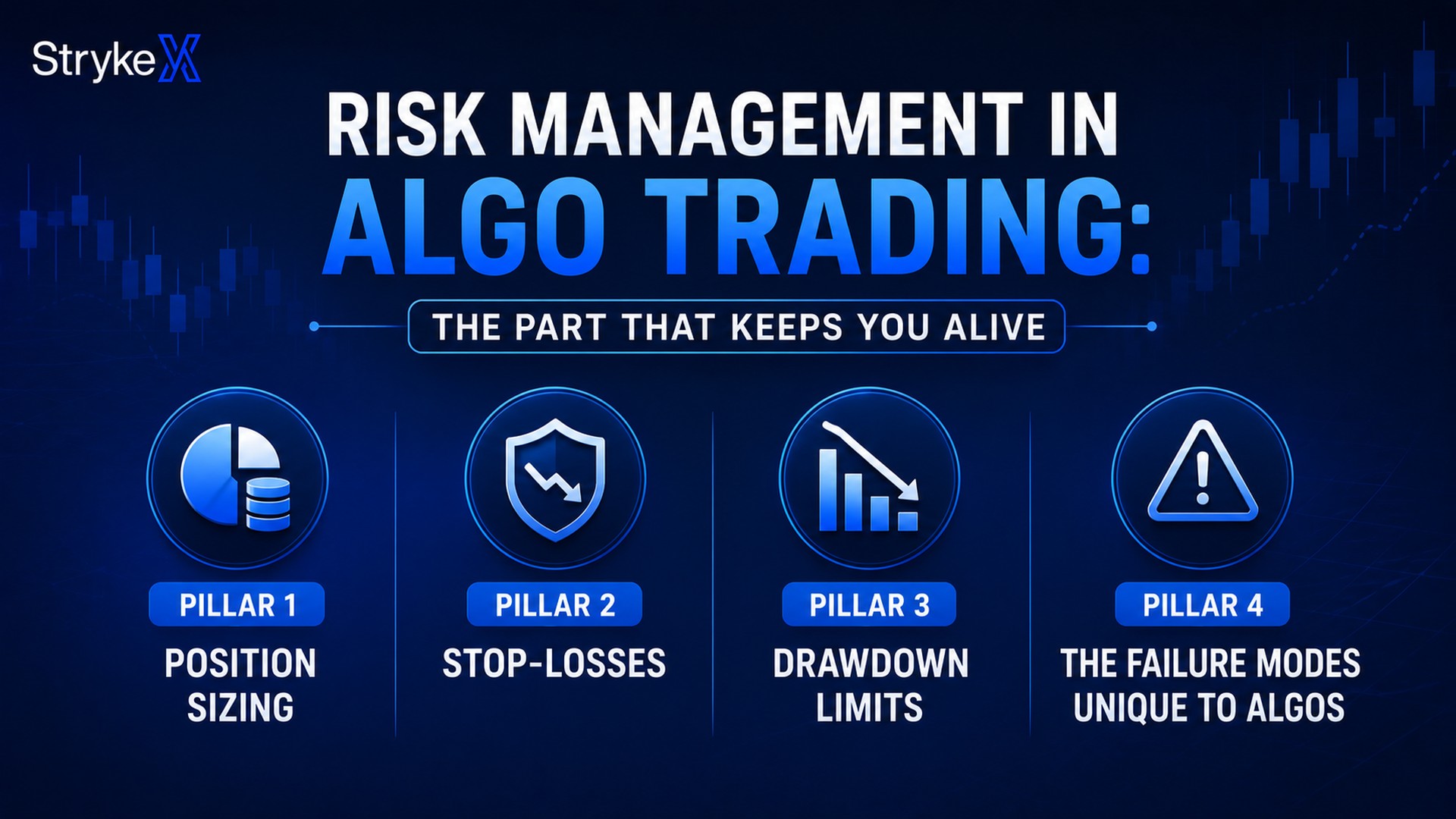
Pillar 2: Stop-losses
A stop-loss defines, in advance, the point at which you exit a losing position. Its job is to convert an open-ended "how much could I lose?" into a known, bounded number.
In an automated system, stops should be built into the strategy, not improvised. The discipline of pre-defining your exit is precisely what automation is good at enforcing — and precisely what humans are bad at when a position is moving against them and hope kicks in. A note of realism: in fast markets, slippage means your actual exit can be worse than your stop level, so a stop bounds your risk but doesn't guarantee the exact price.
Pillar 3: Drawdown limits
Drawdown is the fall from a peak in your account to a later low. Every strategy has them; the question is how deep you let them get before you act.
A maximum-drawdown rule is your system-level circuit breaker: "if the account or this strategy draws down by X, switch it off and review." This is the protection against the scenario that kills automated traders — a strategy that has quietly stopped working continuing to trade because nobody told it to stop. The drawdown limit is the instruction to stop.
Set it in advance, in cold blood, and respect it. The temptation to "give it a bit more room" during a drawdown is the temptation that turns a bad month into a blown account.
Pillar 4: The failure modes unique to algos
Beyond market risk, automated trading adds its own risks that your risk management must account for:
- Code bugs firing unintended orders — mitigated by testing, limits on order size and frequency, and a kill switch.
- Connectivity failures at the wrong moment — mitigated by knowing how your system behaves when the connection drops.
- Overfit strategies that work in backtest and fail live — mitigated by honest backtesting before committing real size.
A real risk plan names these and has an answer for each, rather than assuming the technology just works.
Putting it together: a simple risk skeleton
A workable risk framework for an automated strategy looks like this:
- Risk only a small fixed fraction of the account per trade (position sizing).
- Every position has a predefined stop (bounded loss per trade).
- The strategy has a maximum drawdown at which it shuts off (system circuit breaker).
- There's a kill switch and order limits to contain technical failures.
- You monitor, review, and are willing to turn it off.
None of this is glamorous. None of it improves your win rate. All of it is what separates traders who are still here next year from those who aren't.
The uncomfortable truth behind it all: with most retail derivatives traders losing money, your first job isn't to maximise gains — it's to not be eliminated. Risk management is how you stay in the game long enough for a real edge to express itself. For where this fits the full journey, see the complete guide to algo trading in India.
StrykeX — By Stockwiz Technologies