Trading and Investing
Options Greeks Simplified for Indian Retail Traders
The Greeks scare people off options more than anything else — a set of Greek letters that sound like advanced maths and get explained with formulas nobody asked for. Here's the secret: you don't need the formulas. You need to understand what each Greek tells you about how your option will behave. That's a far simpler thing, and it's learnable in one read.
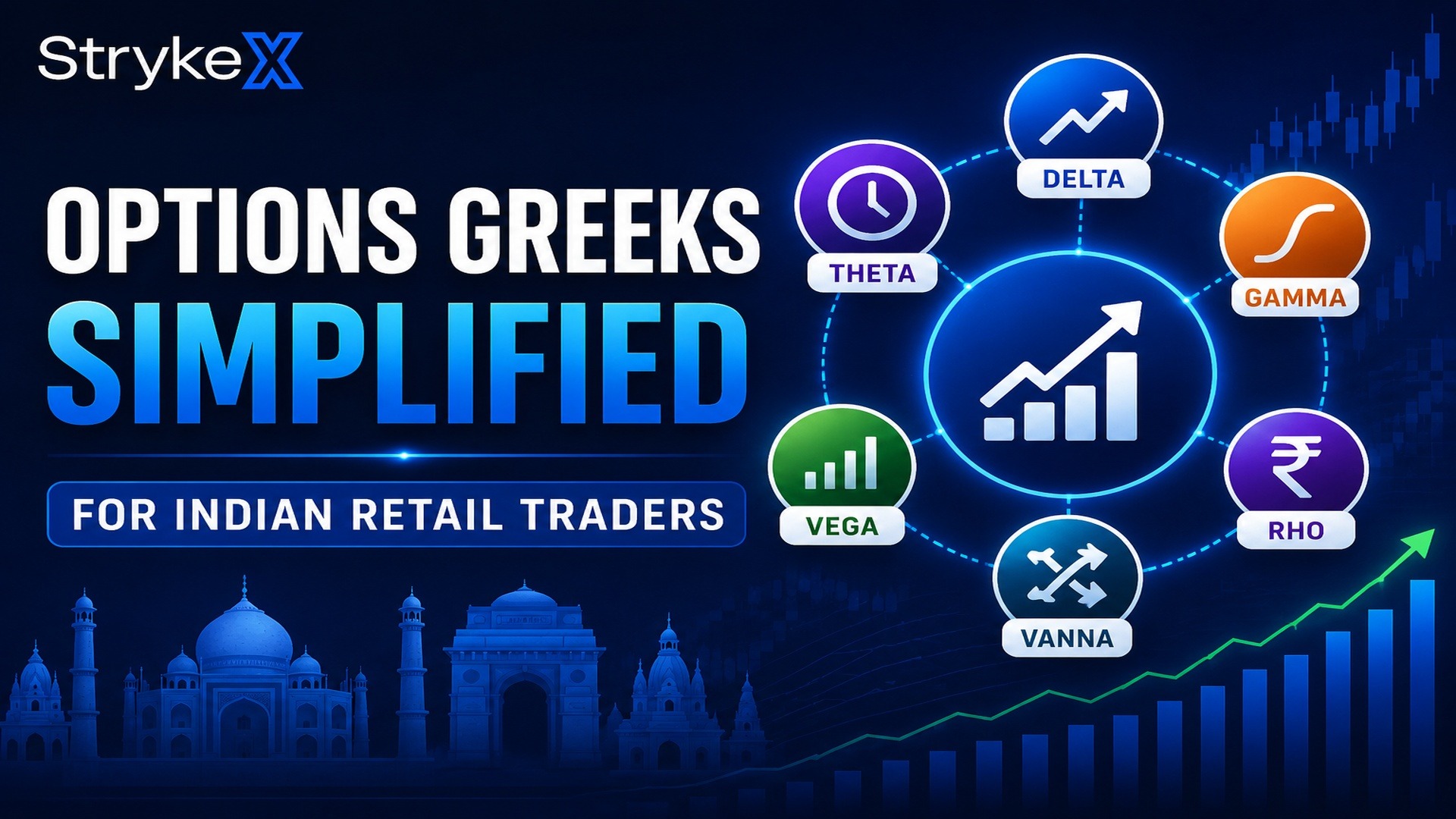
Think of the Greeks as four gauges on a dashboard, each answering one question about your option's price.
Options Greeks Simplified for Indian Retail Traders
The Greeks scare people off options more than anything else — a set of Greek letters that sound like advanced maths and get explained with formulas nobody asked for. Here's the secret: you don't need the formulas. You need to understand what each Greek tells you about how your option will behave. That's a far simpler thing, and it's learnable in one read.
Think of the Greeks as four gauges on a dashboard, each answering one question about your option's price.
Delta: "How much does my option move when the market moves?"
Delta measures how much an option's price changes when the underlying moves by one point.
A delta of 0.5 means: if the underlying rises by ₹1, the option's price rises by roughly ₹0.50. Calls have positive delta (they gain when the underlying rises); puts have negative delta (they gain when it falls).
Why it matters practically: delta tells you how directionally exposed you are. A high-delta option behaves almost like the underlying itself; a low-delta (far out-of-the-money) option barely reacts to small moves — which is why those cheap OTM options so often disappoint buyers expecting them to take off.
Rough mental shortcut: delta also approximates the option's chance of finishing in-the-money. A 0.20-delta option is, loosely, a long shot.
Theta: "How much value am I losing just from time passing?"
Theta measures how much an option loses each day purely because expiry is one day closer. It's the cost of holding an option through time.
Theta is the buyer's enemy and the seller's friend. If you buy an option and the market does nothing, theta quietly erodes your premium every single day — this is the silent killer behind so many "I was right eventually but still lost money" stories. If you sell options, theta works for you: time decay is the income you're harvesting.
Theta accelerates as expiry approaches, which is exactly why expiry-week and expiry-day trading is so brutal for option buyers — the bleed becomes a torrent.
Vega: "What happens to my option if volatility changes?"
Vega measures how much an option's price changes when volatility changes (independent of direction).
When markets get fearful and volatility spikes, option premiums inflate — good for holders, expensive for new buyers. When volatility falls, premiums deflate. This is why you can buy an option, be right about direction, and still lose: if you bought when volatility was high (premium inflated) and volatility then collapsed, vega works against you even as delta works for you.
Practical lesson: be wary of buying options when volatility is already elevated (e.g. right before a big event, when everyone's bid up the premiums). You're paying a "fear tax" that can evaporate.
Gamma: "How fast is my delta itself changing?"
Gamma is the rate at which delta changes as the underlying moves. It's the most abstract of the four, so here's the intuition: gamma is highest for at-the-money options near expiry, and it means your directional exposure can shift fast.
Why care? High gamma means an option's behaviour changes quickly — a position that felt mildly exposed can become sharply exposed after a small move. For traders running options near expiry, gamma is why things can feel like they're moving "too fast to manage" manually. It's also why automation appeals for expiry-day management — machines keep up with gamma's pace better than human clicking can.
Putting the dashboard together
Read your option through all four gauges at once:
- Delta — your directional exposure.
- Theta — what time is costing (or paying) you.
- Vega — your exposure to volatility shifts.
- Gamma — how fast your delta will change.
A long option you're holding through a quiet week: delta isn't helping (no move), theta is bleeding you, vega may be falling. No wonder it loses value. A short option in the same week: theta is paying you, which is the whole point — until a sharp move turns gamma and delta against you violently.
Once you see options this way, the multi-leg structures make sense too — they're just combinations engineered to have a particular blend of these Greeks (e.g. an iron condor is built to be theta-positive and relatively delta-neutral).
You don't need to calculate any of this by hand; your platform shows the Greeks. You just need to read them. For where this fits, see the options strategies guide for India.
StrykeX — By Stockwiz Technologies