Trading Strategies
NIFTY Options Trading: A Practical Strategy Guide
If you're going to trade index options in India, NIFTY is where most people should begin — not because it's easy (no options are), but because it's the most liquid, most-watched, and most forgiving of the major index options to learn on. This guide covers what makes NIFTY options distinctive and how traders actually approach them.
The usual caution, doubly true here: most retail options traders lose money. This is education, not encouragement.
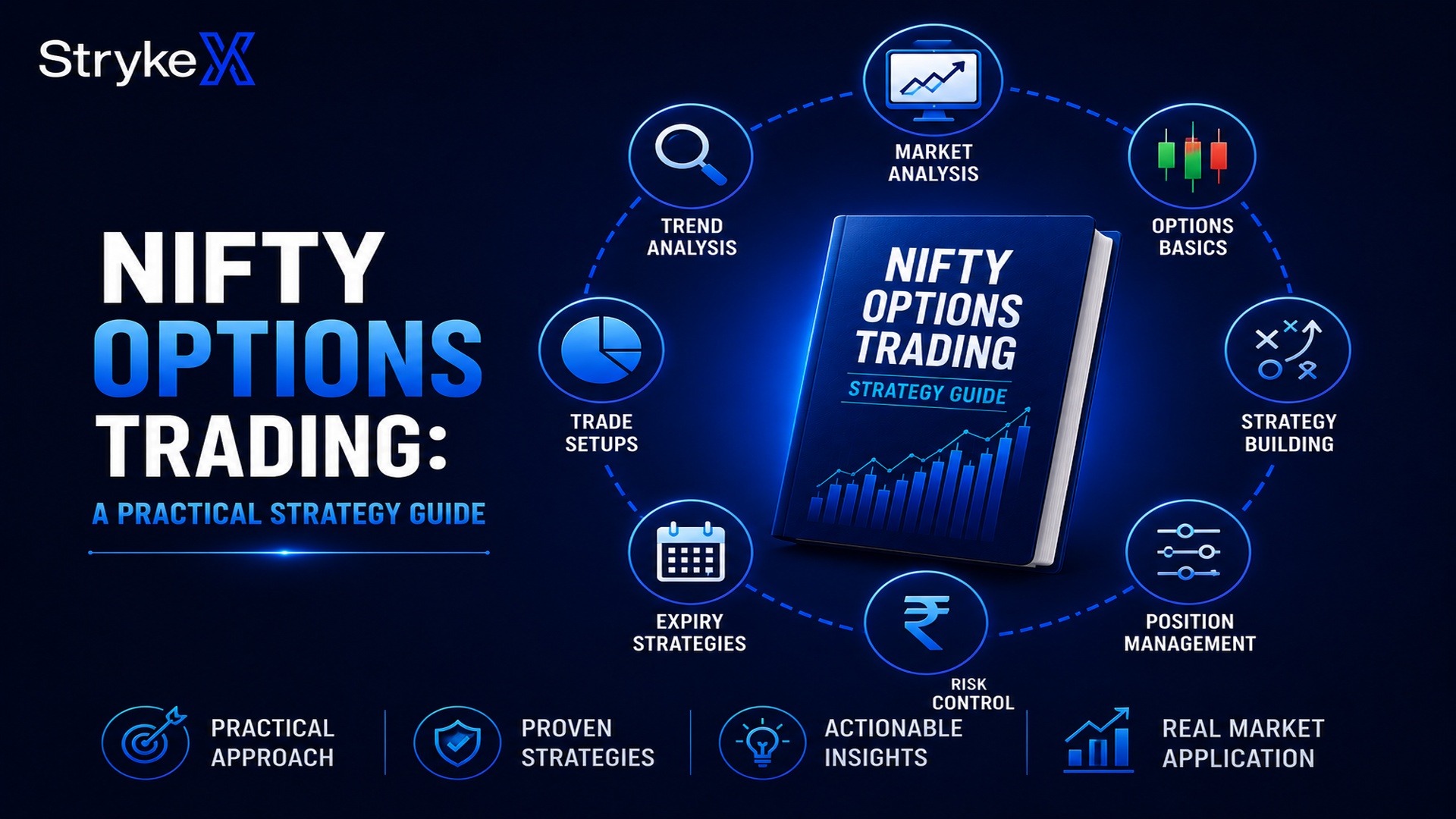
NIFTY Options Trading: A Practical Strategy Guide
If you're going to trade index options in India, NIFTY is where most people should begin — not because it's easy (no options are), but because it's the most liquid, most-watched, and most forgiving of the major index options to learn on. This guide covers what makes NIFTY options distinctive and how traders actually approach them.
The usual caution, doubly true here: most retail options traders lose money. This is education, not encouragement.
Why NIFTY first
NIFTY options track the Nifty 50, India's flagship index of fifty large companies. Three things make them a sensible learning ground:
Liquidity. NIFTY options are among the most heavily traded contracts in the country. High liquidity means tighter bid-ask spreads and less slippage — you get filled closer to the price you wanted. For a beginner, that's a quieter, fairer environment to learn in than a thin, jumpy one.
Relative stability. Being a broad large-cap index, NIFTY tends to move less violently than narrower or more concentrated indices. "Less violently" is relative — it still moves plenty — but it's calmer than [BANKNIFTY], which matters when you're learning to manage risk.
Depth of information. Because so many people trade and analyse it, NIFTY is the best-documented index to learn from.
The contract realities (verify current specs)
NIFTY options trade in fixed lots — as of the January 2026 revision, the lot size is 65, though this gets periodically revised, so confirm the current figure on the NSE. NIFTY also retains weekly expiries alongside monthly ones, which gives traders a range of timeframes to work with. Expiry schedules and weekly availability have shifted with regulatory changes, so always check the current calendar rather than assuming.
The practical point: one NIFTY options lot represents meaningful notional value, so even "small" positions aren't trivial. Size accordingly.
How traders approach NIFTY options
A few common framings, from simpler to more involved:
Directional buying. You expect NIFTY to move up (buy calls) or down (buy puts). Simple to understand, defined risk (you can only lose the premium), but time decay works against you — if the move doesn't come soon enough, the option bleeds value. Most beginners start and stay here, and most learn the hard way how punishing time decay is.
Spreads. Combining a bought and sold option to define both your risk and your reward, usually reducing cost and time-decay drag versus buying outright. A more measured way to express a directional view.
Non-directional structures. Strategies that profit from the market staying in a range, or from a big move in either direction — straddles, strangles, condors. These shift your focus from "which way?" to "how much movement?" Covered in the structures guide.
Premium selling. Writing options to collect premium, profiting from time decay. Higher probability of small wins, but with risk that can dwarf the premium collected if the market moves hard against you. Not a beginner strategy, regardless of how appealing the "steady income" framing sounds.

How traders approach NIFTY options
What NIFTY beginners get wrong
Three recurring mistakes:
1. Buying cheap, far-out-of-the-money options because they're affordable, not realising those are cheap precisely because they're unlikely to pay off. The lottery-ticket trap.
2. Ignoring time decay. Buying an option and "waiting" while theta quietly erodes it every single day.
3. Oversizing. Treating the capped risk of buying options as licence to bet too large relative to the account. Defined risk per trade still adds up to ruin if every trade is too big.
A sensible learning path
Learn the building blocks (calls, puts, buying vs selling), understand the Greeks — especially theta and delta — and paper trade or use tiny size before committing real capital. NIFTY's liquidity makes it the best place to make your inevitable early mistakes cheaply
.
And whatever you do, apply real risk management. NIFTY's relative calm can lull you into oversizing; the index moves enough to hurt anyone who forgets that.
For the bigger options picture, see the options strategies guide for India.
StrykeX — By Stockwiz Technologies