Trading Strategies
Iron Condor, Straddle, Strangle: Which Works in Which Market?
The first time a trader sees a multi-leg options strategy, it looks like alphabet soup — buy this, sell that, two strikes here, two there. But these structures aren't arbitrary complexity. Each is a tool built for a specific market condition, and the skill isn't memorising the recipes — it's matching the structure to what you think the market is about to do.
Let's demystify the three you'll meet most, by the situation each is built for. (Education only — these involve real risk, and most retail options traders lose money.)
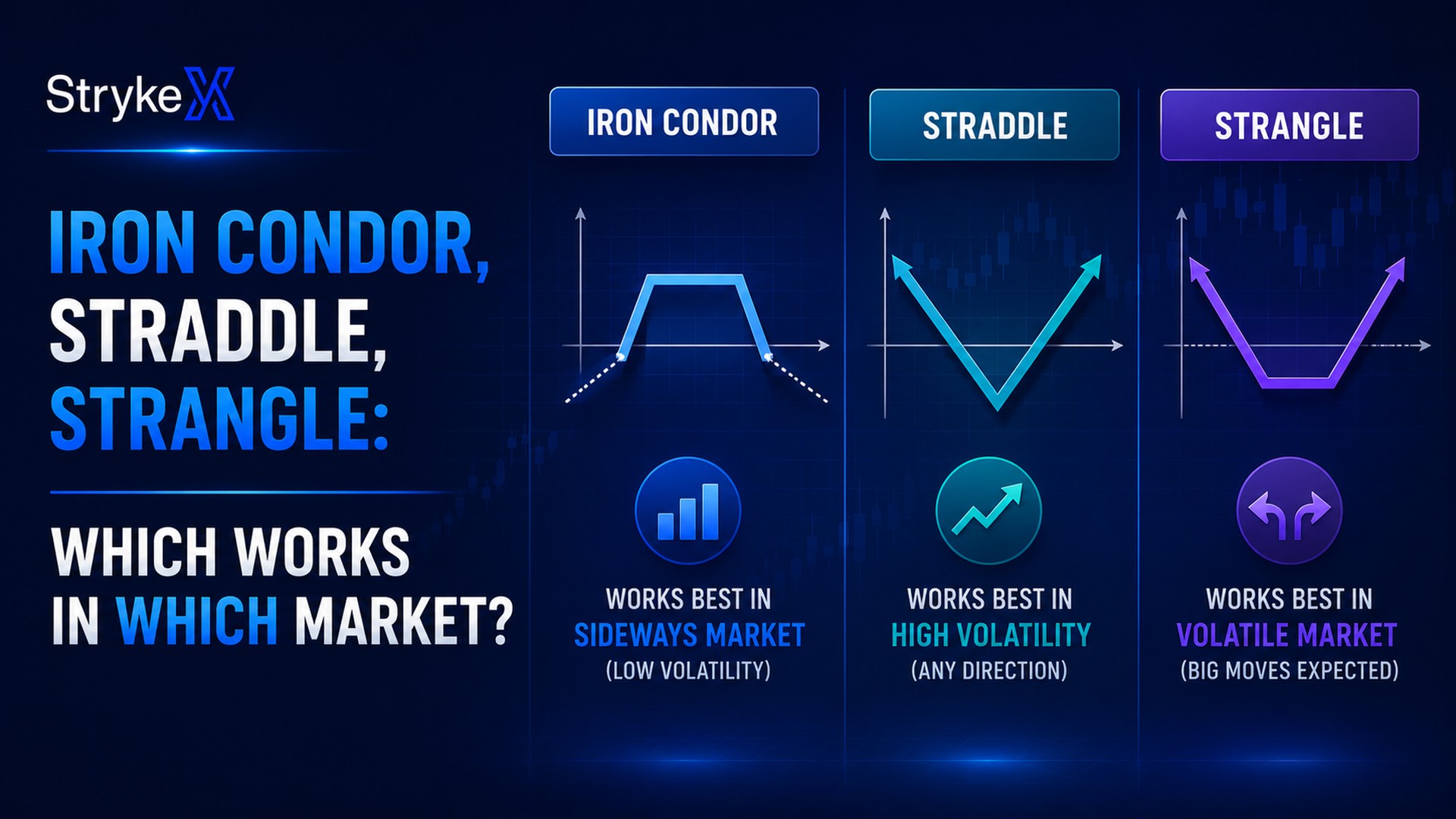
Iron Condor, Straddle, Strangle: Which Works in Which Market?
The first time a trader sees a multi-leg options strategy, it looks like alphabet soup — buy this, sell that, two strikes here, two there. But these structures aren't arbitrary complexity. Each is a tool built for a specific market condition, and the skill isn't memorising the recipes — it's matching the structure to what you think the market is about to do.
Let's demystify the three you'll meet most, by the situation each is built for. (Education only — these involve real risk, and most retail options traders lose money.)
First, the mental shift: from direction to movement
Beginners think in direction: up or down? These strategies require a different question: how much will it move, and does direction even matter?
- A straddle and a strangle are bets on big movement — in either direction.
- An iron condor is a bet on little movement — the market staying in a range.
Get that framing and the structures stop being soup and start being sensible.
The straddle: betting on a big move, either way
A long straddle means buying a call and a put at the same strike, usually at-the-money. You're saying: "I think the market is about to move sharply, but I'm not sure which way."
- Profits when: the underlying moves far enough in either direction to overcome the combined premium you paid.
- Loses when: the market sits still. Both options decay, and you bleed premium.
- Best for: events where a big move is likely but direction is genuinely uncertain (e.g. ahead of a major announcement).
The catch: straddles are expensive (you're buying two options), and the market has to move a lot just to break even. Buy a straddle into an event and watch volatility — and premiums — collapse afterward, and you can lose even if the market moves.
The strangle: a cheaper, wider version of the same bet
A long strangle is like a straddle but using out-of-the-money strikes — a call above and a put below the current price. Cheaper to put on than a straddle, because OTM options cost less.
- Profits when: the market makes a large move in either direction.
- Loses when: the market stays within the gap between your two strikes.
- Best for: expecting a very big move, wanting lower upfront cost than a straddle
The trade-off versus a straddle: you pay less, but the market has to move even further before you profit, because your strikes are further out.
The iron condor: getting paid for nothing happening
The iron condor flips the logic. Instead of betting on a big move, you bet the market stays in a range. It's built from selling an OTM call spread and an OTM put spread — collecting premium from both, with defined risk on each side.
- Profits when: the underlying stays between your inner strikes through expiry, letting the options you sold decay.
- Loses when: the market breaks sharply out of your range.
- Best for: calm, range-bound markets where you expect low movement, and you want time decay working for you.
The appeal is the "income from a quiet market" framing. The danger is that range-bound markets don't stay range-bound forever, and a sharp breakout can hand you a loss that wipes out many quiet months of small gains. Defined risk means the loss is capped — but capped can still be large relative to the premium collected.
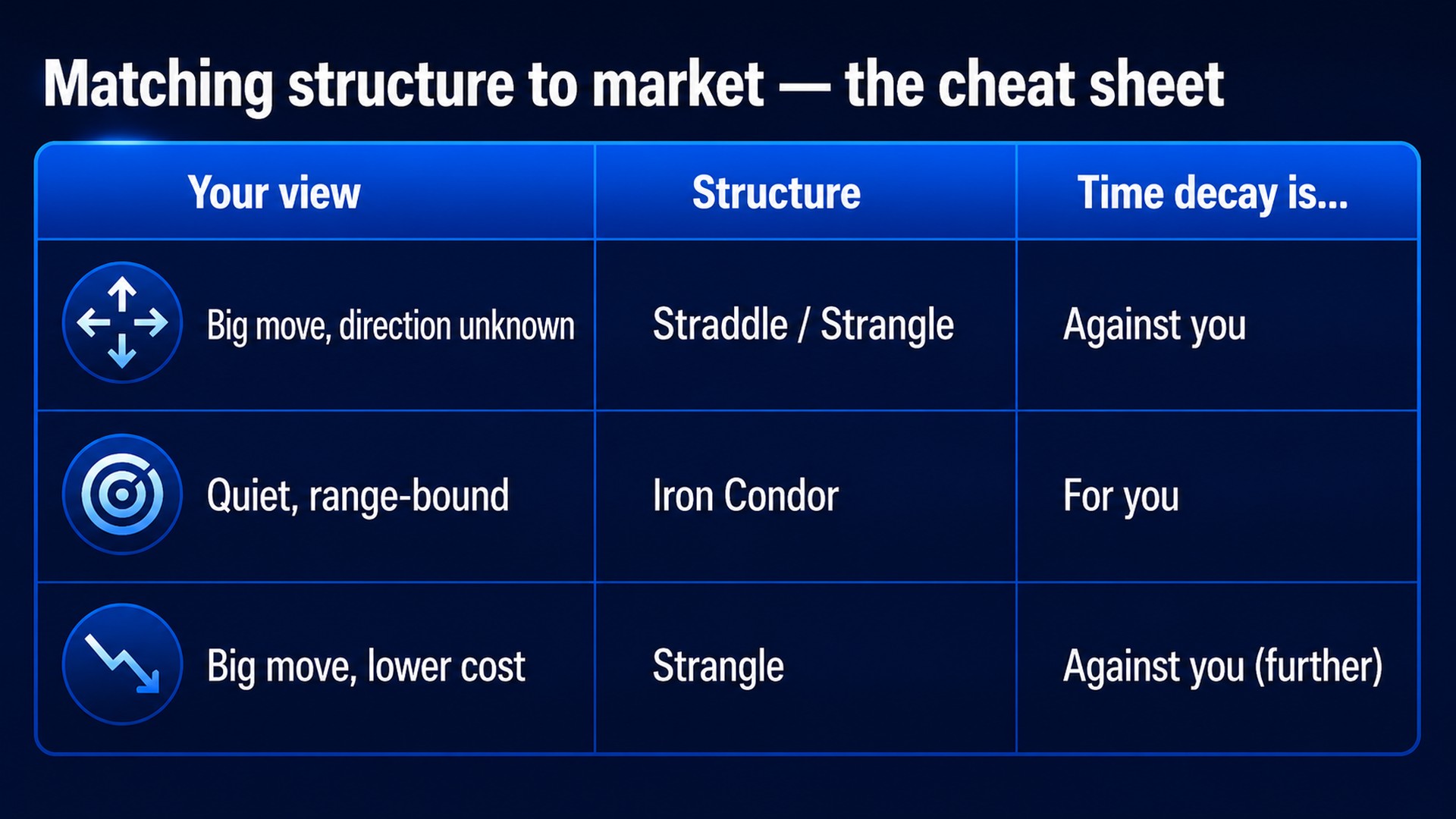
Matching structure to market — the cheat sheet
The single most useful insight: straddles and strangles want movement; condors want stillness. If you put on a condor and the market explodes, or buy a straddle and the market naps, you've matched the wrong tool to the conditions — which is the most common way these strategies lose.
Matching structure to market — the cheat sheet
A reality check on execution
These are multi-leg strategies. Two, three, four orders per position, plus adjustments. Every leg carries brokerage and slippage, and the STT increase from April 2026 adds to the drag. A condor's modest premium can be meaningfully eroded by sloppy execution across four legs — which is one reason traders automate the entry and adjustment of these structures rather than clicking each leg manually. More on that in how algos execute options adjustments.
Whichever you trade, understand the [Greeks] first — these structures are most easily understood through how their combined delta, theta, and vega behave. And size every one of them with real risk management.
For the full options picture, see the options strategies guide for India.
StrykeX — By Stockwiz Technologies