Market Updates
How to Start Algo Trading in India: A Step-by-Step Roadmap
Most "how to start algo trading" guides skip the step that actually decides whether you succeed — and rush you toward connecting an API. So this roadmap puts the steps in the order that protects you, not the order that gets you trading fastest. The difference matters, because the quickest path into algo trading is also the quickest path to losing money on it.
Here's the sequence, start to finish.

Step 1 — Build (and test) a strategy before anything else
This is the step everyone wants to skip, and it's the one that matters most. Before you automate anything, you need a strategy with a defined edge — clear rules for entry, exit, and risk, tested on historical data to see whether it would actually have made money.
Why first? Because automating a strategy you haven't validated just means losing money faster and more reliably. The technology is neutral; it executes whatever you give it. A tested, profitable-on-paper strategy is the foundation. Everything below is plumbing.
If you don't have a strategy yet, this is where you spend your time — learning, building, and backtesting — not on broker APIs.
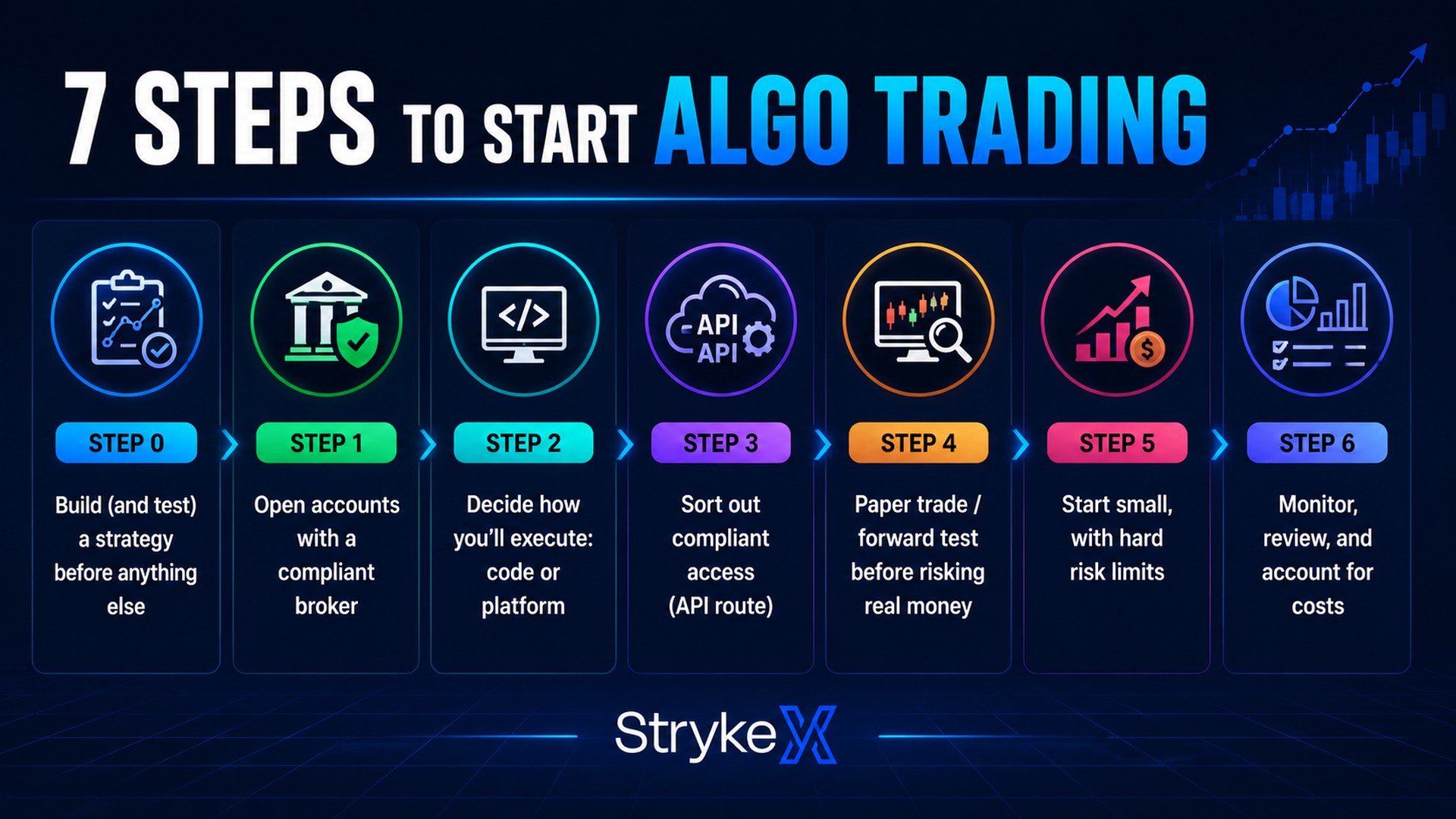
Step 2 — Open accounts with a compliant broker
You'll need a demat and trading account with a broker that supports algo/API trading and is compliant with SEBI's 2026 framework. The quick test of compliance: a broker actively onboarding new API clients has, by definition, cleared the framework's requirements (non-compliant brokers were barred from onboarding from early 2026).
Don't just chase the lowest brokerage. For algo trading, the broker's reliability, API quality, and the fact that they carry regulatory responsibility for the algos on their platform all matter.
Step 3 — Decide how you'll execute: code or platform
This is a genuine fork, and there's no universally right answer:
- Code it yourself via the broker's API if you want full control over your logic and you're comfortable running and securing your own setup.
- Use a managed platform — ideally an exchange-empanelled one — if you'd rather the compliance and execution machinery be handled for you.
We compare the two paths properly in DIY API vs platform and address the coding-skills question here do-you-need-coding-skills-algo-trading. Pick based on how much control versus convenience you want.
Step 4 — Sort out compliant access (API route)
If you're going the API route, set up the access controls the framework requires before you go live:
- A registered static IP that your broker whitelists home connections usually need a static-IP arrangement or a cloud server — here's the full setup.
- Two-factor authentication on your API access.
On a managed platform, much of this is built in and you can skip the heavy lifting.
Step 5 — Paper trade / forward test before risking real money
Backtesting tells you how a strategy would have done. Forward testing — running it on live market data without real money, or with tiny size — tells you how it behaves now, with real latency, real fills, and real slippage that backtests often understate.
Resist the urge to skip this. A strategy that sparkled in backtesting and stumbles in forward testing has just saved you from a costly live lesson.
Step 6 — Start small, with hard risk limits
When you do go live, start with capital you can genuinely afford to lose and with strict risk-management,position-size limits, stop-losses, and a maximum drawdown at which you switch the strategy off. Treat the first weeks live as paid tuition, not as the moment you scale up.
Step 7 — Monitor, review, and account for costs
Automated does not mean unattended. Watch how the strategy behaves, keep your own logs, and review performance against expectations. Crucially, judge results after costs — brokerage, the taxes that apply to trading income,including the F&O STT that rose in April 2026, and slippage. A strategy that's profitable before costs and a loser after them is a loser.
The honest summary
The order is the message: strategy first, plumbing second. People who start at Step 1 (open an account, connect an API, go) and treat Step 0 as optional are the ones who learn the hard way that automation magnifies whatever you feed it.
Get the strategy right, validate it, automate it carefully on a compliant setup, and scale only once it's proven itself live. For the bigger picture around all of this, see the complete guide to algo trading in India.
If you'd rather start on a managed, compliant platform, StrykeX — from Stockwiz, a SEBI-registered firm — is one exchange-empanelled option that handles much of Steps 1–3 for you.
StrykeX — By Stockwiz Technologies