Market Updates
How Much Money Do You Actually Need to Start Algo Trading?
The honest answer to "how much do I need to start?" isn't a number — it's a framework. Anyone who gives you a flat figure ("₹50,000 and you're set!") is either selling something or hasn't thought it through. What you need depends on what you trade, how you trade it, and — most importantly — how much you can afford to lose while you learn.
Let's build the real answer.

How Much Money Do You Actually Need to Start Algo Trading?
The honest answer to "how much do I need to start?" isn't a number — it's a framework. Anyone who gives you a flat figure ("₹50,000 and you're set!") is either selling something or hasn't thought it through. What you need depends on what you trade, how you trade it, and — most importantly — how much you can afford to lose while you learn.
Let's build the real answer.
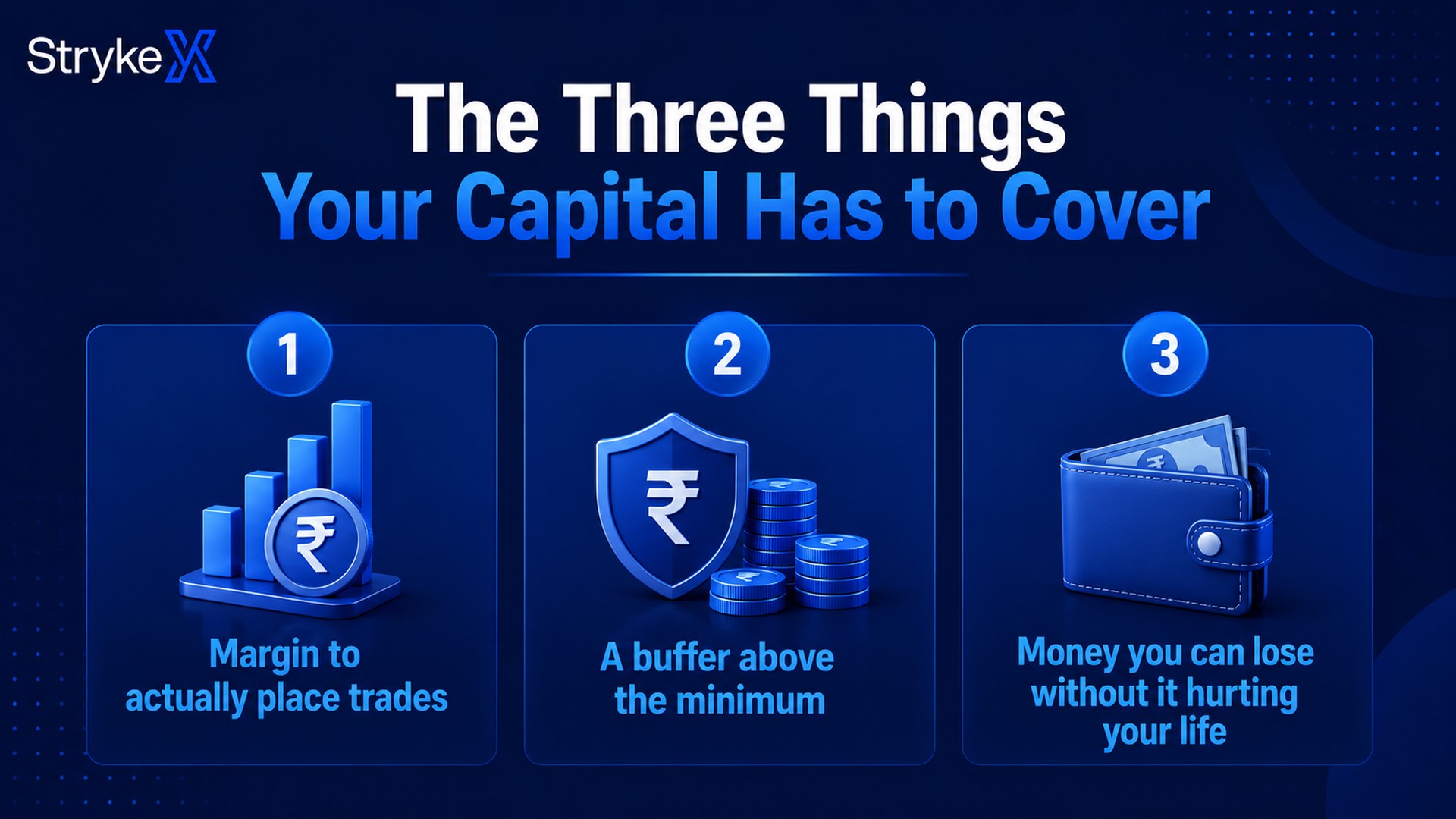
The three things your capital has to cover
Your starting capital isn't one bucket. It has to stretch across three:
- Margin to actually place trades. Derivatives require margin — money blocked to cover potential losses on a position. Index options and futures have meaningful margin requirements, and these change with market volatility and regulation, so treat any figure as a moving target you verify with your broker, not a constant.
- A buffer above the minimum. Trading at the bare minimum margin is how people get stopped out by normal market noise or hit margin calls. A sensible setup keeps a cushion well above the strict minimum so a couple of bad days don't force you out of otherwise-sound positions.
- Money you can lose without it hurting your life. This is the real constraint. Since most retail derivatives traders lose money — SEBI's data puts it above 90% — you should size your starting capital as "tuition I can afford," not "rent money I'm trying to grow."
Why lot sizes matter to the maths
Index derivatives trade in fixed lots, and the lot size sets a floor on how much one position is worth. As of the January 2026 revision, the NIFTY lot is 65 and the BANKNIFTY lot is 30 (these get periodically revised, so check current specs). Multiply the lot size by the index level and you get a sizeable notional value per contract — and your margin is a fraction of that, but still substantial.
The practical upshot: index F&O isn't a ₹5,000 hobby. You need enough to hold at least one position with a proper buffer, and ideally enough to size positions sensibly relative to your account (more on that in risk management).
A tiered way to think about it
Rather than a single number, think in tiers based on where you are:
- Learning / forward-testing tier: effectively near-zero real capital. Paper trade or run tiny size first. This is where everyone should start, and it costs almost nothing.
- Starting-live tier: enough to hold a single, properly-buffered position in whatever you're trading, plus a loss cushion — money you've genuinely written off mentally.
- Sustainable tier: enough that your position sizing can follow a real risk rule (e.g. risking only a small percentage of the account per trade) rather than betting most of your capital on one position.
Notice none of these are exact figures. That's deliberate — the right number is the one that lets you trade your strategy within your risk rules while only risking money you can lose. For a high-volatility instrument and a strategy that needs room, that's more; for a smaller, tightly-controlled strategy, less.
Costs that quietly raise the "real" minimum
Your capital also has to survive the drag of costs: brokerage on every order, the taxes on trading income including the STT that rose in April 2026, and slippage. On a small account, fixed-ish costs eat a larger percentage of your capital, which is another reason starting too small is a trap — the costs can outrun a thin edge before the strategy gets a chance to work.
The mistake to avoid
The classic error is starting with the minimum margin and treating algo trading as a get-rich path with small money. That combination — tiny buffer, high hopes, real leverage — is how accounts blow up fast. Automation doesn't reduce this risk; if anything, it can execute the mistake more efficiently.
Start in the learning tier with no real money at stake. Move to live only when your strategy has proven itself in Backtesting, and even then with capital you can afford to lose and a hard risk limit. The right amount of money to start is whatever lets you do that responsibly — not the smallest number that technically lets you place a trade.
For the full path from idea to live trading, see how to start algo trading in India.
StrykeX — By Stockwiz Technologies