Market Updates
How Algos Execute Options Adjustments Faster Than Humans Can
A lot of options strategies aren't "set and forget" — they need adjusting as the market moves. Rolling a strike, adding a leg, hedging a runaway position, closing one side of a spread. And here's the uncomfortable truth: the moments when adjustments matter most are exactly the moments when human hands are slowest. That mismatch is one of the strongest practical cases for automating options execution.
Let's look at why adjustments are hard manually, and what automation actually does about it.
How Algos Execute Options Adjustments Faster Than Humans Can
A lot of options strategies aren't "set and forget" — they need adjusting as the market moves. Rolling a strike, adding a leg, hedging a runaway position, closing one side of a spread. And here's the uncomfortable truth: the moments when adjustments matter most are exactly the moments when human hands are slowest. That mismatch is one of the strongest practical cases for automating options execution.
Let's look at why adjustments are hard manually, and what automation actually does about it.
Why options strategies need adjusting at all
Multi-leg strategies like spreads and condors are built around assumptions — a range, a level of volatility, a direction. When the market violates those assumptions, the trader often needs to respond: roll a threatened strike further out, close the losing side, add a hedge, or convert one structure into another.
These adjustments are where a lot of an options trader's real skill lives. The original entry is the easy part; managing the position as conditions change is the craft. And it's a craft with a clock running.
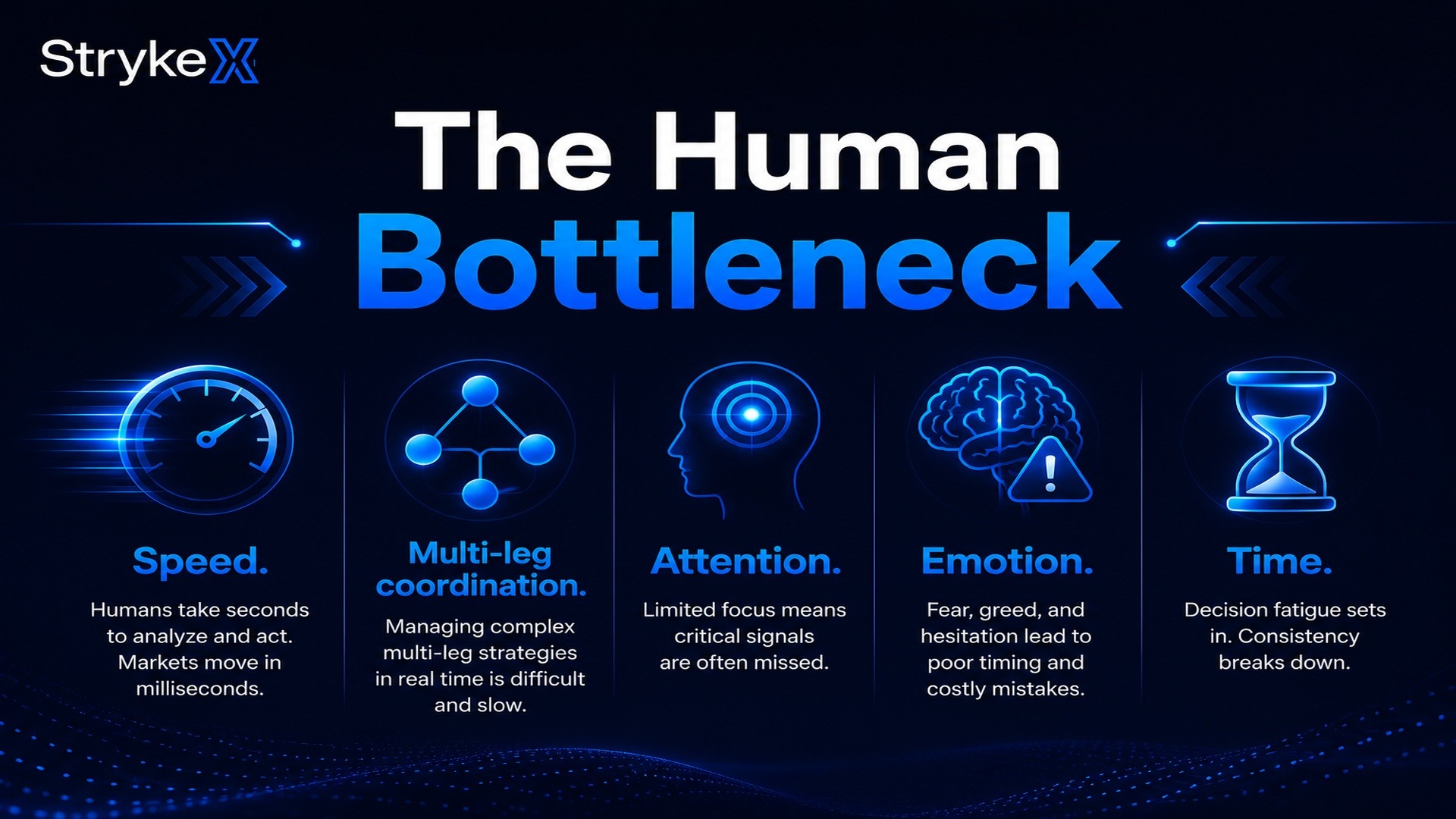
The human bottleneck
When an adjustment is needed, several human limitations bite at once:
Speed. Adjustments are often triggered by the market moving — and a moving market doesn't wait for you to notice, decide, and click through multiple legs. By the time you've manually placed the adjustment, the conditions that called for it may have shifted again. This is acute near expiry, where gamma makes positions move fast.
Multi-leg coordination. Many adjustments involve several orders that ideally execute together. Doing them by hand means legging in sequentially, exposing you to the market drifting between legs — the same legging risk and slippage that erodes the initial entry, now repeated under pressure.
Attention. You can't watch every position every second. A condition that needs an adjustment can develop while you're looking elsewhere, eating lunch, or simply blinking. Manual management means manual monitoring, and humans don't monitor continuously.
Emotion. Adjustments often need to happen at stressful moments — a position moving against you. That's precisely when human decision-making degrades: hesitation, hope, the urge to "wait a bit longer." The adjustment that should have happened at the predefined level happens late, or not at all.
The human bottleneck
What automation actually does
Automation addresses each bottleneck directly — not by being smarter than you, but by being faster and more consistent at execution:
It watches continuously. A rule like "if the underlying breaches this level, roll the threatened leg" runs every second of the session without fatigue or distraction. The condition gets checked the moment it could be true.
It acts in milliseconds. When an adjustment triggers, the orders fire immediately, before the market has drifted further.
It coordinates legs. Automated systems can place the legs of an adjustment together rather than sequentially, reducing the legging risk that hurts manual adjustments.
It removes the emotional delay. The rule executes whether or not you "feel ready." The hesitation that costs manual traders at the worst moments is designed out.
Crucially, automation here isn't predicting anything. It's executing your adjustment logic — the rules you defined — faster and more reliably than you could by hand. The intelligence is still yours; the execution is just better.
The honest limits
Automation isn't a free win, and pretending otherwise would be the kind of overclaim this whole site argues against:
- A badly-designed adjustment rule will execute badly, fast. The logic still has to be sound.
- Automated systems can fail — bugs, connectivity, edge cases — which is why risk controls and kill switches matter as much as the strategy.
- Not every adjustment can be reduced to a rule; genuinely novel situations may still want a human. The best setups often combine automated handling of the routine with human oversight of the unusual.
The practical takeaway
If your options strategies need active management — and most multi-leg strategies do — the manual approach fights a losing battle against speed, coordination, attention, and emotion at exactly the wrong moments. Automating the execution of your adjustment rules turns that battle into a non-issue, letting you focus on designing good logic rather than racing the market to click.
This is the core reason platforms like StrykeX, built by Stockwiz, focus so heavily on fast, precise, multi-leg execution: in options, getting the adjustment done well and on time is often where the strategy is actually won or lost.
For the full options toolkit, see the options strategies guide for India.
StrykeX — By Stockwiz Technologies