Futures vs Options
Futures vs Options: Key Differences Every Indian Trader Should Know
Futures and options are both derivatives, but the core difference is obligation. A futures contract obligates both buyer and seller to complete the trade on expiry. An options contract gives the buyer the right — but not the obligation — to buy or sell, in exchange for a premium.
Futures vs Options: Key Differences Every Indian Trader Should Know
Futures and options are both derivatives, but the core difference is obligation. A futures contract obligates both buyer and seller to complete the trade on expiry. An options contract gives the buyer the right — but not the obligation — to buy or sell, in exchange for a premium. Futures carry potentially unlimited profit and loss; an options buyer’s loss is limited to the premium paid, while an options seller takes on much larger risk. Both involve leverage and significant market risk.
Walk into any conversation about the Indian derivatives market and two words come up again and again: futures and options. Together they are usually shortened to “F&O,” and they are where a huge share of trading volume on the NSE lives. But here is the thing — a surprising number of traders jump into F&O without truly understanding how different these two instruments actually are.
They look similar on the surface. Both are derivatives, both let you take a leveraged position, both expire on a set date. But the way they behave — and the way they can hurt you — is fundamentally different. Getting this distinction right is one of the most important things a new derivatives trader can do. So let us break it down properly, in plain language.
What Are Derivatives? (A 30-Second Refresher)
A derivative is a contract whose value is derived from an underlying asset — a stock, an index like the Nifty, a commodity, or a currency. You are not buying the asset itself; you are trading a contract based on where you think its price is heading. Futures and options are the two most popular types of derivatives traded in India, regulated by SEBI and traded on exchanges like the NSE.
What Is a Futures Contract?
A futures contract is an agreement to buy or sell an underlying asset at a predetermined price on a specified future date. The defining feature is obligation: both parties are bound to honour the contract on expiry, regardless of which way the price moved. If you buy a Nifty futures contract and the index falls, you are still on the hook for the loss.
Futures are popular because they move point-for-point with the underlying and are relatively straightforward to understand: if the price goes up, a long futures position profits; if it falls, it loses. You put up a fraction of the contract value as margin, which gives you leverage — amplifying both gains and losses.
Key feature: Futures = obligation for both sides + leverage + potentially unlimited profit and loss. Simple to follow, but unforgiving if the market moves against you.
What Is an Options Contract?
An options contract gives the buyer the right — but not the obligation — to buy or sell the underlying at a set price (the strike price) before or on expiry. For this right, the buyer pays a premium to the seller. There are two basic types:
- Call option: the right to buy the underlying at the strike price. Buyers expect the price to rise.
- Put option: the right to sell the underlying at the strike price. Buyers expect the price to fall.
The crucial asymmetry: if the market moves against an options buyer, they can simply let the option expire and walk away — losing only the premium they paid. That capped downside is what makes buying options feel safer than futures. But it comes at a cost: the premium decays over time (an effect called time decay), so options can lose value even when the underlying barely moves.
Key feature: Options buyer = right without obligation + loss limited to premium. Options seller = collects premium but takes on much larger, potentially unlimited risk.
Futures vs Options: The Key Differences at a Glance
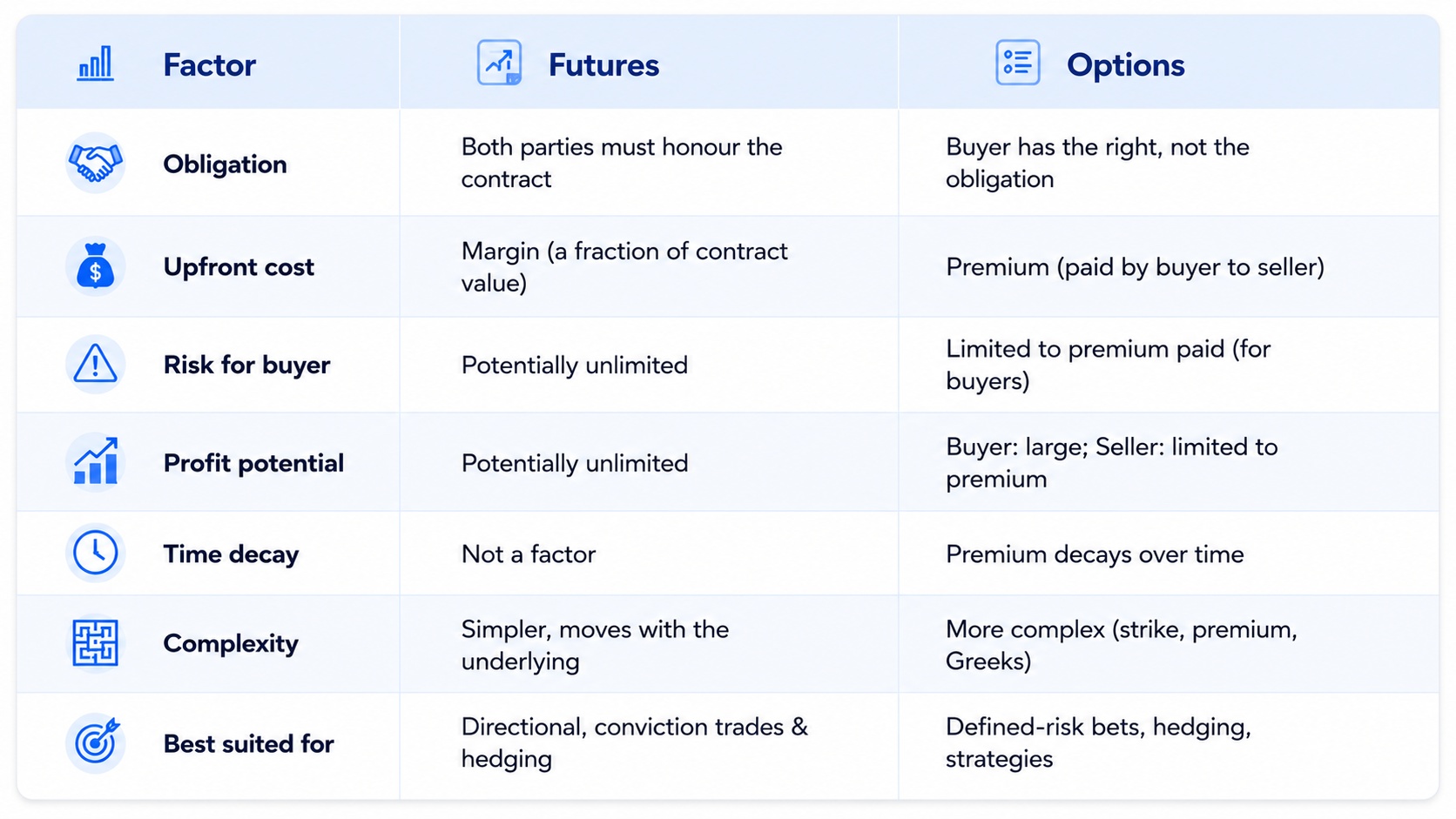
Futures vs Options: The Key Differences at a Glance
Risk and Reward: The Difference That Really Matters
If you remember one thing, remember this. With futures, your profit and loss are both potentially unlimited and move in lockstep with the underlying — there is no built-in safety net. With options, the buyer’s risk is capped at the premium, but the seller (or “writer”) takes on the larger risk in exchange for collecting that premium.
This is why beginners are often steered toward buying options rather than selling them or trading futures — the defined, capped risk is easier to survive while learning. But “capped risk” is not “low risk”: option buyers can and frequently do lose 100% of their premium when a trade goes wrong or simply runs out of time. Neither instrument is safe; they are differently risky.
Important: Both futures and options use leverage and carry significant market risk. Many F&O traders lose money. These are advanced instruments — understand them fully and use strict risk management before trading.
A Simple Example to Make It Click
Imagine a stock trading at ₹100, and you believe it will rise. (These numbers are illustrative, to explain the concept — not a recommendation.)
- With futures: you take a long position. If the stock rises to ₹110, you gain on the full move; if it falls to ₹90, you lose on the full move. Obligation runs both ways.
- With a call option: you pay a premium (say ₹5) for the right to buy at ₹100. If the stock rises to ₹110, you benefit from the move minus the premium. If it falls to ₹90, you simply let the option lapse and lose only the ₹5 premium — not the full ₹10 drop.
That single example captures the whole philosophy: futures give you full, symmetric exposure; options let a buyer cap the downside in exchange for paying a premium and fighting time decay.
Which Should You Trade — Futures or Options?
There is no universal winner; it depends on your goal, experience, and risk appetite. As a general framework many traders use:
- Futures may suit traders with strong directional conviction, those hedging an existing position, or those who want simple, point-for-point exposure — and who can stomach unlimited risk with strict stops.
- Options may suit traders who want defined, capped risk (as buyers), who want to hedge, or who use structured strategies — provided they understand premium, time decay, and strike selection.
Whichever you choose, disciplined, rule-based execution and strict risk control matter more than the instrument itself. Many traders automate their F&O strategies to remove emotion and enforce stop-losses — see how StrykeX works and our StrykeX vs manual trading comparison for how automation helps with discipline.
Final Thoughts
Futures and options are powerful tools, but they reward understanding and punish guesswork. The single distinction to internalise is obligation versus right: futures bind both sides and carry symmetric, unlimited risk; options give the buyer a right with capped downside in exchange for a premium and the drag of time decay. Neither is “safer” in absolute terms — they are differently risky, both leveraged, and both capable of large losses.
Before trading either, learn the mechanics thoroughly, start small, use strict stop-losses, and never risk capital you cannot afford to lose. Used with discipline and proper risk management — ideally rule-based and automated — F&O can be a meaningful part of a trader’s toolkit.
Related Articles
Frequently asked questions
What is the main difference between futures and options?
Obligation. A futures contract obligates both parties to complete the trade on expiry. An options contract gives the buyer the right but not the obligation to buy or sell, in exchange for a premium.
Are options safer than futures?
For the buyer, options cap the maximum loss at the premium paid, which is more defined than futures’ unlimited risk. But “capped” is not “low” — buyers often lose the entire premium. Options sellers take on much larger risk. Both carry significant market risk.
Which is better for beginners, futures or options?
Many beginners start by buying options because the maximum loss is limited to the premium, making risk easier to manage while learning. However, both are advanced, leveraged instruments and require strong risk management.
What is a premium in options?
The premium is the price an options buyer pays the seller for the right granted by the contract. It is the buyer’s maximum loss and the seller’s maximum gain, and it decays over time.
Can I lose more than I invest in F&O?
With futures and with selling options, losses can exceed your initial margin because of leverage and unlimited risk. An options buyer’s loss is limited to the premium paid. Always use strict risk management.
Do futures and options expire?
Yes. Both are time-bound contracts with set expiry dates. Futures must be settled or rolled over; options can be exercised, sold, or allowed to expire.
Can futures and options strategies be automated?
Yes. Rule-based F&O strategies can be automated through a platform that connects to your broker via secure API. See how StrykeX works.
StrykeX — By Stockwiz Technologies