Market Updates
Expiry-Day Options Trading: The Risks Nobody Markets to You
Expiry day has a gravitational pull on options traders. Cheap premiums, explosive moves, the chance to turn a small stake into a multiple in hours — it's the most seductive day of the trading cycle, and the most dangerous. The seduction and the danger come from the same features, which is exactly why it deserves an honest treatment rather than the highlight-reel version social media sells.
Heavy disclaimer up front, and meant sincerely: expiry-day options trading is among the highest-risk activities available to a retail trader. Most retail options traders lose money, and expiry day concentrates the ways that happens. This explains the realities; it does not encourage you to trade them.
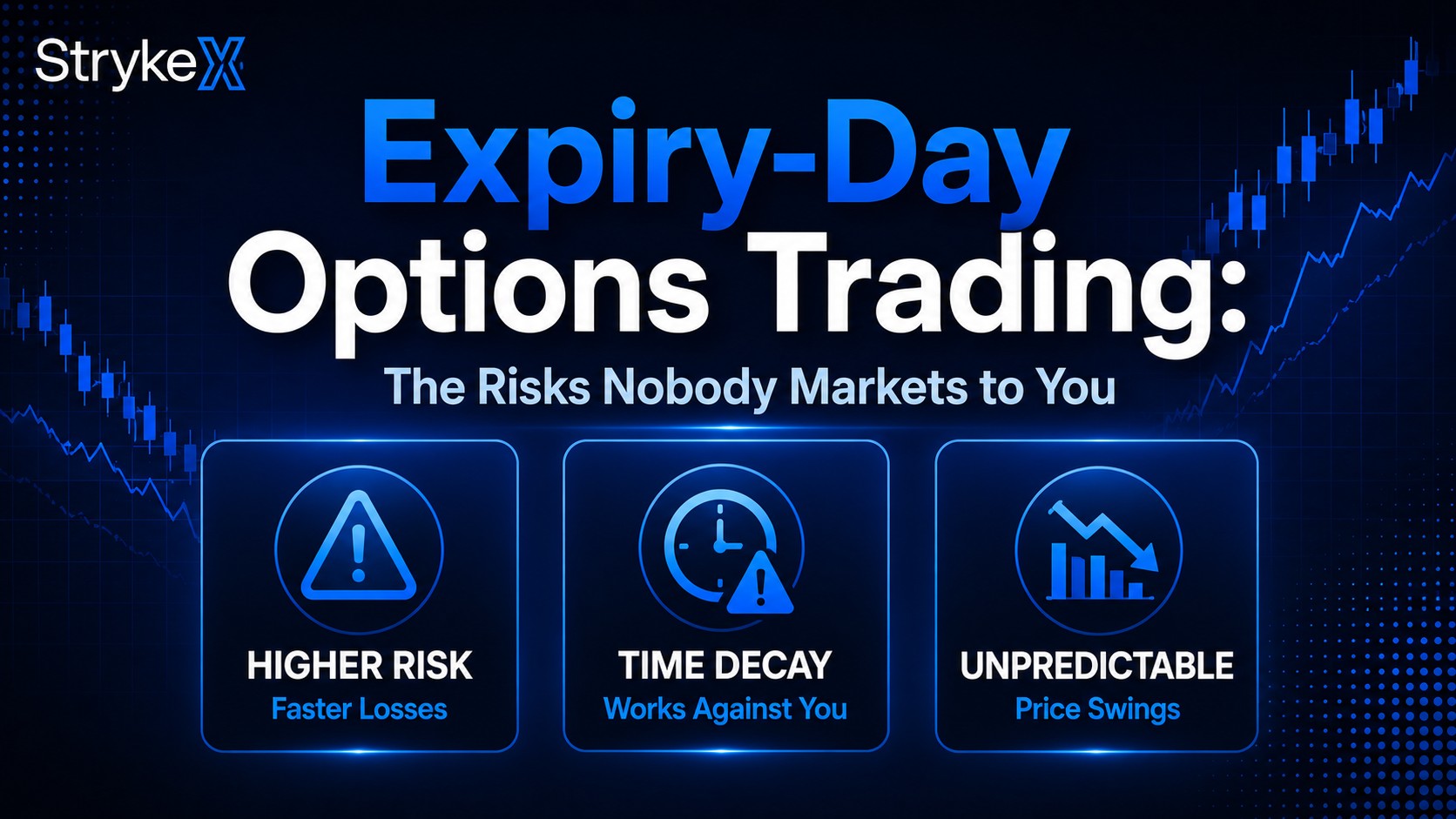
Expiry-Day Options Trading: The Risks Nobody Markets to You
Expiry day has a gravitational pull on options traders. Cheap premiums, explosive moves, the chance to turn a small stake into a multiple in hours — it's the most seductive day of the trading cycle, and the most dangerous. The seduction and the danger come from the same features, which is exactly why it deserves an honest treatment rather than the highlight-reel version social media sells.
Heavy disclaimer up front, and meant sincerely: expiry-day options trading is among the highest-risk activities available to a retail trader. Most retail options traders lose money, and expiry day concentrates the ways that happens. This explains the realities; it does not encourage you to trade them.
Why expiry day behaves so differently
As an option approaches its final hours, two forces go into overdrive:
Time decay collapses. Theta — the daily bleed of an option's time value — accelerates dramatically near expiry. On expiry day, an out-of-the-money option's remaining value can evaporate within hours. This is why those tempting cheap options are cheap: the market is pricing in how little time they have left to come good.
Gamma goes wild. Near expiry, at-the-money options have very high gamma, meaning their delta — their directional sensitivity — changes extremely fast. A small move in the index can swing an option from near-worthless to valuable, or the reverse, in moments. This is the source of the explosive moves people chase.
Together: prices that can multiply fast (the lure) sitting on top of value that's evaporating fast (the trap).
The lottery-ticket trap
Here's the pattern that catches most people. Cheap, far-out-of-the-money options on expiry day are cheap because they're very unlikely to pay off. Buyers see the low price and the occasional viral story of a huge win, and treat them like lottery tickets — small cost, dream payoff.
The maths is the same as a lottery: the rare big win is real, but the expected outcome, repeated, is loss. Most of these options expire worthless. The viral screenshots are survivorship bias — you see the winners, not the thousands of identical tickets that expired at zero. Building a trading approach around this is building it around the part of the market with the worst odds.
The specific risks, named
If you trade expiry day, these are the realities to hold in view:
- Rapid, total loss of premium. An OTM option can go to zero within the session. Your "defined risk" of the premium can simply be gone.
- Violent swings. High gamma means positions move faster than you can comfortably manage by hand — which ties directly to why manual execution struggles on expiry day.
- Slippage at the worst time. Fast markets mean fills can be well away from quoted prices, and stop-losses can gap through their levels.
- Liquidity quirks. Some strikes can thin out or behave erratically as expiry closes in.
- Cost drag. Frequent expiry-day trading stacks brokerage and the post-April-2026 STT on top of already-poor odds.
If you trade it anyway — the discipline that matters
This isn't an endorsement, but if expiry-day trading is something you do, the risk discipline has to be stricter than any other day:
Size tiny. Whatever feels small, smaller. The capped risk of buying options is no comfort if you've sized so large that the capped loss still hurts.
Pre-define everything. Entries, exits, and a hard stop on how much you'll lose in the session — decided in advance, in calm, not in the heat of a fast move.
Respect the gamma. Accept that positions can move faster than you can react manually. This is a genuine argument for either avoiding it or using automated execution that can keep pace, rather than fighting the speed by hand.
Walk away on a limit. Set a maximum loss for the day and stop when you hit it — no "one more trade to make it back." Revenge-trading on expiry day is how a bad morning becomes a bad month.
The honest bottom line
Expiry day is marketed as opportunity and is, for most retail traders, a wealth-transfer mechanism that moves money from the many who buy hope to the few positioned to sell it. The features that make it exciting — collapsing time value, explosive gamma — are the same features that make it punishing.
If you're newer to options, the responsible path is to learn on ordinary days with NIFTY and solid risk management, and to treat expiry-day trading with deep skepticism. The dream payoffs are real but rare; the losses are common and quiet. For the broader context, see the options strategies guide for India.
StrykeX — By Stockwiz Technologies