Market Updates
Do You Need Coding Skills to Algo Trade? (No-Code vs. API)
This is the question that stops a lot of people before they start — the assumption that algo trading is a programmer's game and that if you can't write Python, the door is closed.
It isn't. You can algo trade without writing a single line of code. Whether you should go the no-code route or learn to code depends on what you want, not on whether coding is "required." Let's clear up the confusion.
Do You Need Coding Skills to Algo Trade? (No-Code vs. API)
This is the question that stops a lot of people before they start — the assumption that algo trading is a programmer's game and that if you can't write Python, the door is closed.
It isn't. You can algo trade without writing a single line of code. Whether you should go the no-code route or learn to code depends on what you want, not on whether coding is "required." Let's clear up the confusion.
The two routes, plainly
There are broadly two ways to run an automated strategy:
The API route. You (or someone you hire) write code that connects to your broker's API, reads market data, and places orders according to your logic. Total flexibility — if you can describe it, you can usually build it. The cost is that you need to code, or pay someone who can, and you own the technical upkeep.
The no-code / platform route. You use a platform that lets you build or select strategies through a visual interface or pre-built templates, without programming. The platform handles the connection, execution, and much of the compliance plumbing. Less flexible than raw code, but accessible to anyone.
Both are legitimate. Both can be fully compliant. Neither is "real" algo trading and the other "fake" — that's just snobbery.
What you give up and gain with no-code
No-code platforms trade flexibility for accessibility:
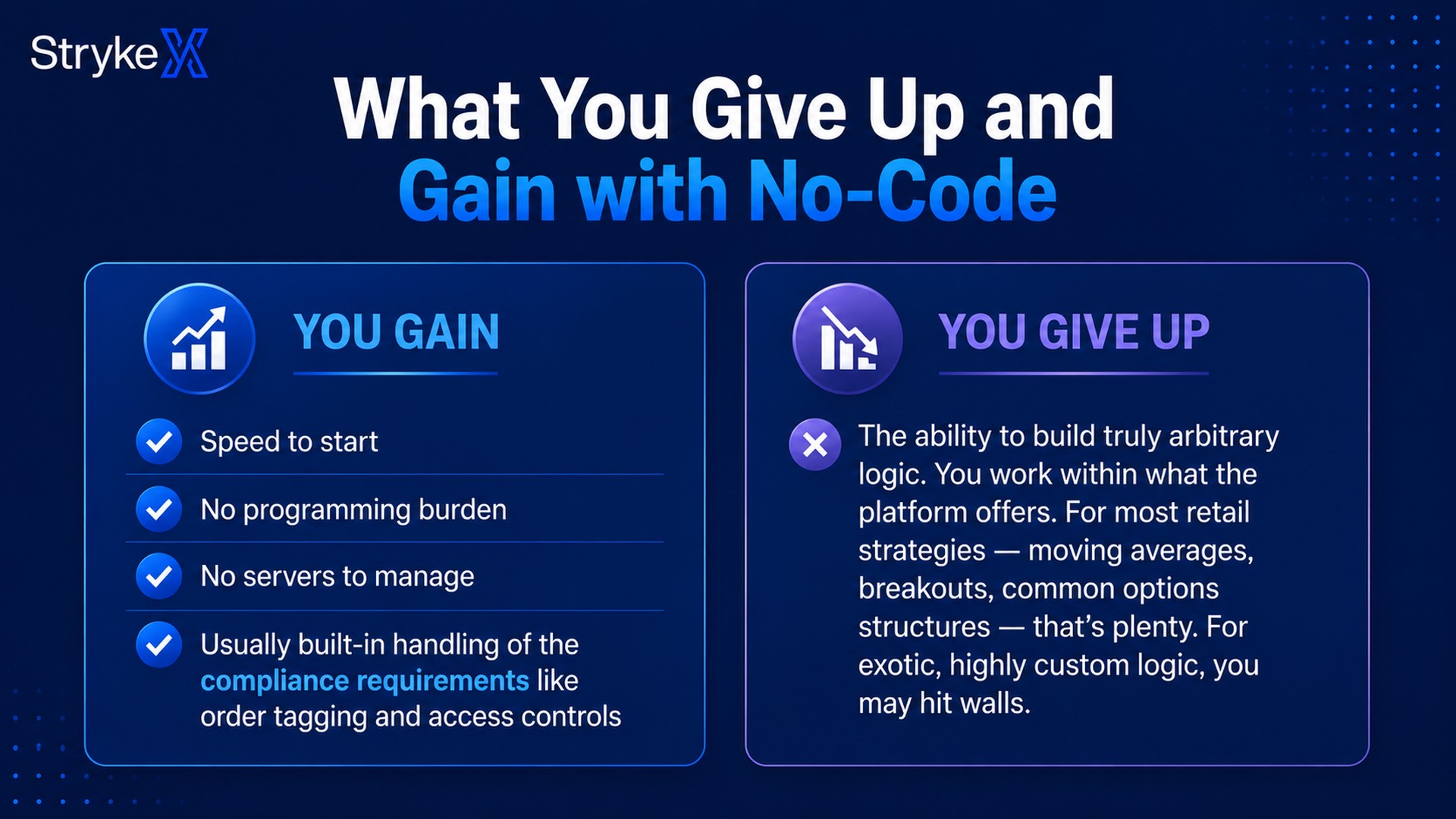
- You gain: speed to start, no programming burden, no servers to manage, and usually built-in handling of the compliance requirements like order tagging and access controls.
- You give up: the ability to build truly arbitrary logic. You work within what the platform offers. For most retail strategies — moving averages, breakouts, common options structures — that's plenty. For exotic, highly custom logic, you may hit walls.
For the large majority of retail traders, the platform route covers what they actually need. The dream of "infinitely custom strategy" matters far less than people think when their actual edge is a fairly standard rules-based approach.
What coding genuinely buys you
If you do code, the advantages are real:
- Arbitrary logic — anything you can express, you can build.
- Full control over execution details, including how orders are placed and managed.
- Independence from any single platform's feature set.
The cost is equally real: you need genuine programming competence (not a weekend tutorial), you have to manage your own static IP and security setup, and when something breaks at 9:20 a.m., it's your problem to debug. Coding gives you a powerful, sharp tool — and sharp tools cut their careless users.
A useful way to decide
Ask yourself three questions:
- Is my strategy expressible in a platform's existing tools? If yes, you probably don't need to code. If it needs genuinely custom logic, lean toward the API.
- Do I want to manage technical infrastructure? If the idea of running a server and debugging code fills you with dread, that's a strong signal for no-code.
- How much control do I actually need — versus how much do I just like the idea of? Be honest. Many people want to code because it feels more "serious," not because their strategy requires it.
The middle path most people miss
You don't have to choose forever. A sensible progression is to start no-code to learn how automated execution behaves with real markets, then move to the API later if you hit a genuine limitation. Starting with code because you think you should often means spending weeks on plumbing before you've even validated a strategy — which is backwards. The strategy is the hard part; the execution method is secondary.
So: no, you don't need to code to algo trade. If you have the skills and a reason, the API route rewards you. If you don't, a no-code platform is a perfectly serious way to trade — StrykeX, for instance, is a managed route that doesn't require you to program. Pick the path that fits your strategy and your appetite for technical work, not the one that sounds most impressive.
For how this choice fits the bigger picture, see the complete guide to algo trading in India and the DIY-vs-platform comparison.
StrykeX — By Stockwiz Technologies