Market Updates
DIY Coder or Platform User? How the New Algo Rules Hit Each Differently
Two traders read the same SEBI framework and walk away with completely different to-do lists. One writes her own strategies in Python and connects through a broker API. The other uses a managed algo platform and has never seen a line of code. The rules apply to both — but the weight of them lands in different places. If you're trying to figure out which path you're on and what it actually demands of you, this is the comparison.
DIY Coder or Platform User? How the New Algo Rules Hit Each Differently
Two traders read the same SEBI framework and walk away with completely different to-do lists. One writes her own strategies in Python and connects through a broker API. The other uses a managed algo platform and has never seen a line of code. The rules apply to both — but the weight of them lands in different places.
If you're trying to figure out which path you're on and what it actually demands of you, this is the comparison.
The DIY API trader
You write your own logic, run it from your own machine or server, and route orders through your broker's API. Here's where the framework touches you most:
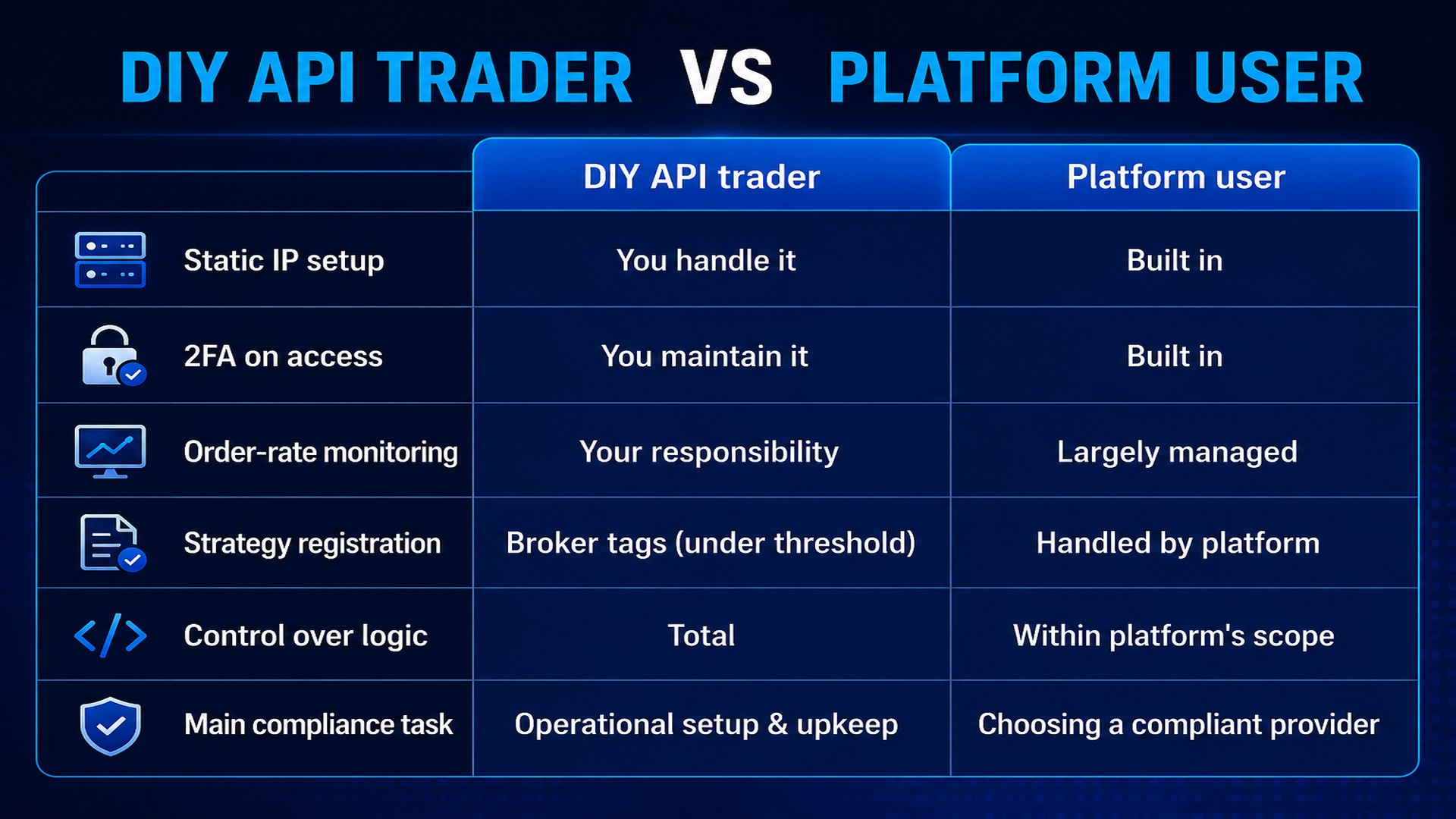
Static IP — your biggest chore. Because your orders originate from wherever your code runs, you have to ensure that's a registered static IP. Home connections rarely qualify out of the box, so most serious DIY traders end up on a cloud server with a fixed IP. This is the setup step you can't skip — here's how to handle itstatic-ip-whitelisting-api-trading-setup.
2FA on API access. Mandatory, and entirely on you to keep working.
Watching your own order rate. Nobody's abstracting this away for you. If your execution logic slices orders aggressively, you need to know whether you brush the 10-orders-per-second threshold. For most DIY strategies you won't, but you're the one responsible for checking.
Strategy registration — usually handled by your broker. The relief here: as long as you're under the threshold and trading your own account, your compliant broker tags your orders with the Algo-ID and you don't separately register each strategy. The registration plumbing sits with the broker.
The DIY path gives you total control over your logic. The trade-off is that the operational compliance — IP, security, rate-awareness — is yours to own and maintain.
The platform user
You use a managed, exchange-empanelled platform and trade through its interface or its pre-built strategies. The framework touches you very differently:
Most of the plumbing is built in. Algo-ID tagging, the registration workflow, static IP and access controls, the security standards — these are part of being on a compliant platform rather than tasks you assemble. You inherit them.
Your main job is choosing a compliant platform. That's the real decision. Is the provider empanelled? Is it run by a registered company? Does your broker accept it? Get this right and most of the operational burden evaporates.
Less control, more convenience. You're working within what the platform offers rather than coding arbitrary logic. For many traders that's a feature, not a limitation — fewer ways to accidentally fall out of compliance.
Which path is "right"?
Neither, universally. They suit different traders.
If you genuinely want to build and control your own strategies and you're comfortable running a server and managing your own access security, DIY is viable and fully compliant — the framework doesn't push you off it. You just carry the operational load.
If you'd rather the compliance machinery be someone else's job and you're happy trading within a provider's toolkit, a managed platform takes most of this off your plate. StrykeX, for instance, is empanelled with the NSE and BSE and folds the tagging, registration, and access controls into the platform — built by Stockwiz, a SEBI-registered firm. It's one example of the managed route, not the only one.
The honest framing: DIY trades convenience for control; a platform trades control for convenience. Pick based on which of those you value more — both can be fully inside the rules.
To map either path against every provision in the framework, see the complete 2026 SEBI algo guide.
StrykeX — By Stockwiz Technologies