Trading and Investing
Algo Trading vs. Manual Trading: Which Actually Wins?
Ask this question in a trading forum and you'll get tribalism — algo evangelists who think manual trading is obsolete, and discretionary traders who think algos are overhyped black boxes. Both camps are wrong, because they're answering the question as if there's one winner. There isn't. There's a right tool for a given trader, strategy, and temperament. Let's drop the tribalism and look at where each genuinely wins.
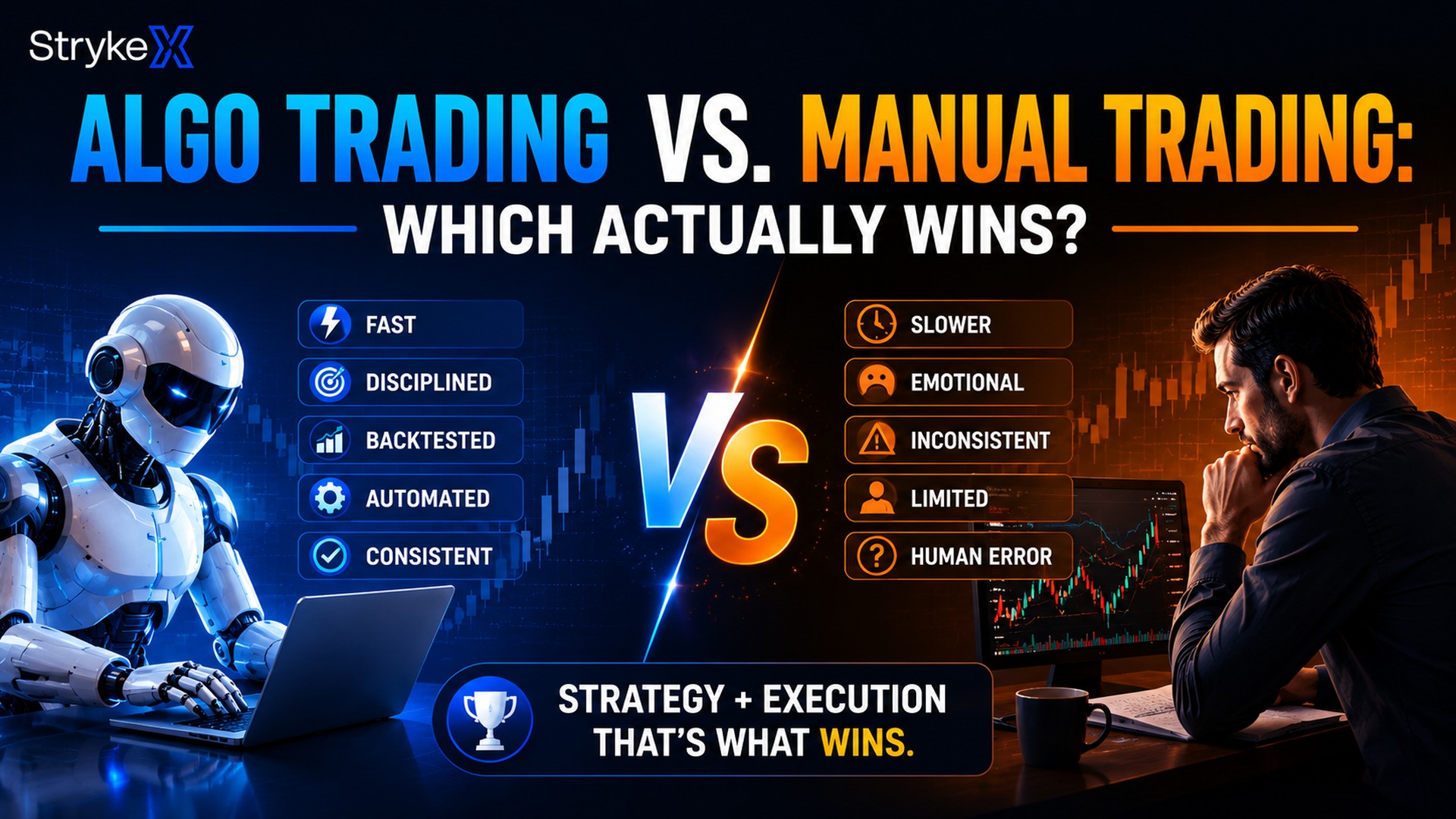
Algo Trading vs. Manual Trading: Which Actually Wins?
Ask this question in a trading forum and you'll get tribalism — algo evangelists who think manual trading is obsolete, and discretionary traders who think algos are overhyped black boxes. Both camps are wrong, because they're answering the question as if there's one winner. There isn't. There's a right tool for a given trader, strategy, and temperament.
Let's drop the tribalism and look at where each genuinely wins.
What manual trading does better
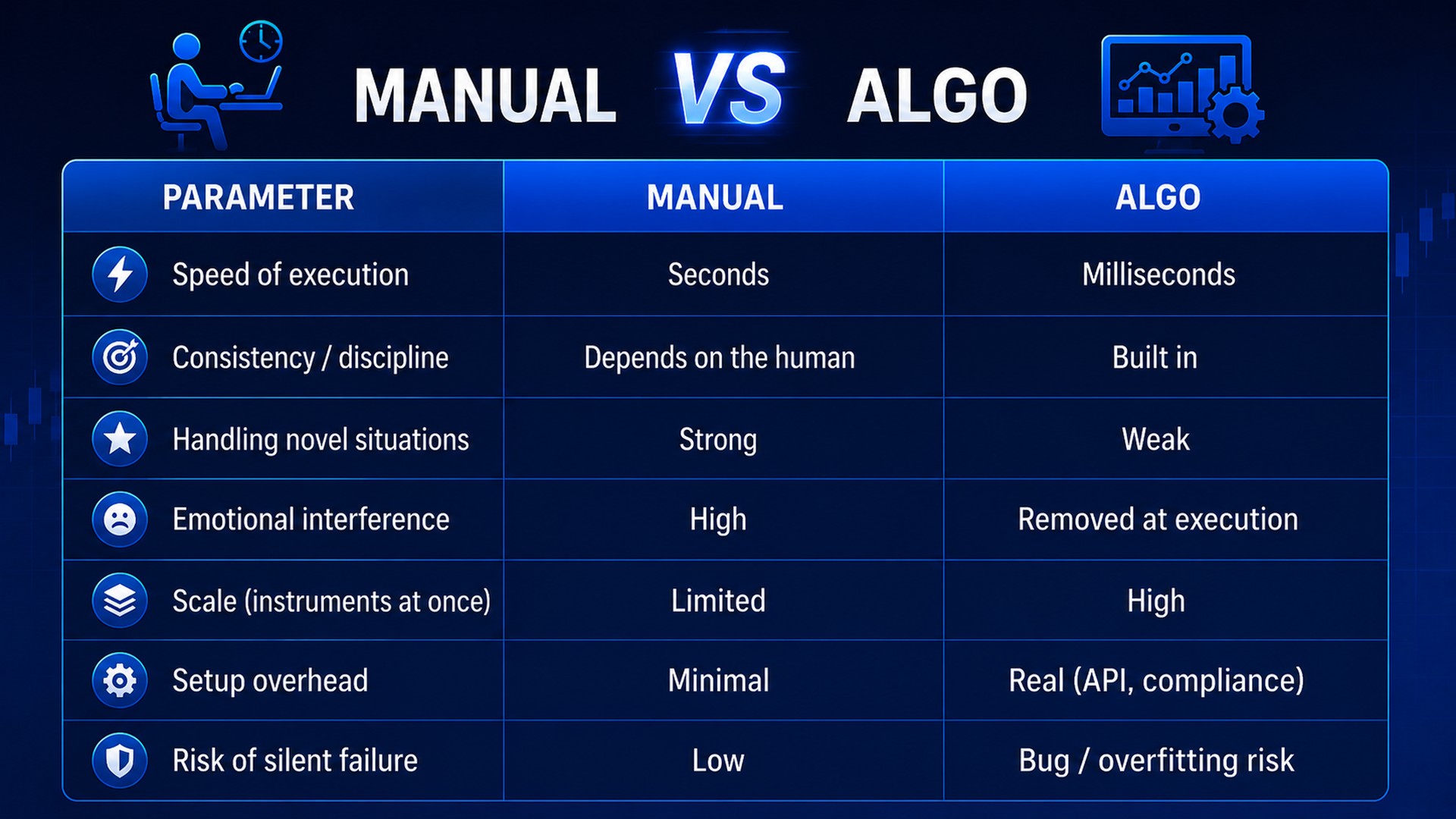
Judgement and context. A human can weigh things an algo can't easily encode — an unusual news event, a market that's behaving strangely, a gut sense built from years of screen time. When the situation is genuinely novel, human discretion adapts in ways rigid rules don't.
Nuance in messy situations. Algos struggle with ambiguity. A discretionary trader can hold a position through noise that would trip an algo's stop, or step aside from a setup that "technically" qualifies but smells wrong.
No infrastructure overhead. No API setup, no static IP, no code to debug. You log in and trade. For someone who trades occasionally and thoughtfully, that simplicity is a feature.
The catch: every one of these strengths depends on the human being disciplined and unemotional — which, under pressure, most of us aren't.
What algo trading does better
Speed. Milliseconds versus seconds. For strategies where the entry window is brief, there's no contest.
Consistency. The algo follows the plan every time, without fatigue, boredom, fear, or greed. It won't skip the trade that turns out to be the winner because it lost the last three.
Scale and breadth. One person can manually watch a handful of instruments. An algo can monitor dozens simultaneously and act on all of them at once.
Discipline by design. This is the big one. Most retail traders don't lose because their strategy is bad — they lose because they don't follow it. Automation removes the human from the exact step where discipline usually collapses.
The catch: an algo faithfully executes whatever you give it, including a flawed strategy or a coding bug. It has no judgement to catch its own mistakes.
The reframe that actually helps
The useful question isn't "which is better." It's "what kind of trader am I, and what am I trying to fix?"
If your problem is that you don't follow your own rules — you hesitate, you override your stops, you revenge-trade — then automation directly fixes the thing costing you money. Algo wins.
If your edge comes from judgement you can't reduce to rules — reading context, adapting to the unusual — then forcing it into an algo throws away the very thing that works. Manual wins.
If you trade a clear, rules-based, frequent strategy, algo's speed and consistency are a strong fit. If you trade rarely and thoughtfully on conviction, manual's simplicity is fine.
You don't have to pick a side
Plenty of serious traders do both: algos for the systematic, repeatable part of their trading, and manual discretion for the situations that need a human. The automation handles the grind; the human handles the exceptions. That hybrid is often more sensible than the purist version of either.
And a closing caution that applies to both: neither approach creates an edge that isn't there. An algo can't rescue a losing strategy, and discretion can't rescue a trader with no plan. The tool amplifies what you bring to it.
If you're leaning toward automating, the step-by-step starting roadmap and the complete guide to algo trading in India are your next stops.
StrykeX — By Stockwiz Technologies