Market Updates
2FA, Audit Trails & VAPT: The New Security Mandates Behind Your Algo Trades
This is the least glamorous corner of SEBI's 2026 algo framework, and the part most traders never think about — until you realise it's the reason a broker can or can't legally let you trade through their API at all. Three requirements sit underneath everything else: two-factor authentication, complete audit trails, and VAPT. None of them changes how you place a trade. All of them change whether the platform you're trading on is allowed to exist in its current form. Worth understanding what your broker had to do to keep your access switched on.
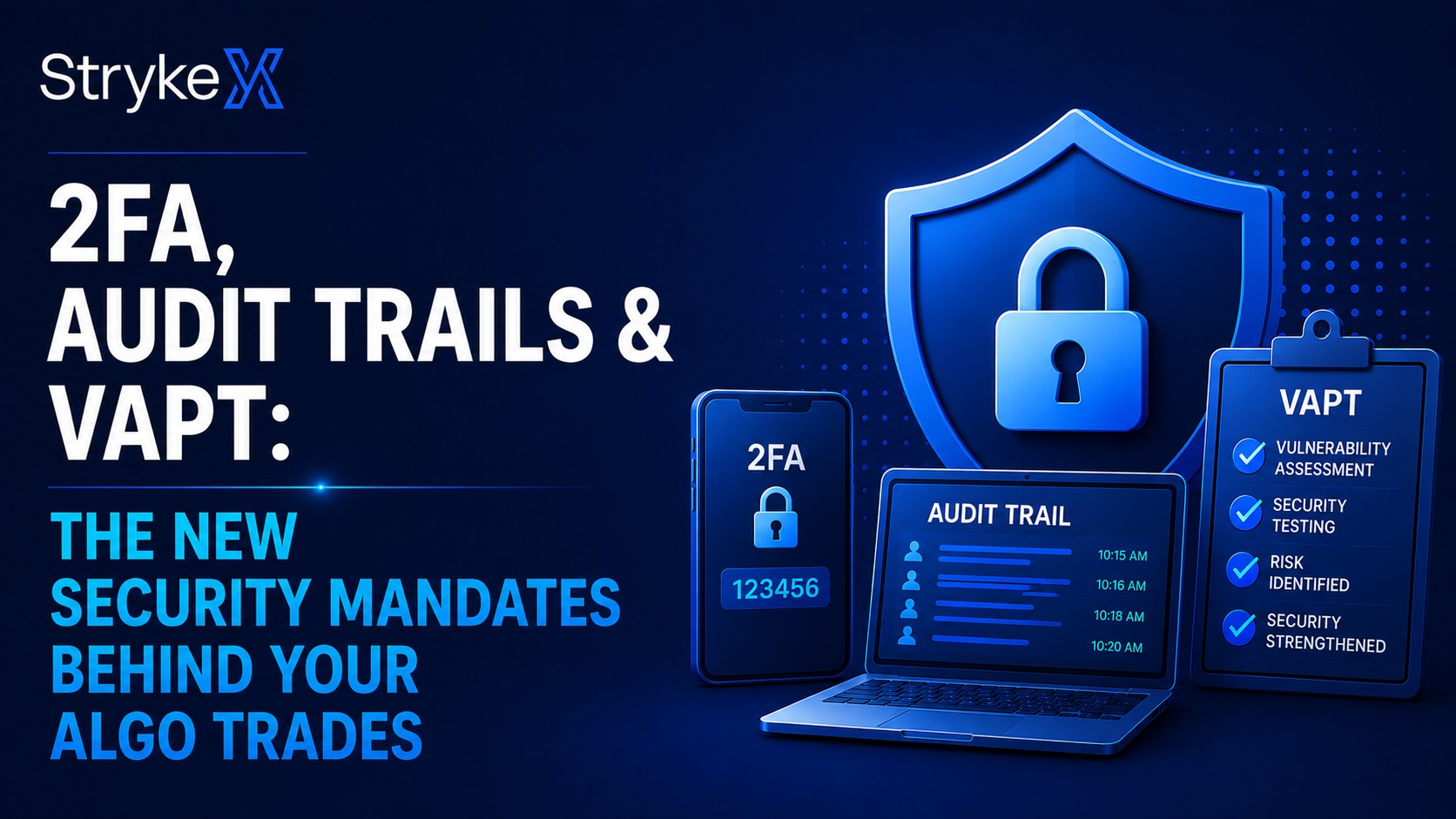
2FA, Audit Trails & VAPT: The New Security Mandates Behind Your Algo Trades
This is the least glamorous corner of SEBI's 2026 algo framework, and the part most traders never think about — until you realise it's the reason a broker can or can't legally let you trade through their API at all.
Three requirements sit underneath everything else: two-factor authentication, complete audit trails, and VAPT. None of them changes how you place a trade. All of them change whether the platform you're trading on is allowed to exist in its current form. Worth understanding what your broker had to do to keep your access switched on.
Two-factor authentication (2FA)
You already know 2FA from everyday life — the one-time code on top of your password. Under the framework, it's mandatory for algo and API access, not just for logging into the app.
The reasoning is straightforward. API access is powerful: a leaked key could, in the wrong hands, push orders on your account. A static IP requirement handles part of that risk by restricting where orders can come from; 2FA handles another part by adding a second proof of who is authorising access. Together they make a stolen credential far less useful to an attacker.
If you trade via API and your broker added a 2FA step to that pathway over the past year, this rule is why.
Audit trails
Every order — placed, modified, cancelled — has to be logged in a way that can be reconstructed later. That's the audit trail, and it pairs naturally with the Algo-ID system: the Algo-ID says which strategy an order came from, and the audit trail records what happened, when.
For a regulator investigating unusual activity, the combination is decisive. They can pull the thread from a suspicious order back to its source and see the full sequence of actions around it. For an honest trader, the audit trail is simply a complete record sitting quietly in the background — useful if you ever need to dispute or reconstruct something yourself.
VAPT — the one nobody outside the industry has heard of
VAPT stands for Vulnerability Assessment and Penetration Testing. In plain terms: before a broker's platform can run retail algos, it has to be security-tested — both scanned for known weaknesses (the assessment) and actively attacked by friendly testers trying to break in (the penetration test).
This is the requirement that has real teeth at the platform level. A broker can't simply declare itself secure; it has to demonstrate it. And the framework made this non-negotiable: platforms without these standards in place can't onboard new API clients. So VAPT isn't paperwork — it's a gate that decides whether a broker stays in the algo business.
What this trio means for you
Practically, three things:
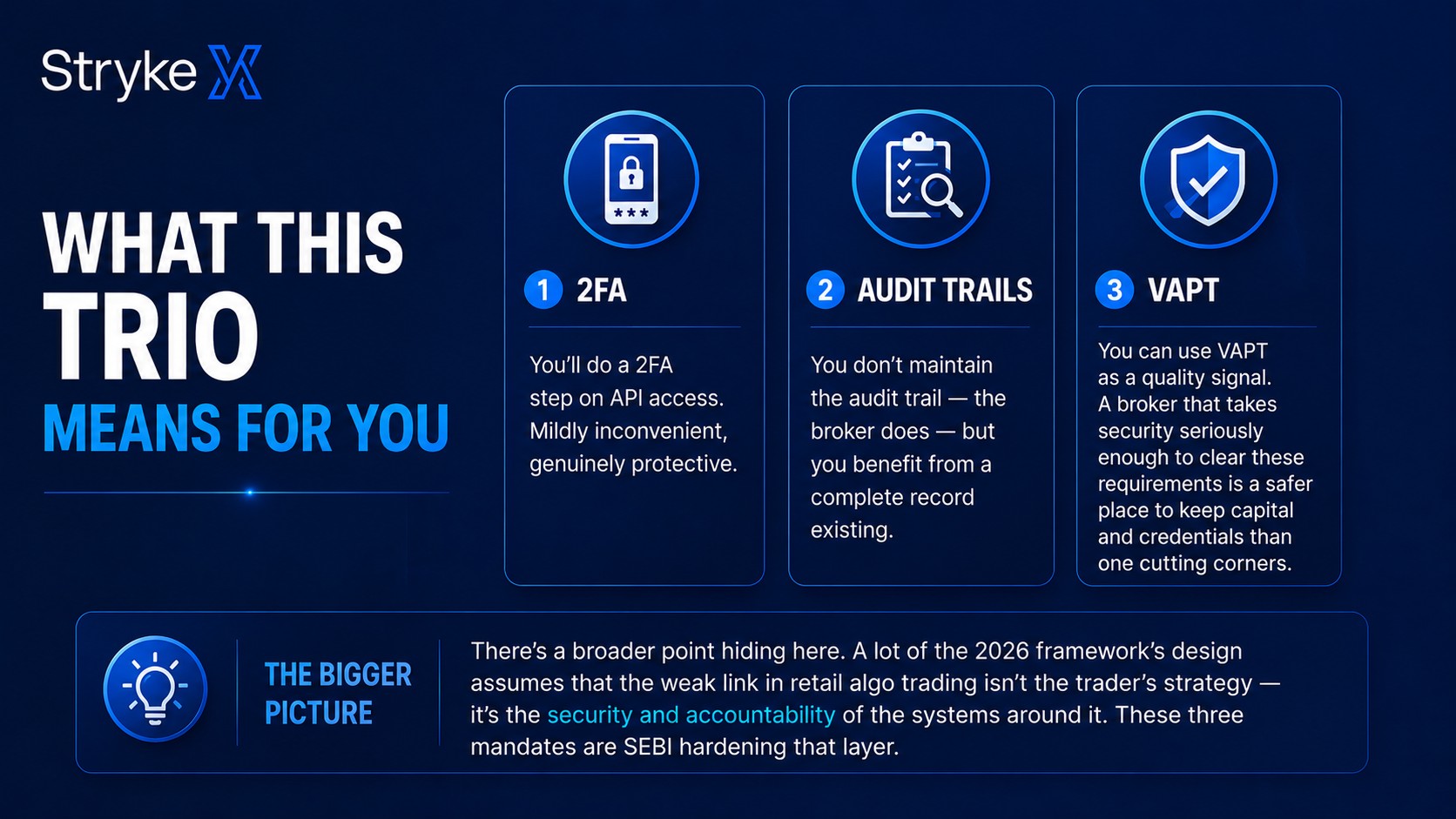
- You'll do a 2FA step on API access. Mildly inconvenient, genuinely protective.
- You don't maintain the audit trail — the broker does — but you benefit from a complete record existing.
- You can use VAPT as a quality signal. A broker that takes security seriously enough to clear these requirements is a safer place to keep capital and credentials than one cutting corners.
There's a broader point hiding here. A lot of the 2026 framework's design assumes that the weak link in retail algo trading isn't the trader's strategy — it's the security and accountability of the systems around it. These three mandates are SEBI hardening that layer.
If you want to see how the security requirements sit alongside the Algo-ID, the broker-as-principal model, and the access rules, the complete 2026 SEBI algo framework guide lays them out together.
StrykeX — By Stockwiz Technologies